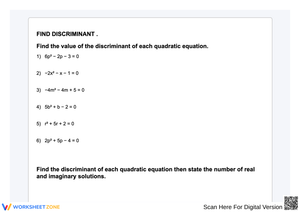
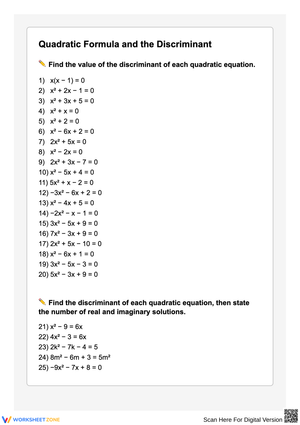
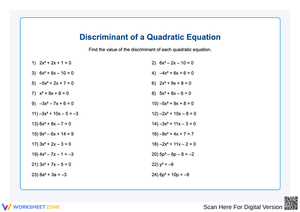
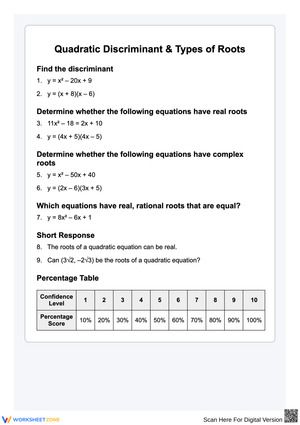
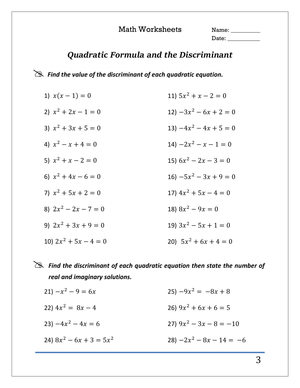
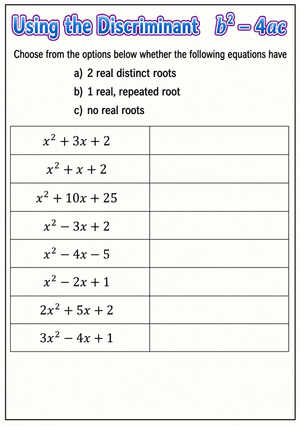
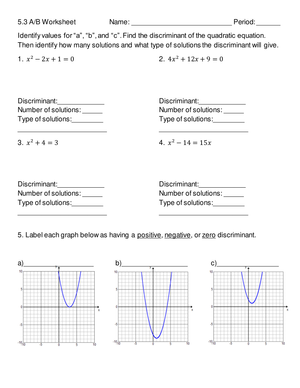
Discriminant worksheets give teachers and parents a measurable way to assess how well students understand the structure of quadratic equations. Each printable converts an abstract algebraic concept into a quantifiable performance metric, allowing instructors to capture concrete data on whether learners can correctly identify the nature of roots before they attempt to solve.
The structured progression inside every set begins with simple coefficient identification, then advances to evaluating b squared minus 4ac, and finally to interpreting positive, zero, and negative results. This stepwise design exposes the exact moment a student stalls, turning vague classroom impressions into precise, addressable learning gaps that respond to targeted reteaching from teachers and parents.
Built-in answer keys accompany many worksheets, allowing rapid grading and immediate feedback for students who need reinforcement on sign rules, perfect squares, or simplification of radicals. Educators using the related quadratic formula practice set can pair the two resources to verify that root predictions match calculated solutions across a full instructional sequence.
Tracking performance across multiple discriminant worksheets reveals patterns that single quizzes cannot. Teachers can monitor accuracy on negative discriminants separately from zero or positive cases, then assign targeted intervention or extension work. Parents working at home gain the same visibility, making homework sessions data-driven rather than guesswork-based for every learner involved in algebra.
For high school classrooms searching for additional engagement, the Worksheetzone library connects naturally with broader high school math activity ideas that reinforce algebraic reasoning. Adopt these discriminant worksheets to move from anecdotal observation to documented mastery, supplying every classroom with verifiable evidence of progress on quadratic analysis.
Frequently Asked Questions
Question 1: What exactly do discriminant worksheets teach?
Discriminant worksheets teach students how to evaluate the expression b squared minus 4ac inside any quadratic equation and interpret what the result reveals about the roots. Learners practice identifying coefficients, substituting values accurately, and classifying outcomes as two real roots, one repeated root, or two complex roots, building the analytical foundation needed for advanced algebra coursework.
Question 2: Which grade levels benefit most from these worksheets?
These printables are designed primarily for students in grades nine through twelve who are studying Algebra 1, Algebra 2, or Pre-Calculus. Advanced middle school learners exploring quadratic relationships also benefit, as do college-bound students reviewing for placement assessments. The structured progression makes the resources adaptable for both classroom instruction and individualized homework support across multiple proficiency levels.
Question 3: How do teachers use discriminant worksheets for assessment?
Teachers use discriminant worksheets as diagnostic tools to measure whether students can analyze a quadratic before solving it. By comparing accuracy on positive, zero, and negative cases, instructors pinpoint specific misconceptions in sign handling or arithmetic. The included answer keys allow rapid grading, while performance patterns guide grouping decisions and targeted reteaching for the next instructional cycle.
Question 4: Can parents support discriminant practice at home?
Yes. Parents can guide students through each worksheet by reviewing the substitution steps and discussing what each numerical outcome means about the equation. The clear layout requires no advanced math background to supervise, and the answer keys provide reliable confirmation. Working through one worksheet several times each week reinforces fluency and builds genuine confidence in algebraic problem analysis.