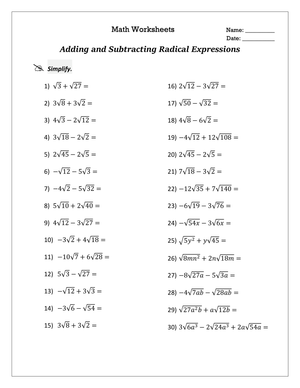
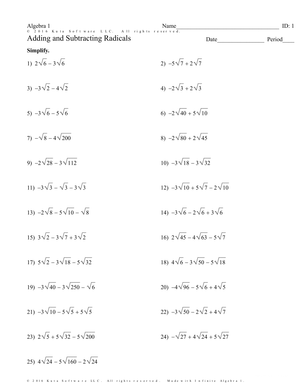
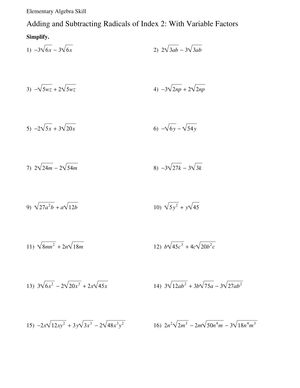
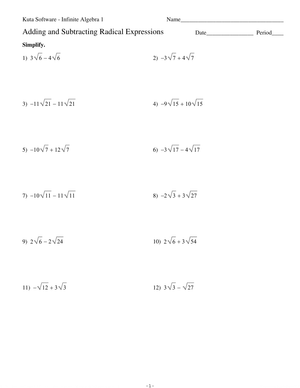
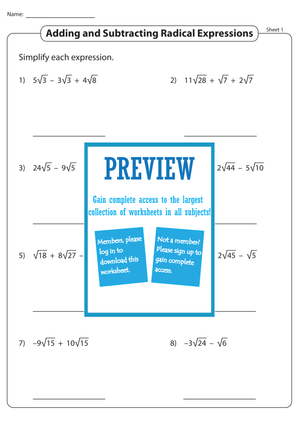
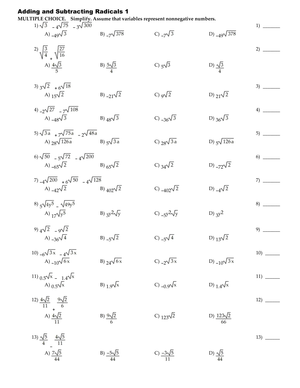
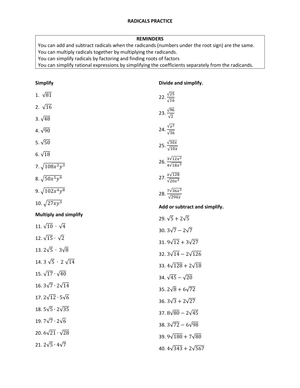
Adding and subtracting radicals worksheets solve a very specific classroom problem: students see two square roots sitting next to a plus sign and assume they can just add the numbers underneath. Root 2 plus root 3 becomes root 5 in a student's notebook far more often than any teacher would like. This is not a careless mistake so much as a logical one, since students have already learned that combining like terms means adding coefficients while keeping the variable the same. Radicals follow that exact same rule, but the radicand has to match first, and that step is easy to skip when a worksheet jumps straight to mixed practice.
A well-sequenced worksheet set walks students through simplifying radicals, then identifying like radicals, then combining them, before mixing everything together. That order matters more than the number of problems on the page.
What Counts as a Like Radical
Radicals can only be added or subtracted directly when they share the same index and the same radicand. A cube root and a square root are never like radicals, even if the numbers underneath look identical. Once students can reliably sort expressions into like and unlike groups, the actual arithmetic of adding or subtracting the coefficients is usually the easy part.
Worksheets that isolate this sorting step, asking students to circle or color-code matching radicals before doing any computation, tend to reduce the coefficient-versus-radicand confusion much faster than jumping straight into full problems.
Simplify First, Then Combine
The real skill hiding inside this topic is simplifying radicals by factoring out perfect squares or perfect cubes. Root 8 and root 18 look nothing alike until a student factors them into 2 times root 2 and 3 times root 2, at which point they become like radicals that combine into 5 root 2. Students who struggle here usually have a gap in factoring, not in the addition rule itself, so a quick factor-tree warm-up before the radical worksheet often does more for accuracy than reteaching the addition step a second time.
This is also the point where a radicand reference chart, listing perfect squares up to 144 and perfect cubes up to 125, saves significant class time. Students who can quickly recognize that 50 equals 25 times 2 move through problems far faster than those recalculating factors from scratch every time.
Standards Alignment for Lesson Planning
These worksheets connect directly to two standards that teachers can reference when documenting a lesson or unit plan. Grade 8 students meet this content under 8.EE.A.2, which covers working with radicals and integer exponents, including square and cube roots. In high school, HSN-RN.B.3 extends the reasoning to sums of rational and irrational numbers, which is the underlying justification for why unlike radicals cannot simply be merged together the way whole numbers can.
According to the Common Core State Standards for Grade 8 Expressions and Equations, standard 8.EE.A.2 requires students to work with radicals and integer exponents, including evaluating square roots of small perfect squares and cube roots of small perfect cubes, which sets up the foundational vocabulary and number sense that adding and subtracting radicals worksheets later build on in Algebra 1 and Algebra 2.
Classroom Implementation
For whole-class instruction, start with a five-minute simplification warm-up before handing out the combination worksheet itself. Students who simplify first rarely make the radicand-addition error later in the same set.
- Use color-coding: have students underline or highlight matching radicands in one color before combining, which makes unlike radicals visually obvious.
- Group problems by difficulty across the page rather than random order, so struggling students build confidence before hitting three-term combinations.
- Pair a simplification-only worksheet with a combination-only worksheet for two shorter, more focused practice sessions instead of one long mixed set.
- Reserve the final page of mixed review problems for an exit ticket or quick formative check, since it best reveals whether students have internalized the like-radical rule.
Frequently Asked Questions
1. What is the difference between like and unlike radicals when adding or subtracting?
Like radicals share the same index and the same radicand, similar to how like terms share the same variable. Unlike radicals cannot be combined until they are simplified into a matching form.
2. Why cannot you add radicals with different radicands directly?
Radicals represent specific numeric values, not variables, so adding root 2 and root 3 the way you would add 2x and 3x produces an incorrect result. Only the coefficients of matching radicands can be combined.
3. What grade level typically introduces adding and subtracting radicals?
This skill generally appears in Grade 8 under 8.EE.A.2 and is reinforced and extended in Algebra 1 and Algebra 2 courses in high school.
4. How should teachers sequence radical worksheets within an Algebra unit?
Start with simplifying radicals alone, move to identifying like radicals, then practice full addition and subtraction problems, and finish with mixed review before advancing to multiplication and division of radicals.
5. What prerequisite skills do students need before practicing radical addition and subtraction?
Students need solid factoring skills, particularly recognizing perfect squares and perfect cubes, since simplifying radicals into a common radicand depends entirely on that factoring foundation.