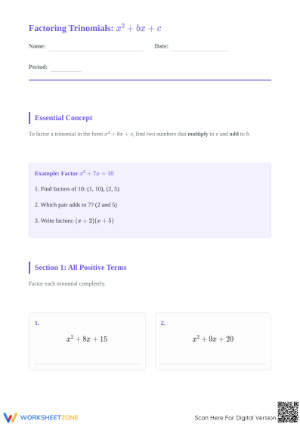
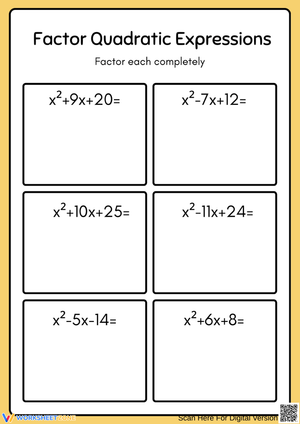
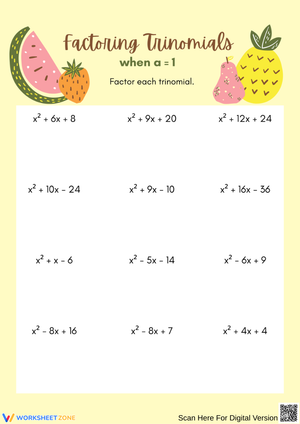
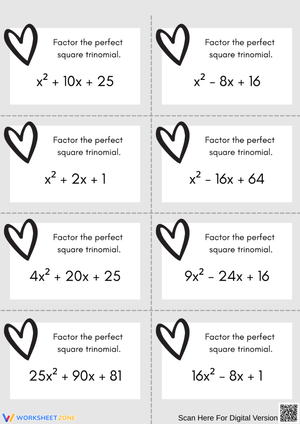
What These Factoring Trinomials Worksheets Cover
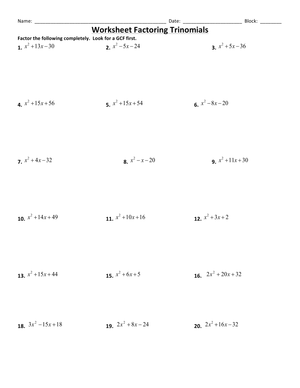
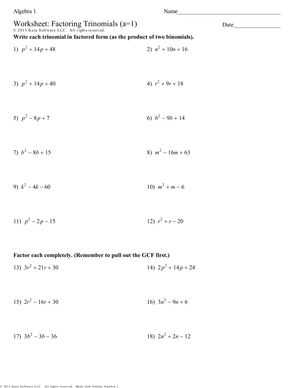
These factoring trinomials worksheets give Algebra 1 teachers ready-to-print practice for one of the most tested skills in the polynomial unit. Each set moves students through trinomials in the form x^2 + bx + c and the tougher ax^2 + bx + c cases, so you can assign a single page or build a full week of graduated practice. The problems are structured for grades 8 and 9, where factoring usually lands right after polynomial multiplication and just before students solve quadratic equations.
Because the sheets separate skills by difficulty, you can hand a warm-up to the whole class, send a homework set home, and still keep a differentiated version ready for a small group. Every worksheet stays focused on factoring, not mixed review, so students get repeated reps on the exact pattern you just taught. That focus makes the sets easy to slot into a lesson plan without any extra prep.
The Two-Tier Progression: a = 1 and a Not Equal to 1
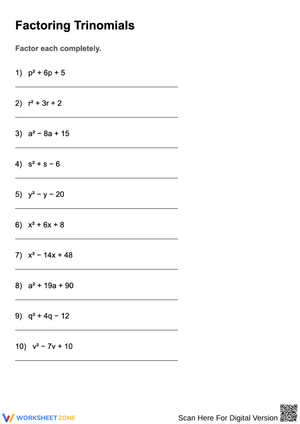
Most Algebra 1 curricula teach factoring in two clear tiers, and these worksheets mirror that sequence. The first tier covers trinomials where the leading coefficient is 1, such as x^2 + 7x + 12. Students look for two numbers that multiply to the constant and add to the middle coefficient. This tier builds number sense and sign fluency before any new procedure appears.
The second tier handles ax^2 + bx + c, where the leading coefficient is not 1, such as 6x^2 + 11x + 3. These problems usually call for the box method, the magic X, or grouping. Keeping the two tiers on separate pages lets you decide exactly when a class is ready to move up, instead of mixing both difficulties into one overwhelming set.
Here is the practical payoff of the split: when the leading coefficient is 1, a student factors x^2 + bx + c by testing factor pairs of c, so a constant like 12 offers only six factor pairs to check. Once a is not 1, the number of candidate combinations multiplies because both the leading and constant coefficients factor independently, which is exactly why students who breezed through tier one suddenly stall. Sequencing the worksheets by tier isolates that jump so you can reteach the method, not the arithmetic.
Methods Students Practice: Guess-and-Check and Grouping
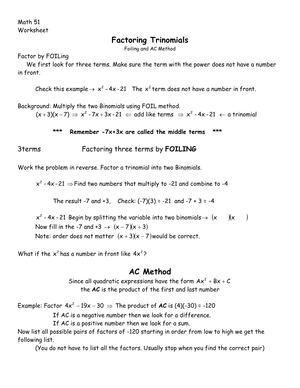
Two methods dominate Algebra 1 factoring instruction, and the worksheets support both. Guess-and-check works well for tier-one trinomials and for confident students who can see factor pairs quickly. Grouping, sometimes taught as splitting the middle term, gives students a reliable procedure for the a not equal to 1 problems where guessing gets slow.
According to Trinomial Factoring Part 1 from MathBitsNotebook (A1), factoring a trinomial like x^2 + bx + c comes down to finding two numbers whose product equals c and whose sum equals b. That single pattern powers the majority of the 20-plus problems on a typical tier-one practice set, which is why so much early factoring success rests on quick recall of factor pairs.
Having both methods represented means you can match the tool to the student. Some learners hold onto grouping as their default even for simple trinomials, and that is fine; the worksheets give them room to apply one consistent process across every problem type.
Special-Case Trinomials for Extension
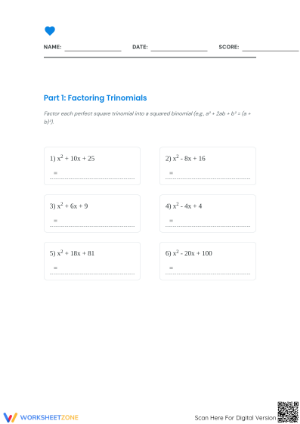
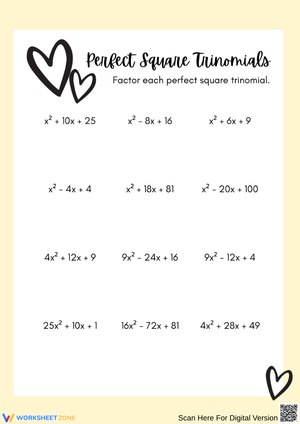
Beyond the standard two tiers, factoring units usually bundle in special cases, and these worksheets include them as extension practice. Perfect square trinomials, such as x^2 + 10x + 25, factor into a squared binomial and reward students who spot the pattern instead of grinding through factor pairs. Recognizing that the first and last terms are perfect squares and the middle term is twice their roots turns a multi-step problem into a quick read.
These extension pages work well for early finishers and for advanced students who need a challenge while the rest of the class consolidates the core skill. They also preview the structure students will lean on later when they complete the square, so the time spent here pays off well beyond the current unit.
How the Worksheets Connect to Solving Quadratics
Factoring trinomials is not the destination; it is the bridge to solving quadratic equations by factoring. Once students can rewrite x^2 + 7x + 12 as (x + 3)(x + 4), setting each factor equal to zero to find solutions is a short next step. The 9.2 Factor Trinomials lesson in the Algebra 1 Common Core sequence places this skill directly before that solving unit for exactly that reason.
Using these worksheets as a dedicated factoring block means students arrive at the quadratics unit already fluent in the harder half of the work. When factoring is automatic, the new idea, the zero product property, is the only thing students have to learn, and retention improves.
Using These Worksheets In Algebra 1 Classes
Start with a tier-one page as guided practice, working the first two or three problems together under a document camera before releasing students to finish independently. Reserve a second tier-one page for homework so the skill gets a night of spaced practice before you introduce a not equal to 1.
For the a not equal to 1 lessons, pair students and assign one grouping page per pair so they can talk through the middle-term split. Use a short exit ticket of two problems, one from each tier, to decide who needs a small-group reteach the next morning. Keep the perfect square trinomial page in a folder as an anytime enrichment option.
These sheets also work as spiral review. Dropping three factoring problems into a Friday warm-up throughout the quarter keeps the skill sharp long after the unit test, which matters because factoring resurfaces in rational expressions and again in Algebra 2.
Frequently Asked Questions
1. What grade level typically covers factoring trinomials?
Factoring trinomials is a core Algebra 1 skill, usually taught in grade 8 or 9 depending on when a student takes Algebra 1. It follows polynomial multiplication and sets up the quadratic equations unit later in the year.
2. What is the difference between factoring trinomials with a = 1 versus a not equal to 1?
When a = 1, students find two numbers that multiply to the constant and add to the middle coefficient. When a is not 1, both the leading and constant coefficients factor, so students usually switch to grouping or the box method to manage the extra combinations.
3. Which method should teachers introduce first: guess-and-check or grouping?
Most teachers start with guess-and-check on tier-one trinomials to build factor-pair fluency, then introduce grouping when the leading coefficient is not 1 and guessing becomes slow. Students who prefer one consistent process can use grouping throughout.
4. How do these worksheets connect to solving quadratic equations later in the unit?
Factoring a trinomial into two binomials is the first step in solving a quadratic by factoring. Once the expression is factored, students apply the zero product property to find the solutions, so fluent factoring makes the solving unit much faster.