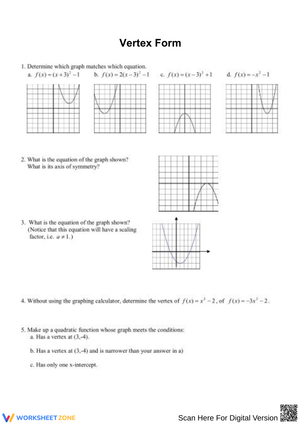
What Quadratic Transformations Worksheets Should Do
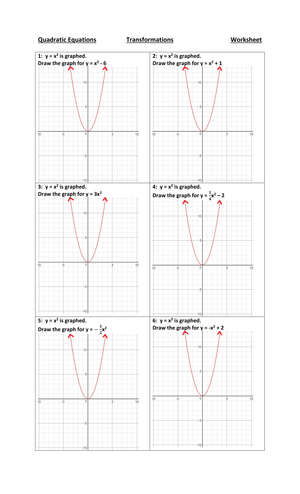
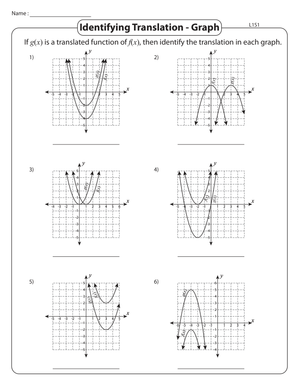
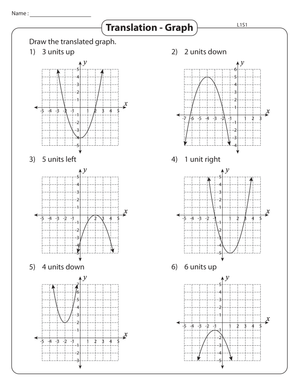
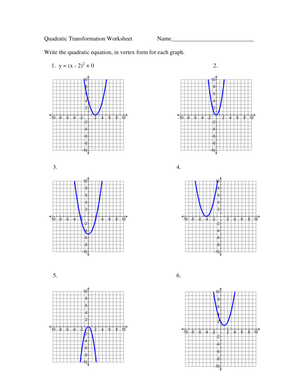
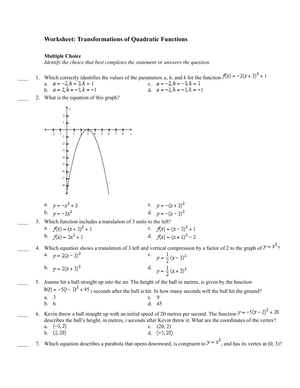
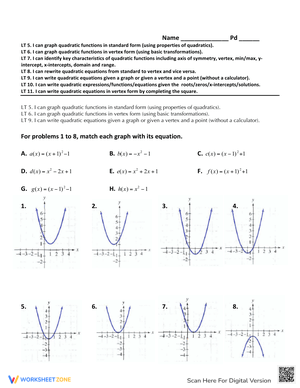
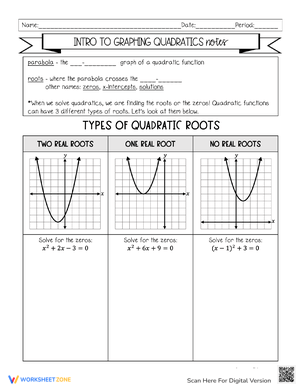
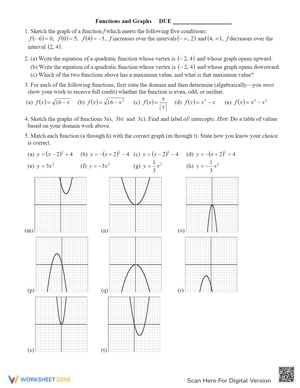
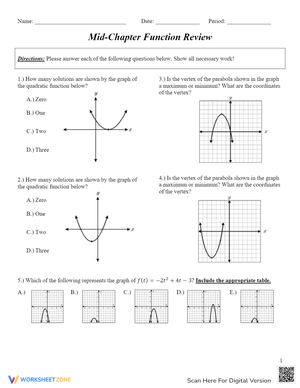
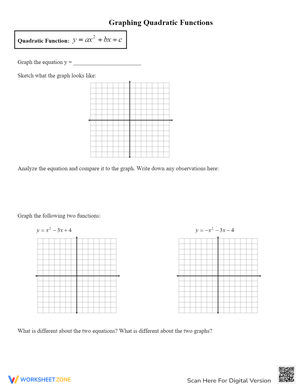
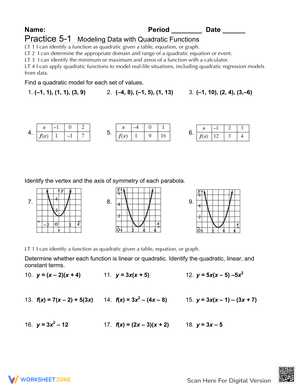
When you search for quadratic transformations worksheets, you're usually looking for practice pages that push students past plotting points and into predicting how a parabola moves. A strong set of worksheets asks students to connect the algebra of vertex form to the picture on the graph: which way the parabola slides, how wide or narrow it opens, and whether it flips. For Algebra 1 and Algebra 2 classes, that connection is the whole point of the unit, and the right worksheets make it visible one parameter at a time.
The goal isn't a stack of 40 identical problems. It's a sequence that builds from the parent function y = x² toward graphs that combine a shift, a stretch, and a reflection. A worksheet that jumps straight to full vertex form on problem one usually produces guessing rather than reasoning. Below is how experienced teachers structure that progression and where worksheets fit at each step.
Sequencing the Unit from y = x²
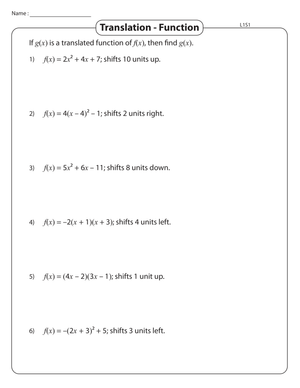
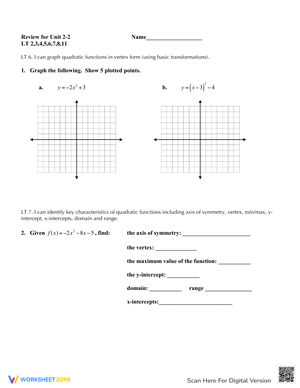
Start with the parent function and change exactly one thing at a time. Students first graph y = x², then compare it to y = x² + k to see vertical shifts, then y = (x - h)² for horizontal shifts. Only after those land do you introduce the a value for vertical stretch, shrink, and reflection.
Worksheets that isolate one variable keep the cognitive load manageable. A page on vertical shifts alone lets students generalize the rule before you complicate it. Once each transformation is secure on its own, a mixed page that combines all three parameters in full vertex form becomes a fair challenge rather than a wall.
The order matters more than teachers expect. Introducing the stretch factor before students are fluent with shifts tends to blur the two effects together, and they start attributing every change in the graph to a. Holding a at one until vertical and horizontal shifts are automatic keeps each rule cleanly attached to its own parameter.
Reading Vertex Form Parameters
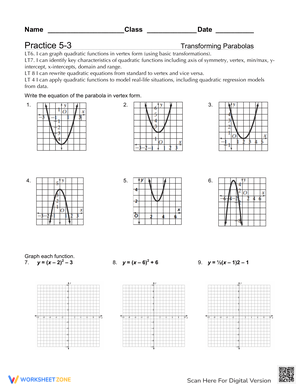
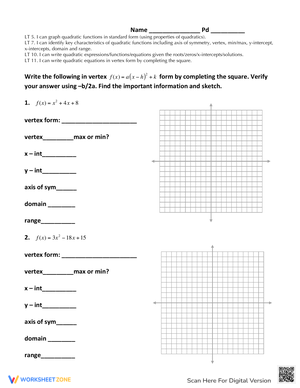
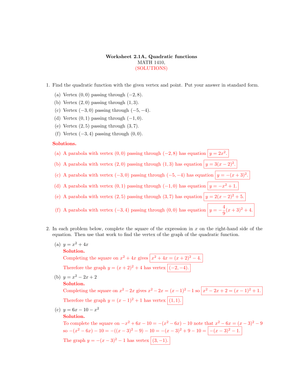
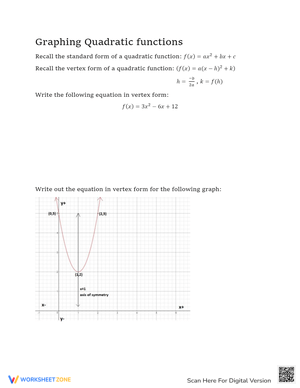
Vertex form, f(x) = a(x - h)² + k, is the backbone of this unit. The value h shifts the graph left or right, k shifts it up or down, and a controls how steep the parabola is—stretching it when the absolute value is greater than one, shrinking it when it's between zero and one, and reflecting it over the x-axis when it's negative. Worksheets should ask students to read these values directly from an equation and describe the resulting move in words.
The parameter that trips up the most students is h, because the graph moves opposite to the sign inside the parentheses: (x - 3)² shifts right, not left. A worksheet that deliberately pairs (x - 3)² and (x + 3)² back to back, and asks students to justify the direction before graphing, catches this reversal earlier than a page that scatters the two forms across unrelated problems.
Grounding Practice in the Standard
According to the Common Core High School Functions: Building Functions domain, standard F-BF.3 asks students to identify the effect on a graph of replacing f(x) with f(x)+k, k·f(x), f(kx), and f(x+k) for specific values of k—four distinct transformation types students must both predict and reverse-engineer from a given graph.
In practice, most Algebra 1 courses narrow this to quadratics and skip the horizontal stretch case, f(kx), saving it for Algebra 2. Knowing that boundary helps you pick worksheets at the right depth: an Algebra 1 set should stay in vertex form with vertical stretches, while an Algebra 2 set can add horizontal compressions and combined transformations. Matching worksheet difficulty to where the standard sits in your course keeps practice honest and prevents students from meeting a case they haven't been taught.
Pairing Worksheets with Graphing Technology
Transformation practice sticks faster when students can check their prediction against a picture. Have students predict the vertex and direction on the worksheet first, then confirm with a graphing calculator or a free graphing tool before moving on. The prediction has to come first—otherwise the technology does the thinking for them.
A quick routine makes this concrete: predict, sketch, verify. Students write the predicted vertex, sketch the parabola by hand, and only then pull up the graph. When the two disagree, the gap is the lesson, and it usually points straight at a sign error in h or a forgotten reflection.
This pairing also speeds up feedback. Instead of waiting for you to grade a page, students catch their own reversed shifts the moment the graph disagrees with their written answer. That immediate correction is hard to replicate with an answer key alone.
Classroom Implementation
Use worksheets in three roles across the unit. During guided practice, work the first two problems together and narrate your thinking about each parameter. For independent practice, assign a single-transformation page so every student can succeed before the mixed set. For formative assessment, a short four-problem exit slip—one shift, one stretch, one reflection, one combined—tells you exactly which parameter needs reteaching.
For small-group intervention, cut the mixed problems and rebuild fluency on one transformation at a time with a graphing check after each. For enrichment, hand advanced students a page that composes multiple transformations or asks them to write an equation from a described graph. The same vertex form skeleton scales up and down, so one worksheet family can serve the whole room without separate handouts for every group.
Keep an answer key that shows the vertex and direction, not just the final graph, so students reviewing their work see the reasoning steps and not only the endpoint.
Frequently Asked Questions
1. What grade level typically covers quadratic transformations worksheets?
Most students meet quadratic transformations in Algebra 1, usually in grades 8-9, and revisit them in Algebra 2 as part of general function transformations. Algebra 1 focuses on vertex form shifts, stretches, and reflections, while Algebra 2 extends the same ideas to horizontal compressions and functions beyond parabolas.
2. What is the difference between vertex form and standard form for teaching transformations?
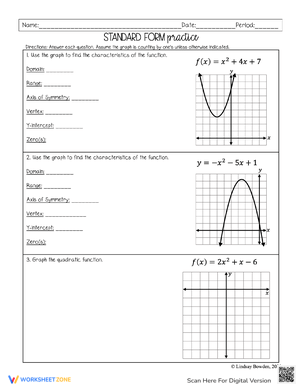
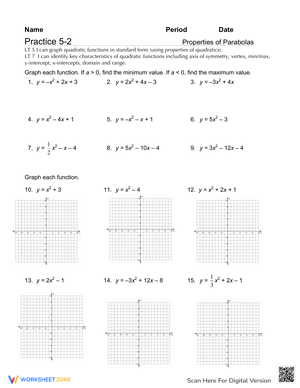
Vertex form, a(x - h)² + k, shows the transformations directly: you can read the shift and stretch straight from the equation. Standard form hides them, so students would need to complete the square first. For a transformations unit, vertex form keeps the focus on the moves themselves.
3. How can teachers use quadratic transformation worksheets for formative assessment?
A short exit slip with one problem per transformation type gives a quick read on understanding. Ask students to both graph the function and describe the transformation in words. The written description often reveals a misconception the graph alone would hide, such as a reversed horizontal shift.
4. What common mistakes should teachers watch for during practice?
Watch for reversed horizontal shifts, the assumption that a larger a widens the parabola, and forgotten reflections when a is negative. Building distractor-matching problems into worksheets brings these errors into the open where students can discuss and correct them.