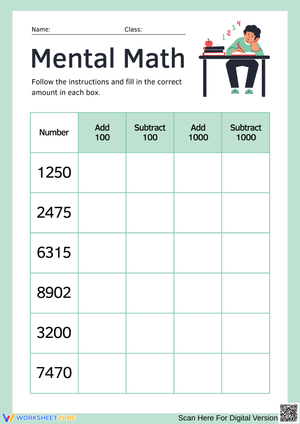
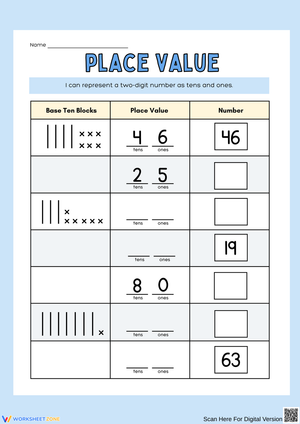
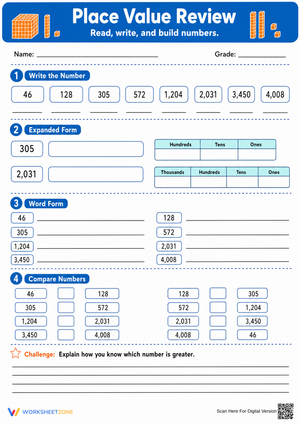
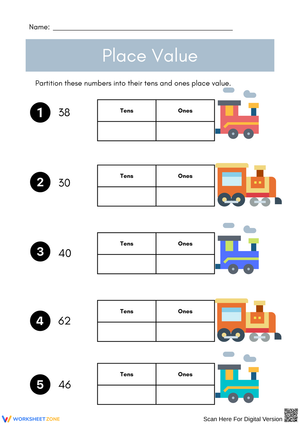
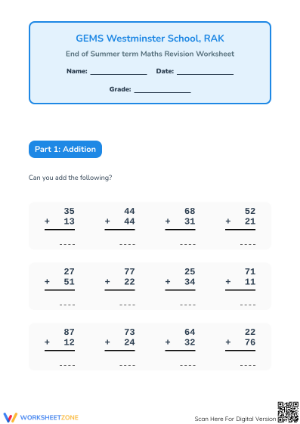
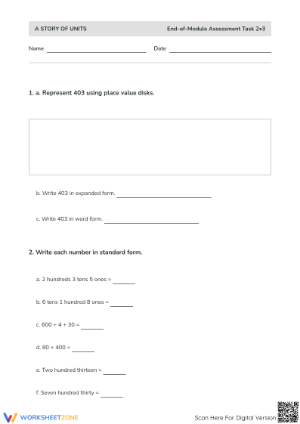
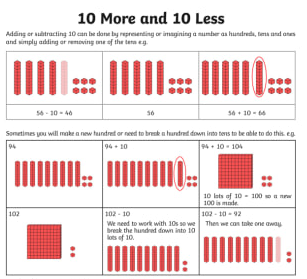
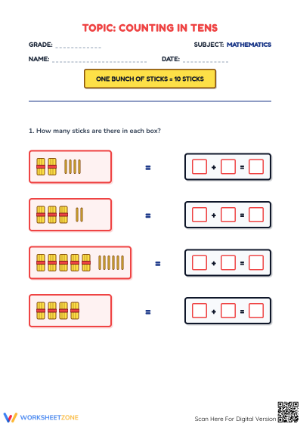
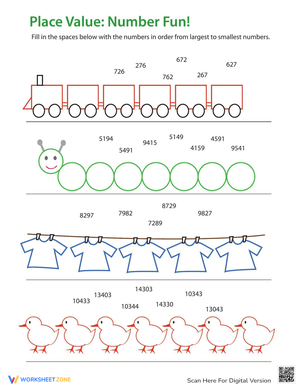
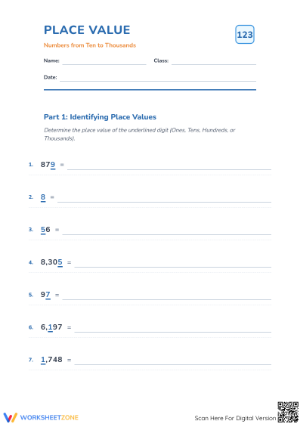
These place value worksheets give teachers a ready-to-print collection spanning the full K–5 progression — from first graders building tens-and-ones understanding to fifth graders reading and comparing decimals at the thousandths place. Each worksheet targets one specific skill and one specific format, so you pull exactly what the lesson calls for. The range across the set means you can address whole-class instruction, small-group intervention, and formative assessment without hunting down separate resources.
What the Worksheets Target
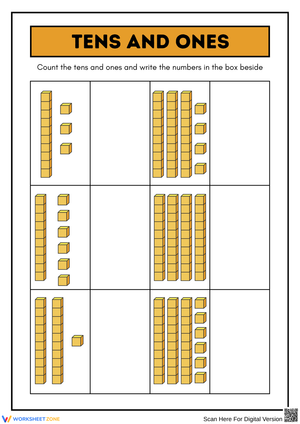
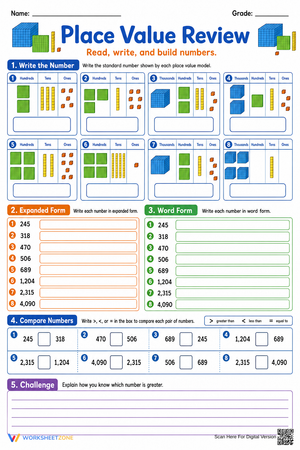
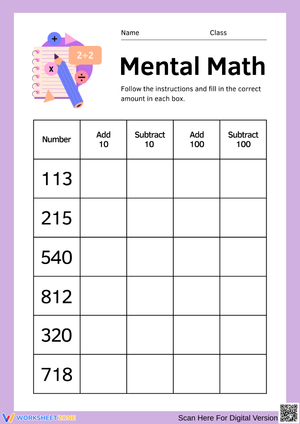
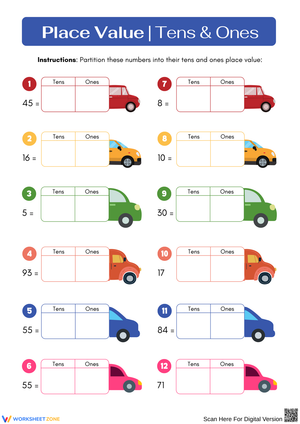
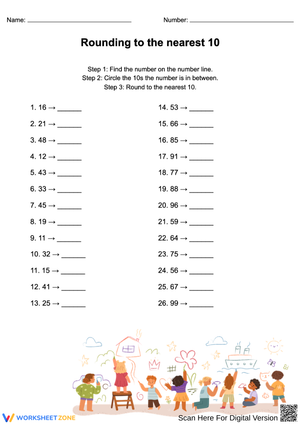
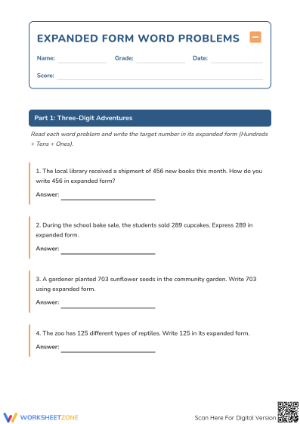
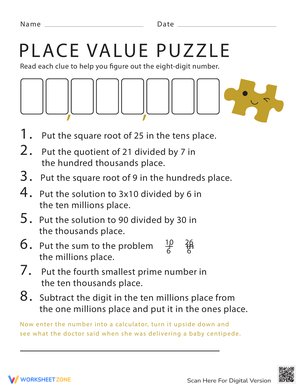
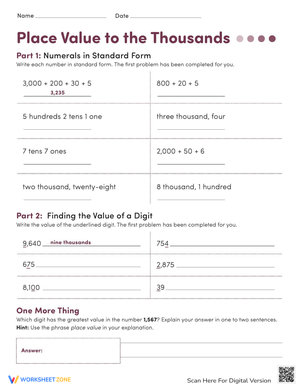
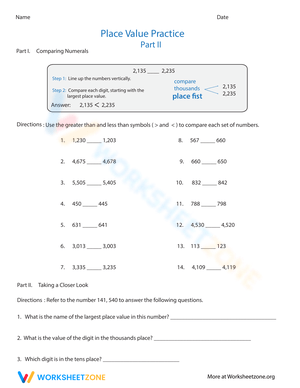
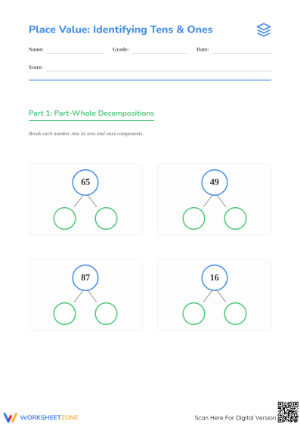
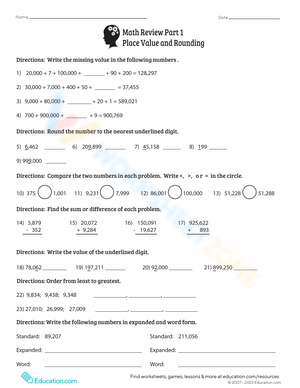
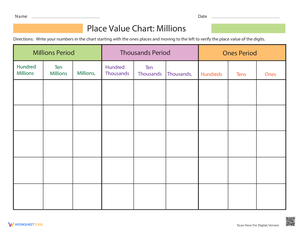
The formats map directly onto the representations that elementary math programs use throughout the NBT progression. Place value charts ask students to write each digit into a labeled column — ones, tens, hundreds, thousands — making the positional structure of whole numbers explicit rather than assumed. Expanded form worksheets require students to decompose a number into its component place values (347 = 300 + 40 + 7), work that directly underpins regrouping in addition and subtraction. Base-ten block worksheets connect the abstract digit to a countable quantity: students draw or interpret flats, rods, and unit cubes to match a written number. Rounding worksheets specify a target place and require students to identify the correct neighboring digit before applying the rounding rule. Comparison worksheets pair two multi-digit numbers and ask students to mark the relationship using <, >, and = — reasoning that depends on positional value, not digit face value.
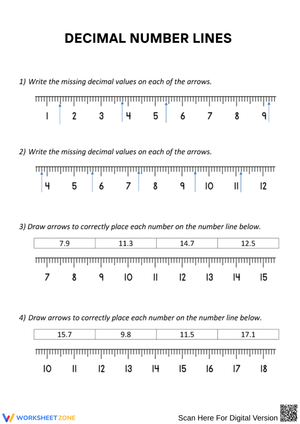
A teacher downloading each place value worksheets for grades 4–5 will find that the decimal extension uses the same column structure students already recognize from whole-number work, which reduces the adjustment time when decimal place value is introduced mid-year. The tenths, hundredths, and thousandths columns extend to the right of the ones column just as the hundreds and thousands columns appear to the left — the chart stays symmetrical and visually predictable.
Student Error Patterns Worth Anticipating
The most common error in expanded form work is digit-value confusion: a student writes 347 as 3 + 4 + 7 instead of 300 + 40 + 7. That student knows the first digit is 3, but hasn't separated the digit from its positional value. This gap shows up in nearly every class that hasn't had explicit instruction on what each column in a place value chart actually represents, and expanded form worksheets expose it immediately.
Placeholder zeros create a quieter but equally revealing problem. Students frequently write 304 in expanded form as 300 + 4, dropping the tens position entirely. In a quick scan of twenty papers, that looks like carelessness. It isn't — it signals that the student hasn't yet internalized zero as a digit that holds a place rather than marking an absence.
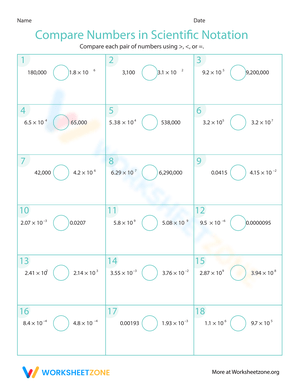
Decimal place value introduces a third persistent misconception: students mark 0.30 as greater than 0.9 because "thirty is bigger than nine." This error appears reliably by fourth grade and, without targeted correction, follows students into middle school. The decimal comparison worksheets in the set surface that reasoning early — which is the prerequisite for addressing it.
Where These Worksheets Fit in Your Instructional Routine
These worksheets slot into the parts of the day where teachers most need a ready format without setup time:
- Opening warm-up: A place value chart at the start of math class takes three to five minutes and activates the number sense students need before the lesson launches.
- Exit ticket: Two or three rounding or comparison problems at the end of a lesson show you within ninety seconds who is ready to move forward and who needs the concept restated before homework goes home.
- Small-group intervention: Base-ten block diagram worksheets work particularly well in pull-out groups because they require students to connect an abstract digit to a countable quantity, not just fill columns by rote.
- Simultaneous whole-class differentiation: Run the same chart format at three different numerical ranges at once — hundreds for the intervention group, ten-thousands for on-level students, decimals for those who are ready.
That last approach deserves emphasis. When every student is filling in a place value chart and the only variable is the column range, the visual routine is shared even when the numbers aren't. Students at different readiness levels are doing structurally identical work, which removes the social friction that comes with visibly separate tasks and simplifies what you need to prepare.
Sorting a printed set of place value worksheets by format rather than by lesson date — charts in one section, expanded form in another, rounding in a third — means retrieval during a two-minute planning window is fast enough to be practical. A folder organized this way functions as a running resource bank for the full NBT unit rather than a stack of papers that gets filed after one use.
Standard Alignment
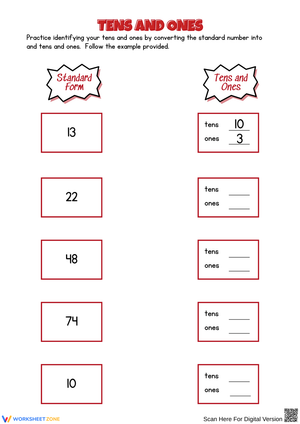
The worksheets address the Number and Operations in Base Ten (NBT) domain of the Common Core State Standards, spanning 1.NBT through 5.NBT. The foundational standard, 1.NBT.B.2, establishes that the two digits of a two-digit number represent amounts of tens and ones — the conceptual anchor for the entire progression. By 4.NBT.A.1, students are expected to recognize that a digit in one place represents ten times the value of the same digit one position to its right, a multiplicative relationship the place value chart format makes legible rather than abstract. The decimal extension falls under 5.NBT.A.3, which requires students to read, write, and compare decimals to thousandths using place value understanding. The set covers each of these standards without requiring teachers to adjust materials for curriculum sequence.
Adjusting the Set for Different Readiness Levels
The same skill type can be practiced at different points along the place value progression simply by selecting a different worksheet. A student consolidating tens-and-ones understanding works with a chart that tops out at two digits. A student on grade level with four-digit numbers gets a chart that runs to the ten-thousands. A student working ahead moves to the decimal extension. The chart format is consistent across all three; only the column range changes, which means students at different levels see themselves doing the same kind of work even when the difficulty differs.
For students who struggle with abstract numerals, pairing a place value chart worksheet with physical base-ten blocks lets them build the number concretely before recording it. That's not a modification of the worksheet — it's an additional material that changes how students access the task without changing the task itself. For students who finish early, asking them to write the same number in expanded form and word form alongside the completed chart turns one worksheet into a three-part exercise without printing anything extra.
Frequently Asked Questions
Which grade levels does the collection cover?
The worksheets span kindergarten through grade 5, following the NBT progression from start to finish. The earliest worksheets address ones and tens; the most advanced target decimal place value through the thousandths, aligning with 5.NBT.A.3.
How do I match a worksheet to a specific lesson goal?
Start with the representation the lesson centers on. If students are learning what each digit position means, a place value chart is the right format. If the goal is building number sense around the values those positions carry, use an expanded form worksheet. Rounding and comparison worksheets work best once the underlying concept is established and students are applying it rather than encountering it for the first time.
Can these worksheets function as formative assessments?
Expanded form and place value chart worksheets that require students to produce answers — rather than circle or match — work well as exit tickets or unit pre-assessments. A single rounding problem at the end of a lesson tells you more than a five-question multiple-choice sheet because it shows whether students understand the decision-making process, not just the outcome.
Are the files free to download and print?
The place value worksheets files on Worksheetzone are all free to download and print — no account required. Select the worksheet that matches your lesson target, download the PDF, and print as many copies as your class needs.













 Interactive Worksheet Maker
 Quiz Maker
 Word Search Maker
 Crossword Puzzle Maker
 Word Scramble Generator
 Sentence Scramble Generator
 Handwriting Worksheet Generator
 Name Tracing Generator
 Fill In The Blank Generator