Students who can count by ones but freeze at 4 x 6 usually need a visual model before they need more flashcards. Arrays worksheets give teachers that model: rows and columns of objects that students can count, group, and eventually multiply. Before introducing the multiplication symbol, students need to see that six rows of four dots and four rows of six dots both total the same amount. That visual proof is what makes array practice so valuable in a Grade 2 or Grade 3 classroom, whether you are teaching a whole-group lesson or pulling a small group for reteaching.
What Grade 2 Standards Say About Rectangular Arrays
Array instruction is not just a nice visual add-on. It is written directly into the Grade 2 Operations and Algebraic Thinking standards, which means array worksheets support a specific, measurable classroom expectation rather than a loosely connected enrichment activity.
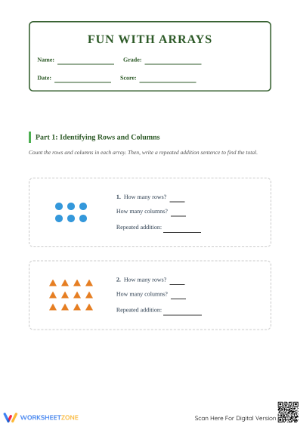
Under CCSS 2.OA.4, Grade 2 students are expected to use addition to find the total number of objects arranged in rectangular arrays with up to 5 rows and up to 5 columns, then write the total as a sum of equal addends. That size constraint matters for worksheet design: a Grade 2 array worksheet should stay within a 5-by-5 grid so it matches the standard, while Grade 3 sheets can extend beyond that range as students move toward full multiplication fact fluency.
According to the Common Core State Standards Initiative, second graders must 'use addition to find the total number of objects arranged in rectangular arrays with up to 5 rows and up to 5 columns' and represent that total as a sum of equal addends (CCSS.MATH.CONTENT.2.OA.C.4). This single sentence defines the size and structure every Grade 2 array worksheet should follow.
Sequencing Array Worksheets From Repeated Addition to Multiplication Facts
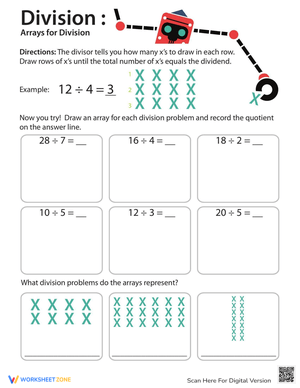
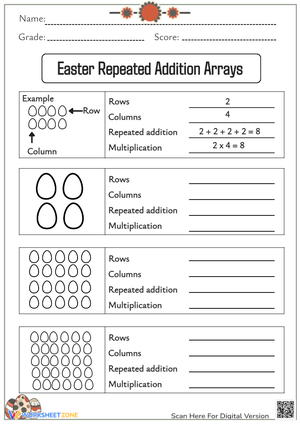
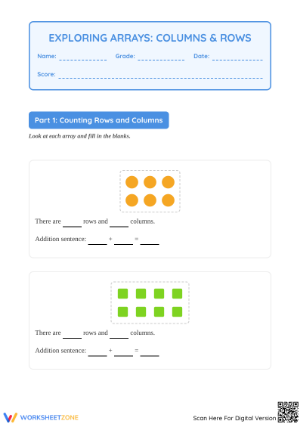
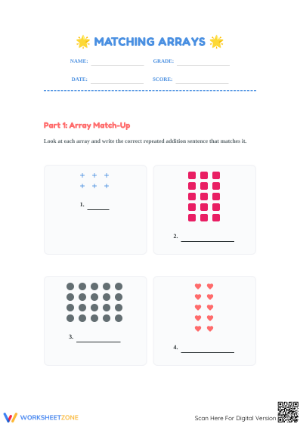
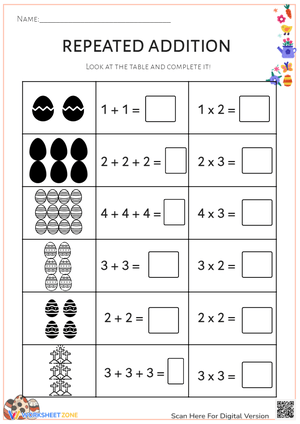
Array worksheets work best when they follow a deliberate sequence rather than jumping straight to abstract facts. Start students with worksheets that ask them to count total dots or tiles in a small array and write the count as repeated addition, such as 3 + 3 + 3 + 3. Once students can do this reliably, move to worksheets that pair the same array with both an addition sentence and a multiplication sentence, so students see 4 x 3 and 3 + 3 + 3 + 3 as two names for the same picture. The final stage in the sequence removes the picture and asks students to sketch their own array from a multiplication fact, which checks whether the visual model has become internalized rather than just recognized.
- Stage 1: Count and label a given array using repeated addition only
- Stage 2: Match a given array to both an addition and a multiplication sentence
- Stage 3: Draw an array from a multiplication fact with no picture provided
- Stage 4: Solve mixed word problems that require choosing rows and columns independently
Teaching the Commutative Property With Array Rotation
One of the most useful features of an array is that rotating it does not change the total. A worksheet showing 5 rows of 3 next to 3 rows of 5 lets students physically see that 5 x 3 and 3 x 5 produce the same answer, which builds early understanding of the commutative property well before students meet that vocabulary term. A simple hands-on extension pairs the worksheet with square tiles or counters: students build an array, count the total, rotate it 90 degrees, and count again. When the numbers match every time, students start trusting the property instead of memorizing it as an isolated rule. This kind of paired worksheet and manipulative task also gives teachers a quick way to spot students who are still counting one-by-one instead of using rows or columns as a shortcut.
Common Misconceptions With Rows and Columns
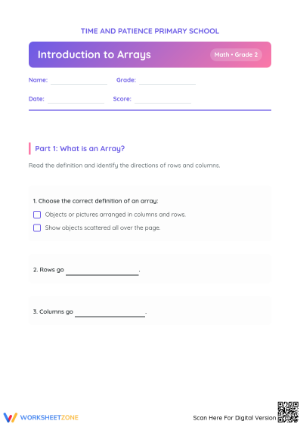
The most frequent error on array worksheets is students confusing rows with columns, which leads them to write 3 x 4 when the array actually shows 4 x 3. This mix-up is usually harmless for the total but becomes a real problem once students start matching arrays to specific word problems, where the order of factors reflects a real-world grouping. A second common misconception shows up when students skip-count down a column instead of across a row, which can produce the right total through the wrong strategy and mask a gap that will surface later. Worksheets that explicitly label 'rows' and 'columns' with arrows, and that ask students to write both orders of the multiplication sentence, help surface and correct this pattern early.
Classroom Implementation
Array worksheets flex easily between whole-class instruction and small-group intervention, which makes them useful across a full math block. For whole-class lessons, project a single array and have students work through counting, addition, and multiplication together before releasing them to independent practice at their own pace. For small-group intervention, choose worksheets with fewer rows and columns and add manipulatives so struggling students can build every array by hand before writing the matching number sentence. Keep a few blank array grids on hand for exit tickets: give students a multiplication fact and ask them to sketch and label the matching array in the last five minutes of class. This quick check tells you within a day whether a student needs another round of concrete practice or is ready to move toward standard multiplication algorithms in Grade 3.
Frequently Asked Questions
1. What grade level are array worksheets appropriate for?
Array worksheets are most directly tied to Grade 2, where CCSS 2.OA.4 requires students to find totals in rectangular arrays with up to 5 rows and up to 5 columns. Grade 3 classrooms continue using arrays to reinforce multiplication and division reasoning as part of the broader Operations and Algebraic Thinking progression.
2. How do arrays help students understand multiplication facts?
Arrays give students a visual, countable model for multiplication instead of an abstract number sentence. Seeing rows and columns lets students connect repeated addition to multiplication and understand why a fact like 4 x 3 represents a specific, checkable quantity rather than a fact to memorize in isolation.
3. What is the difference between an array and an equal groups model?
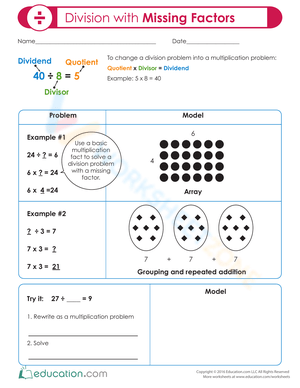
An array arranges objects in fixed rows and columns, which makes rotation and the commutative property visible. An equal groups model shows separate clusters of the same size but does not organize them into a grid, so it does not demonstrate row-column rotation the way an array does.
4. How can teachers use arrays for math intervention or reteaching?
Intervention groups benefit from smaller arrays paired with physical manipulatives like tiles or counters, so students can build each array before writing a number sentence. Starting with concrete objects and moving to array worksheets gives struggling students a slower, hands-on path back to the same standard the rest of the class is working toward.
5. How do arrays connect to the commutative property of multiplication?
Rotating an array from rows to columns does not change the total, which gives students direct visual proof that 5 x 3 and 3 x 5 are equal. Worksheets that pair a rotated array with both multiplication sentences help students internalize the commutative property before they encounter it as a formal term.