Why the Distributive Property Trips Up Students Between Grades 3 and 6
Distributive property worksheets show up in almost every US math scope and sequence, but the skill itself changes shape as students move through elementary and middle school. In grade 3, it is a multiplication strategy: breaking a hard fact into two easier ones. By grade 6, it is an algebraic tool for expanding and factoring expressions with variables. If you teach either grade band, the worksheets you choose need to match where a student sits on that continuum, not just the grade-level label on the standard.
The distributive property is one of the most persistent gap areas on state math assessments precisely because it sits at the seam between concrete arithmetic and abstract reasoning. Students who can compute 7 x 8 correctly often cannot explain why 7 x (5 + 3) equals the same value, and that explanatory gap is exactly what well-sequenced worksheets are built to close.
Building the Concrete Foundation: Arrays and Area Models in Grade 3
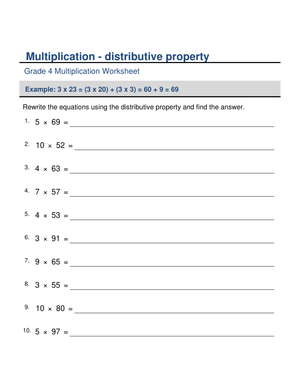
CCSS 3.OA.B.5 introduces the distributive property as one of several strategies for multiplication and division fact fluency. Worksheets at this level should lean on arrays and area models before any symbolic notation appears. A typical task might ask students to split an array for 7 x 8 into a 7 x 5 section and a 7 x 3 section, then add the two partial products. This visual step matters more than the arithmetic itself, since it gives students a picture to point to when they later meet the abstract version of the rule.
Effective grade 3 worksheets sequence several fact families this way before asking students to generate their own splits. Early pages should provide the array already partitioned; later pages should ask students to choose their own split and justify it, which pushes them toward flexible number sense rather than a single memorized trick.
Moving to Symbolic Notation: Writing a(b+c) as ab + ac
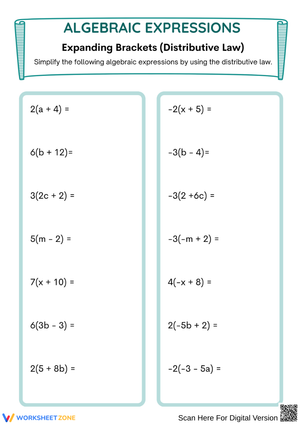
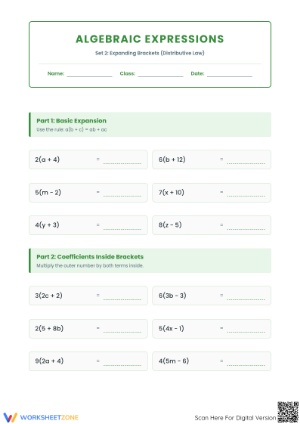
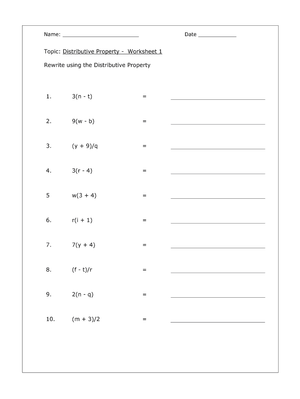
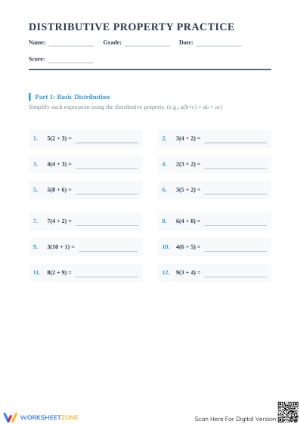
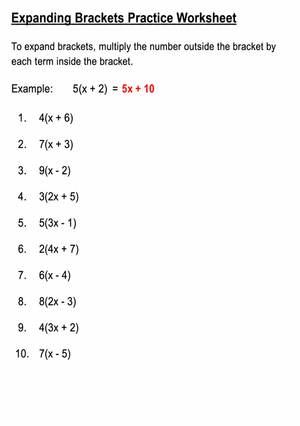
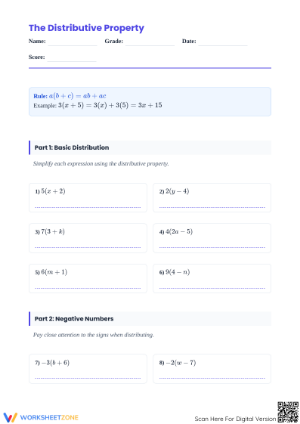
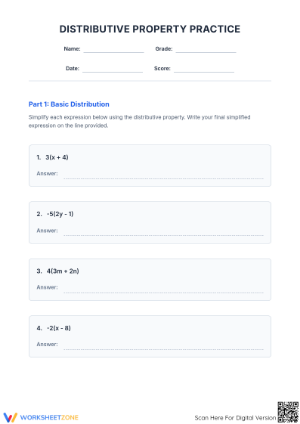
Once students are comfortable splitting arrays, worksheets can introduce the symbolic form. This bridge page is often the one teachers skip too quickly. A useful sequence pairs a numeric example, such as 4 x (10 + 2) = 40 + 8, directly next to a variable example, such as 4 x (x + 2) = 4x + 8, so students see the identical structure repeated with a letter standing in for a number. Worksheets that isolate this pairing, rather than mixing it with unrelated review problems, give students a cleaner mental model to carry into middle school.
Distributive Property Worksheets for Grade 6 Algebraic Expressions
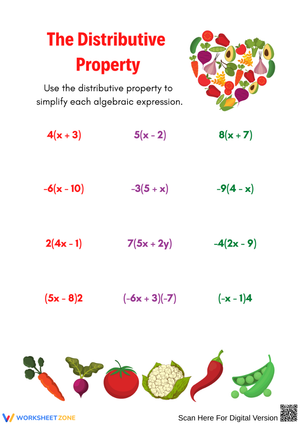
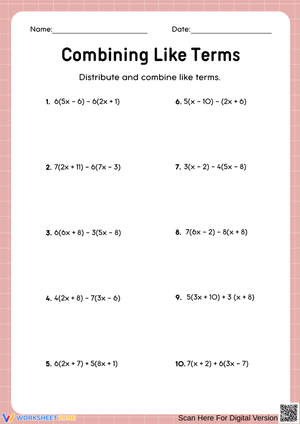
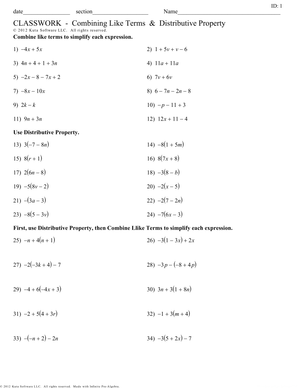
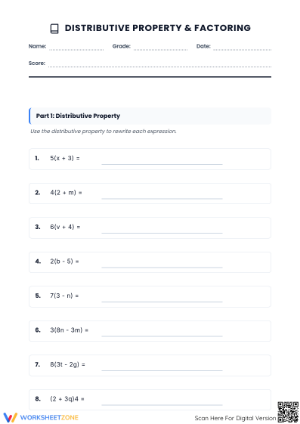
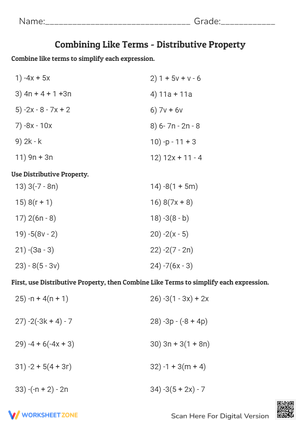
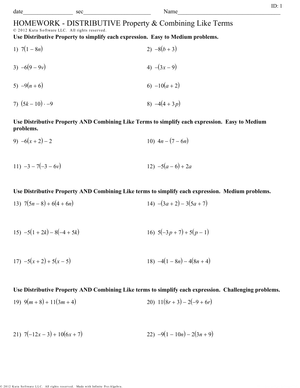
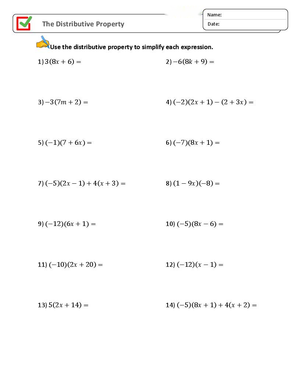
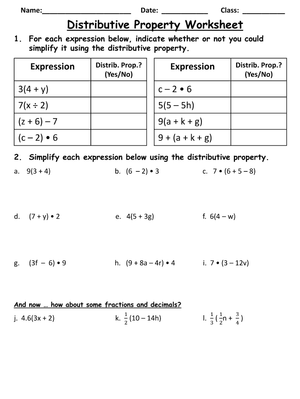
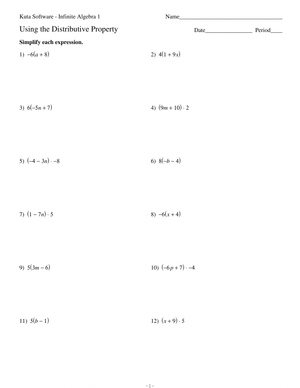
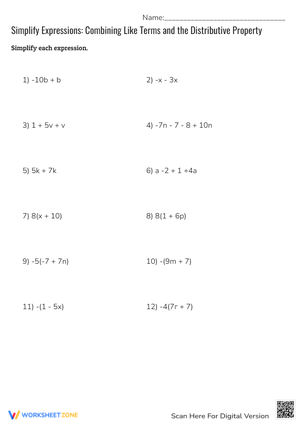
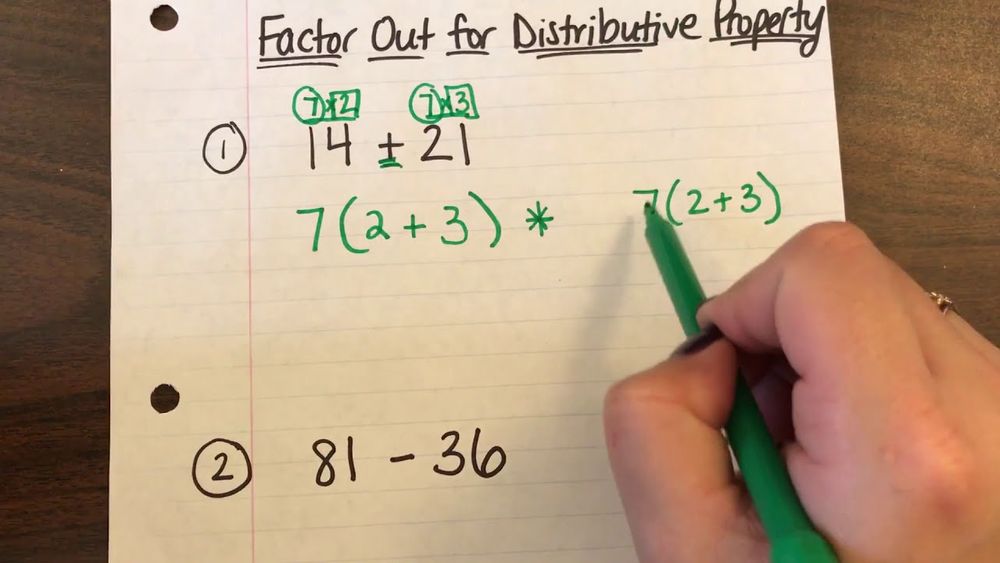
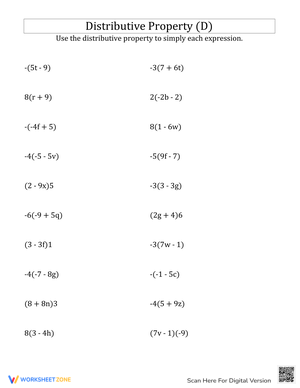
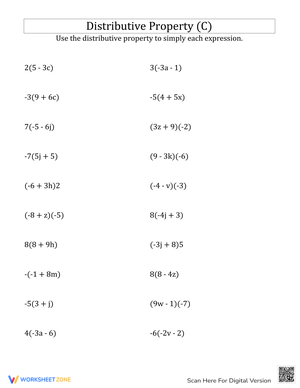
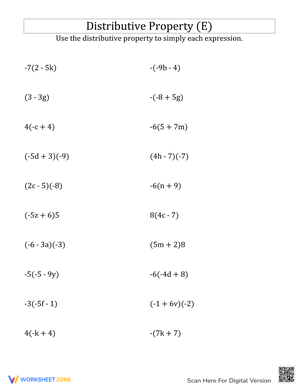
CCSS 6.EE.A.3 extends the distributive property into generating equivalent expressions, including expanding expressions like 3(x + 4) and factoring expressions like 6x + 15 back into 3(2x + 5). Grade 6 worksheets typically pair this skill with combining like terms, since state assessments frequently test both skills in the same item. A strong worksheet set for this grade band moves from pure expansion, to expansion followed by combining like terms, to factoring, so students practice the property in both directions rather than only expanding.
Because expansion and factoring are the inverse of each other, worksheets that only ask students to expand leave a real gap: many sixth graders can distribute correctly but cannot work backward to identify the greatest common factor needed for factoring. Building both directions into a single worksheet set closes that gap before it surfaces on a unit test.
Common Error Patterns Worksheets Should Target
A well-designed worksheet does more than provide repetition; it anticipates the mistakes students are likely to make. Three patterns show up often enough to plan around directly:
- Distributing to only the first term in a sum, so 5(x + 3) becomes 5x + 3 instead of 5x + 15.
- Sign errors when subtraction is involved, such as treating 4(x - 2) as 4x - 2 rather than 4x - 8.
- Skipping the distribution step entirely when a negative sign sits outside the parentheses, as in -(x + 6).
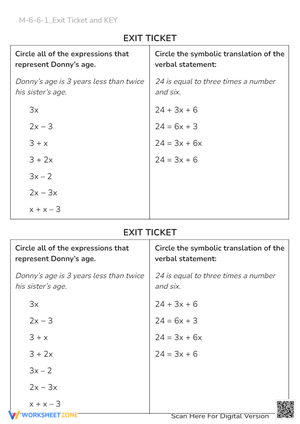
Worksheets that include a short answer-analysis section, where students identify and correct someone else's mistake, tend to surface these errors faster than straight computation practice. This works well as a warm-up or an exit ticket rather than a full page of new content.
Frequently Asked Questions
1. What grade level is the distributive property typically taught in US classrooms?
The distributive property first appears in grade 3 under CCSS 3.OA.B.5 as a multiplication and division fact strategy. It reappears in grade 6 under CCSS 6.EE.A.3, where it is used to generate equivalent algebraic expressions.
2. How does a distributive property worksheet differ between elementary and middle school?
Elementary worksheets rely on arrays and area models to break a multiplication fact into two smaller facts. Middle school worksheets use symbolic notation to expand expressions like a(b + c) and factor expressions back into that form, often alongside combining like terms.
3. What are common student errors when applying the distributive property, and how can worksheets target them?
Frequent errors include distributing to only one term in a sum, mishandling a negative sign, and skipping distribution altogether when a variable sits outside the parentheses. Worksheets that include error-analysis items, where students find and correct a mistake, target these patterns directly.
4. How can teachers use distributive property worksheets for both whole-class instruction and small-group intervention?
For whole-class instruction, worksheets can move a class through the sequence from arrays to symbolic notation across several lessons. For small-group intervention, the same array-based worksheet can double as a diagnostic tool, showing whether an older student's gap is conceptual or simply a matter of notation.