One to one correspondence worksheets give early counting practice a clear purpose
One to one correspondence worksheets work best when teachers want students to slow down and match each object to one spoken count. In preschool, pre-K, kindergarten, and early intervention settings, that simple action matters more than reciting a long number list. A child can say numbers in order and still skip objects, double-count, or touch everything too quickly. That is why printable practice should center on matching, pointing, moving, and checking, not just writing numerals.
On Worksheetzone, these pages fit early math lessons that focus on counting sets, matching quantities, and building confidence with small numbers before students move into more complex counting work. Teachers can use one to one correspondence worksheets during centers, warm-ups, intervention blocks, or quick progress checks. The goal is not a page filled in neatly. The goal is accurate counting behavior that transfers to manipulatives, dot cards, board paths, and classroom materials.
Why this skill matters before students are expected to count fluently
One-to-one correspondence means each object counted is matched to one number word. That definition sounds basic, but it carries a lot of instructional weight. When students connect one touch to one count, they begin to understand that counting is not just a chant. It is a way to determine how many items are in a set. That understanding supports later work with cardinality, numeral matching, comparing sets, and early addition.
If students are rushed into higher number tasks without this foundation, teachers often see familiar errors. Some children point to one object twice. Others say three number words while touching only two objects. Some sweep a finger across a row without any one-to-one action at all. Worksheets can make those patterns visible because the teacher can watch how a child counts while completing the page, then decide what kind of support is needed next.
What strong one to one correspondence worksheets should include
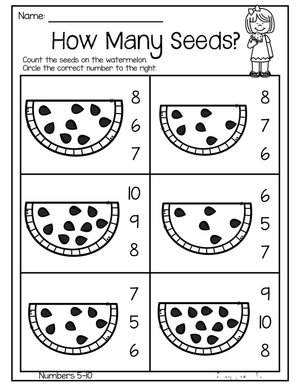
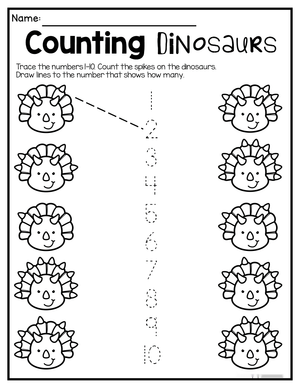
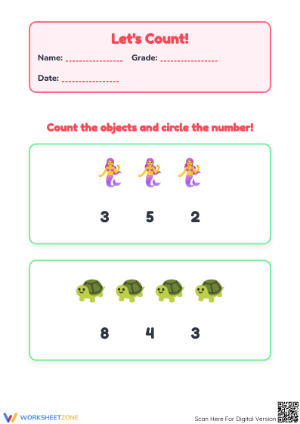
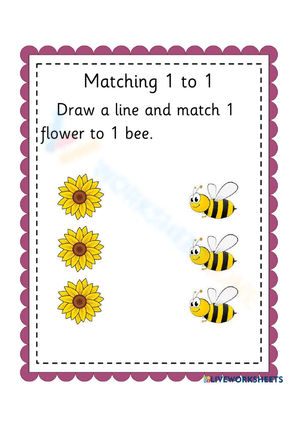
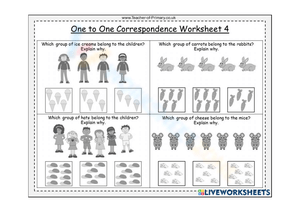
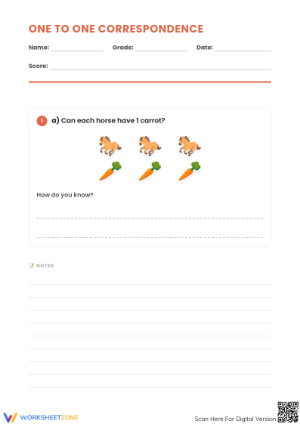
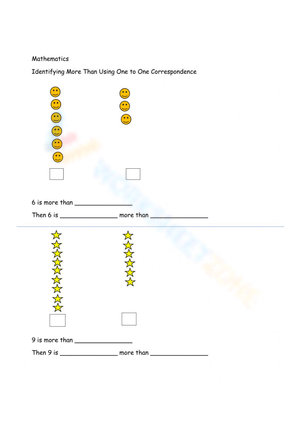
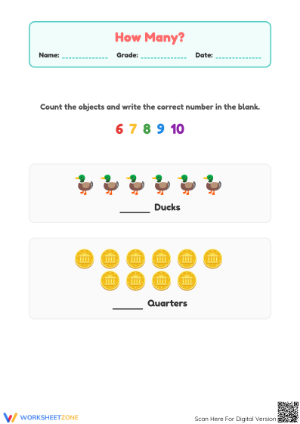
The best one to one correspondence worksheets are narrow in focus. They ask students to count small sets, match objects to numerals, connect quantities to pictures, or show that each item has been counted once. For early learners, that usually means uncluttered layouts, predictable spacing, and quantities that increase gradually instead of jumping from very easy to very hard on the same page.
- Small sets that let teachers observe counting behavior clearly
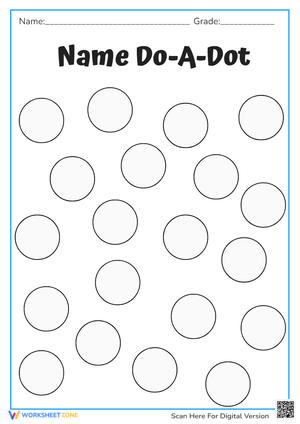
- Picture groups spaced well enough for pointing or moving counters
- Tasks that connect quantities and numerals without overloading the page
- Clear visual paths so children know where to start and where to stop
- Practice that moves from counting objects to checking total quantity
Worksheets are especially useful when they do not stay pencil-only. If students can place a counter on each object, tap each picture, or slide along a number path while counting, the page becomes a bridge between hands-on experience and independent practice. That bridge matters for learners who can perform better with movement than with verbal responses alone.
How to use these pages for centers, intervention, and fast formative checks
Teachers often need printable tasks that can serve more than one purpose across the week. One page can work in a math center on Monday, a small-group reteach on Tuesday, and a quick check on Friday if the routine stays consistent. In a center, students might count and cover objects with small manipulatives before marking answers. In intervention, the same page can be used more slowly with teacher prompts such as 'touch and say' or 'move one, count one.'
For formative assessment, one to one correspondence worksheets help teachers notice whether mistakes come from number sequence, object tracking, or quantity recognition. That distinction is useful. A student who knows the number sequence but skips objects needs a different next step than a student who touches accurately but cannot say number words in order. The worksheet becomes evidence of what part of the counting routine is secure and what still needs direct modeling.
Classroom Implementation
A reliable classroom sequence is to keep worksheet quantities within about 1 to 5 at first, then move to 1 to 10 only after students consistently touch, move, or mark each item once. That progression prevents a common illusion of mastery: children may appear fluent when reciting to 10, but accuracy often drops as visual tracking demands increase across a page.
In practice, that means teachers should model the action before assigning the page. Count a sample row out loud. Touch each picture once. Show what happens when an item is skipped, then correct it. After that, let students complete one or two items with support before expecting independent work. When possible, pair the worksheet with counters, mini erasers, linking cubes, or finger taps so the counting action stays concrete.
Simple routines make implementation easier across the class:
- Model: teacher touches each object and says one number word per touch
- Practice together: students count the first set with guided prompts
- Independent try: students complete a short section on their own
- Check and explain: students show how they know each object was counted once
This structure works well in mixed-readiness groups because the directions stay stable while the quantity range changes. It also helps paraprofessionals and intervention staff use the same language across settings, which reduces confusion for students who need repetition.
How to differentiate without changing the goal of the lesson
Differentiation in this topic should change access, not the mathematical target. Every learner is still working on one object to one count. What changes is the size of the set, the amount of visual support, and the level of movement built into the task. For students who are just starting, choose pages with fewer objects, larger images, and direct matching tasks. For students who are more secure, add numeral-to-quantity matching or mixed picture arrangements that require more careful tracking.
Teachers can also vary the response mode. Some students count more accurately when they physically cover each picture with a token. Others do better when they point with a finger or draw a small mark beside each item. If a child loses place easily, offer a simple left-to-right counting strip or have the student work one row at a time. Those changes preserve the purpose of one to one correspondence worksheets while making success more likely.
What teachers should watch for before moving to harder counting work
Before increasing difficulty, students should show more than a correct final answer. They should demonstrate a stable counting routine. That means they can touch or track each object once, say number words in order for the set they are counting, and stop when every object has been counted. They should also be able to answer 'How many?' without starting the whole count over every time.
When those behaviors are inconsistent, stay with targeted practice rather than moving ahead too fast. A child who sometimes gets the total correct by accident may still need more work with matching each object to one count. This is where one to one correspondence worksheets are useful for decision-making. They let teachers compare performance across several short tasks and see whether accuracy holds when the arrangement of objects changes.
Frequently Asked Questions
1. What is one-to-one correspondence in early math?
It is the ability to match each object in a set to one number word while counting. In early math, that helps students understand that counting tells how many items are in the group, not just the order of the number words.
2. What age or grade usually practices one-to-one correspondence?
It is most common in preschool, pre-K, kindergarten, and early intervention. Teachers may also revisit it with older students who can recite numbers but still need support with accurate object counting and quantity matching.
3. How can teachers use worksheets without making counting too abstract?
Pair the page with action. Have students point, tap, move counters, or cover each object as they count. That keeps the worksheet connected to concrete counting behavior instead of turning it into a pencil task that hides errors.
4. What skills should students show before moving to harder counting tasks?
Students should consistently count each object once, say number words in order for the set, and identify the total after counting. When those habits are steady, teachers can extend the range of numbers and add more complex quantity matching.