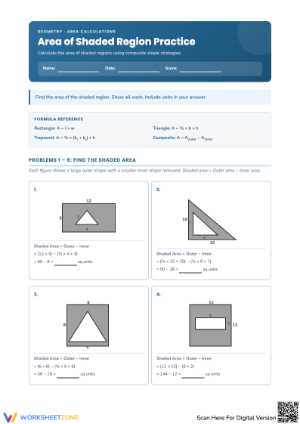
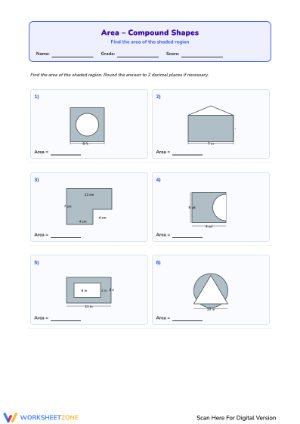
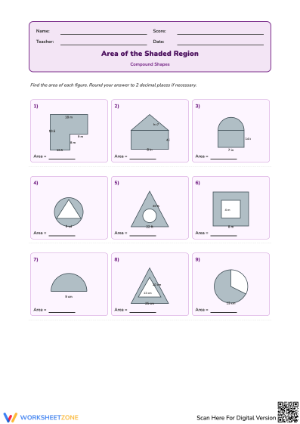
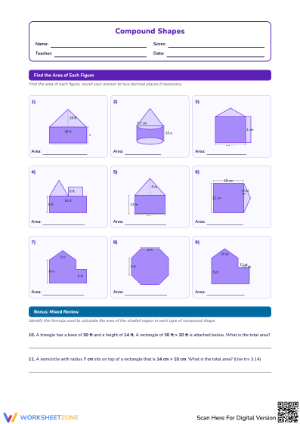
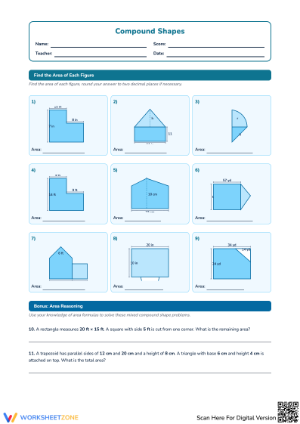
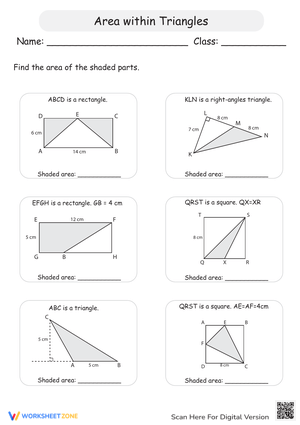
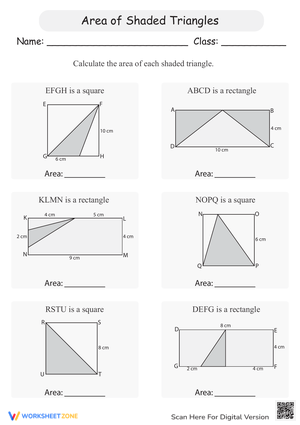
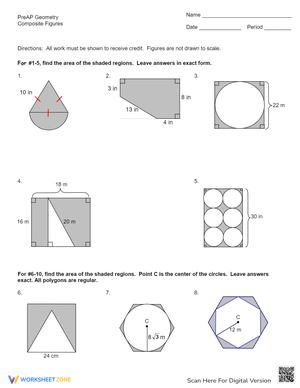
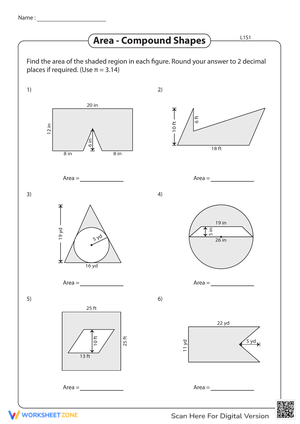
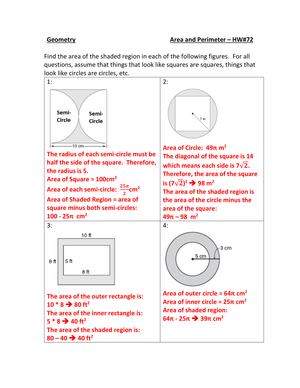
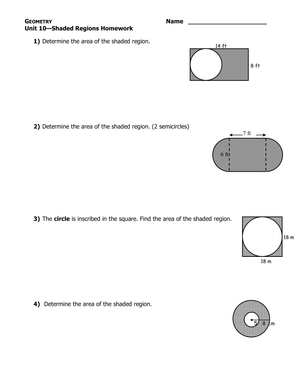
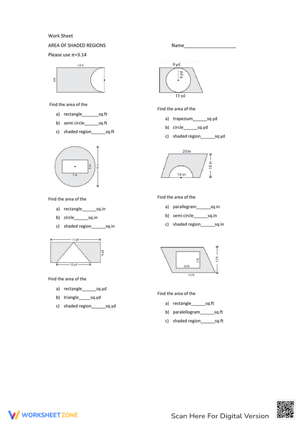
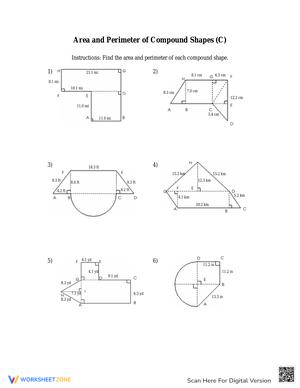
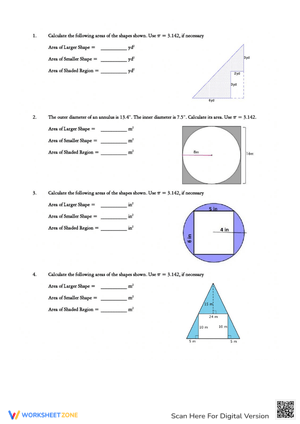
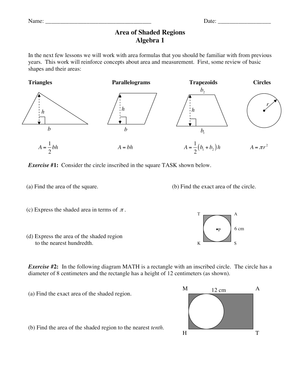
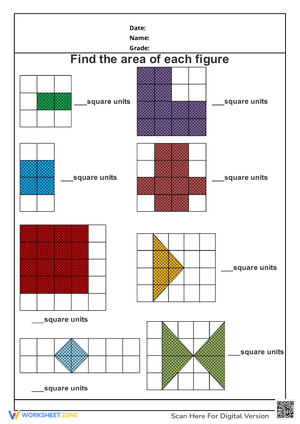
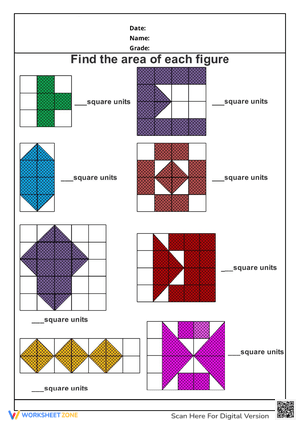
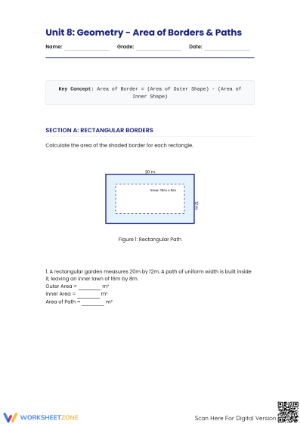
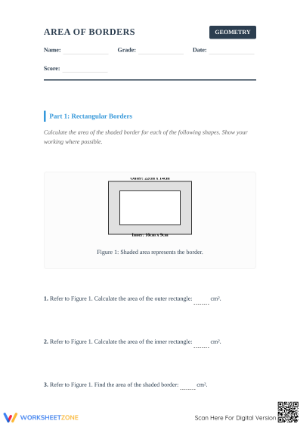
When a student can find the area of a rectangle and the area of a circle but still freezes on a composite figure, the gap usually is not a formula problem. It is a planning problem. Find the area of the shaded region worksheets ask students to hold two shapes in mind at once, decide which one is bigger, and subtract in the right order. For teachers building geometry units in grades 6 through 8, this skill sits at the exact spot where basic area formulas turn into real problem solving.
The Three-Step Subtraction Method
Teachers can frame this as a repeatable three-step routine that students write at the top of their paper before starting any shaded region set.
- Step 1: Identify and calculate the area of the larger, outer shape.
- Step 2: Identify and calculate the area of the smaller, unshaded inner shape.
- Step 3: Subtract the inner area from the outer area to get the shaded area.
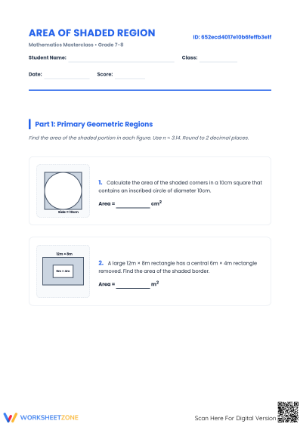
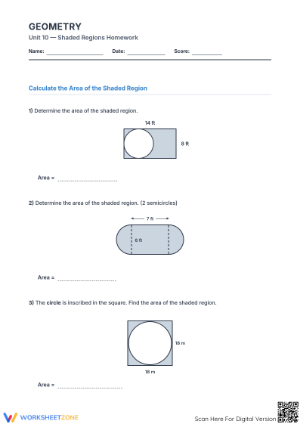
Consider a worked example: a square with a 10-inch side has a circle with a 5-inch radius inscribed inside it, and the region outside the circle but inside the square is shaded. The square's area is 10 times 10, or 100 square inches. The circle's area is pi times radius squared, or roughly 78.5 square inches using pi as 3.14. Subtracting gives a shaded area of about 21.5 square inches. Writing this out step by step, with labeled formulas at each stage, gives students a template they can reapply to triangle-in-rectangle or trapezoid-in-trapezoid versions of the same task.
The subtraction method is not just a shortcut; it is the same reasoning that underlies the area formulas for annuli, washers, and composite regions that students will meet again in high school geometry and eventually in calculus-based area-between-curves problems. Introducing it cleanly in grade 6 or 7, using concrete shapes like circles and squares, gives students a mental model they can extend for years rather than a one-time worksheet trick.
How the Skill Builds Across Grades 6-8
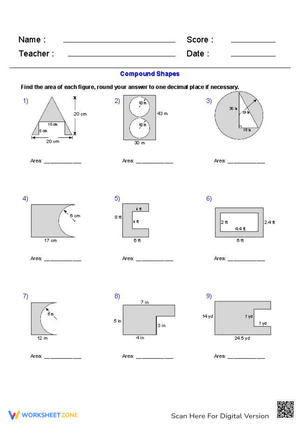
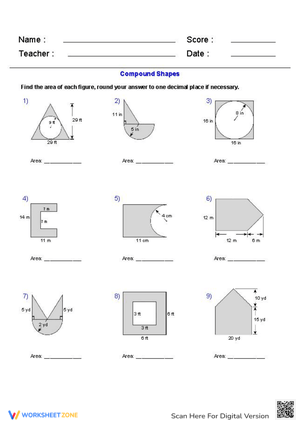
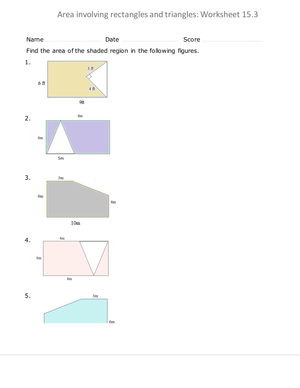
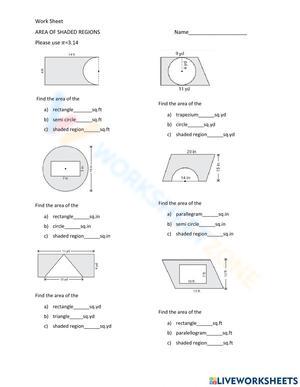
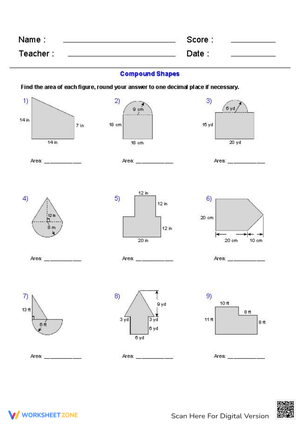
Shaded region worksheets are not a single-grade skill; they scale in complexity across the middle grades. In grade 6, problems typically involve composite polygons, such as a triangle removed from a rectangle or a smaller square removed from a larger one, aligning to CCSS 6.G.A.1, which covers finding the area of triangles, quadrilaterals, and other polygons by composing and decomposing shapes. By grade 7, circles enter the mix, and problems ask students to apply circle area formulas alongside polygon formulas, connecting to CCSS 7.G.B.4 for circle area and circumference and CCSS 7.G.B.6 for the area and volume of composite figures involving triangles, quadrilaterals, and polygons. Some grade 7-8 worksheet sets extend further into circle sectors, which requires calculating a fractional part of a circle's area using the sector angle before subtracting it from or adding it to another shape.
This progression means the same worksheet format, find the area of the shaded region, can serve as an on-grade assignment in grade 6 and a spiral review or extension task in grades 7 and 8. Worksheetzone hosts a grade-8-labeled version of this exact worksheet topic, which reflects how commonly this format gets reused as review material once students have circle formulas under their belt.
Common Student Errors to Watch For
A few mistakes show up repeatedly on shaded region worksheets, and naming them ahead of time helps students self-correct.
- Adding the two areas instead of subtracting, especially when the shapes are drawn overlapping rather than clearly nested.
- Using the diameter where the radius is required in the circle area formula, which produces an area four times too large.
- Forgetting to convert a sector's central angle into a fraction of 360 degrees before applying it to the full circle area.
- Mislabeling which shape is the outer shape when two similar-looking figures overlap in the diagram.
Reviewing two or three problems as a class, with students narrating out loud which shape is outer and which is inner before any calculation begins, tends to reduce these errors faster than reteaching the formulas themselves.
Classroom Implementation
These worksheets fit naturally into several classroom routines. For small-group intervention, pull students who already know individual area formulas but stumble on multi-step problems, and have them work through three or four shaded region items with the three-step method written out each time. For enrichment, hand advanced students the sector-based problems, which require one extra formula step and reward students who are ready for a challenge beyond straightforward polygon subtraction. As a warm-up or spiral review, a single shaded region problem at the start of class keeps circle and polygon area formulas active in students' memory between formal geometry units. As a formative check, a two-problem exit ticket, one polygon-based and one circle-based, gives a fast read on whether students have internalized the subtraction method or are still guessing at whether to add or subtract.
Frequently Asked Questions
1. What grade level are shaded-region area worksheets appropriate for?
They work well across grades 6 through 8. Grade 6 versions typically use polygon-only combinations, while grade 7 and 8 versions add circles and, in some sets, circle sectors, making the format flexible enough for on-grade instruction or review.
2. What is the best method for teaching students to find the area of a shaded region?
The three-step subtraction method works reliably: calculate the outer shape's area, calculate the inner shape's area, then subtract the inner area from the outer area. Practicing this explicit sequence reduces the common error of adding the two areas instead.
3. Which standards do shaded-region area problems align to?
Polygon-based versions align to CCSS 6.G.A.1, which covers finding area by composing and decomposing shapes. Circle-based versions align to CCSS 7.G.B.4 for circle area and circumference, and CCSS 7.G.B.6 for the area of composite figures involving polygons.
4. What shape combinations commonly appear in these worksheets?
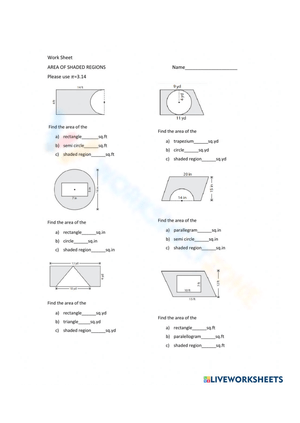
Frequent pairings include a circle inscribed in a square, a triangle removed from a rectangle, and overlapping parallelograms or trapezoids. More advanced sets include circle sectors layered with polygons.
5. How can teachers use these worksheets for intervention versus enrichment?
For intervention, pair students who already know individual area formulas with guided practice on the three-step subtraction routine. For enrichment, assign sector-based problems, which require an extra formula step and suit students ready to extend beyond basic polygon subtraction.