


























Views
Downloads

Combining Like Terms Worksheet | Grade 7 Essential
Paste this activity's link or code into your existing LMS (Google Classroom, Canvas, Teams, Schoology, Moodle, etc.).
Students can open and work on the activity right away, with no student login required.
You'll still be able to track student progress and results from your teacher account.
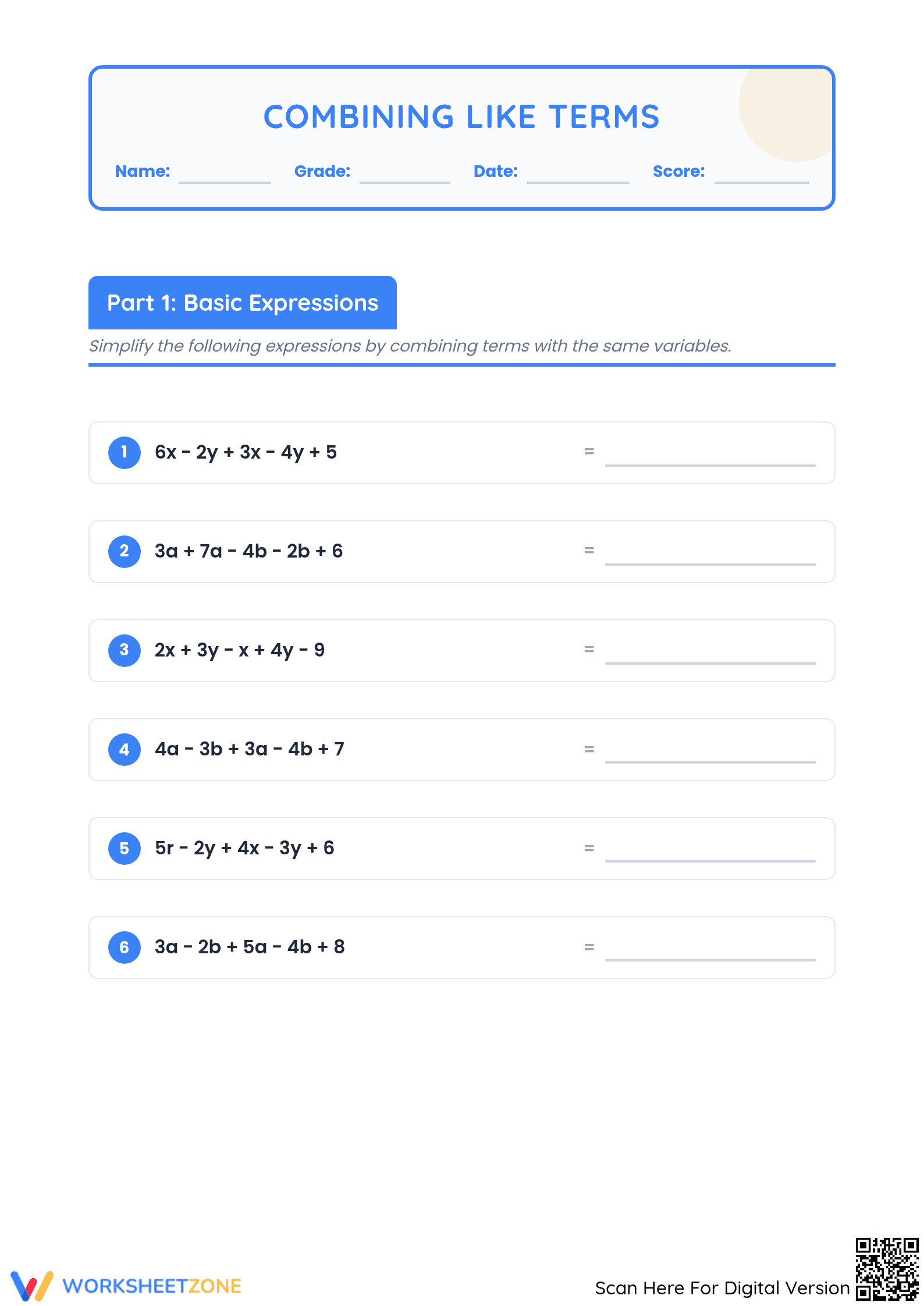
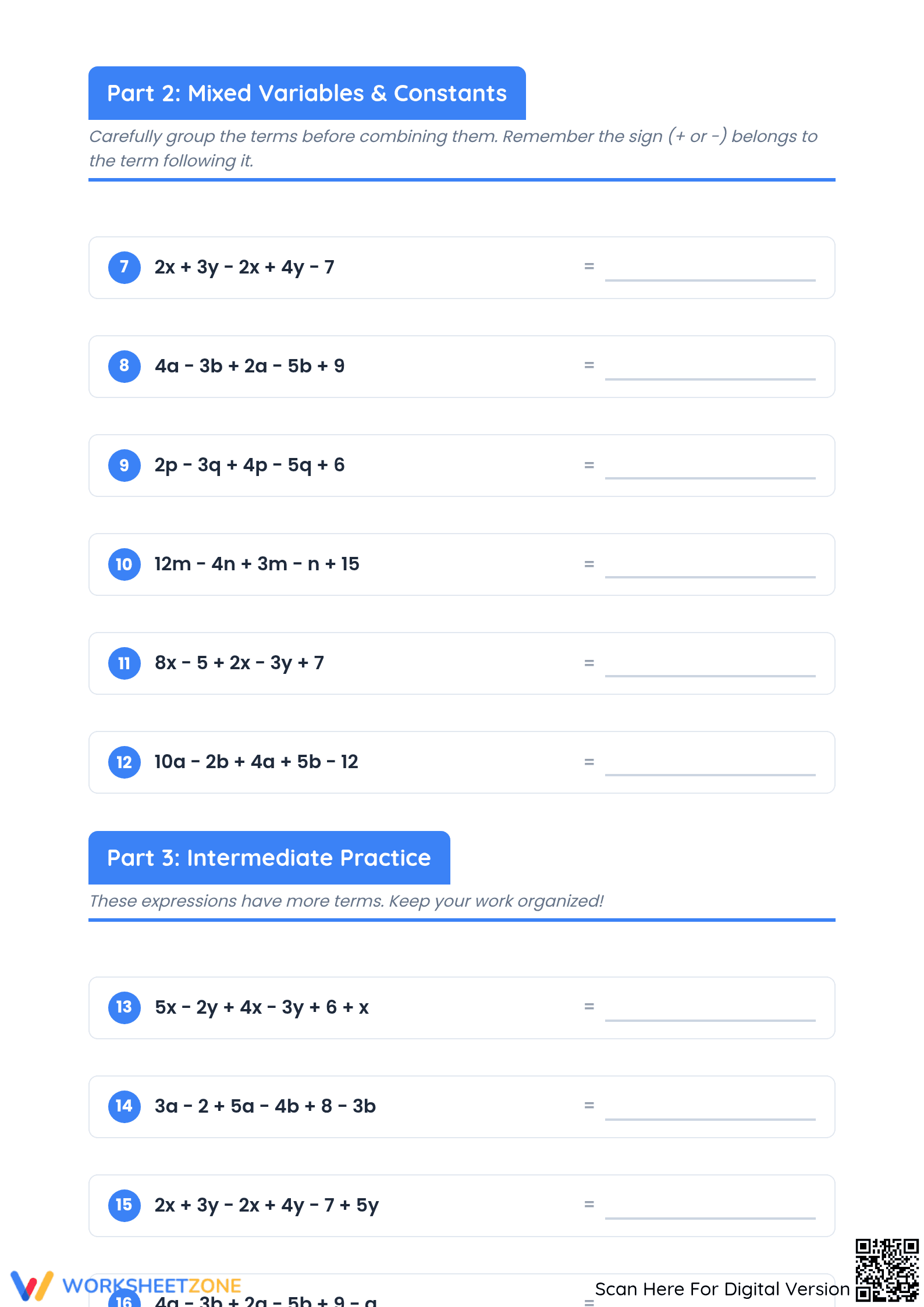
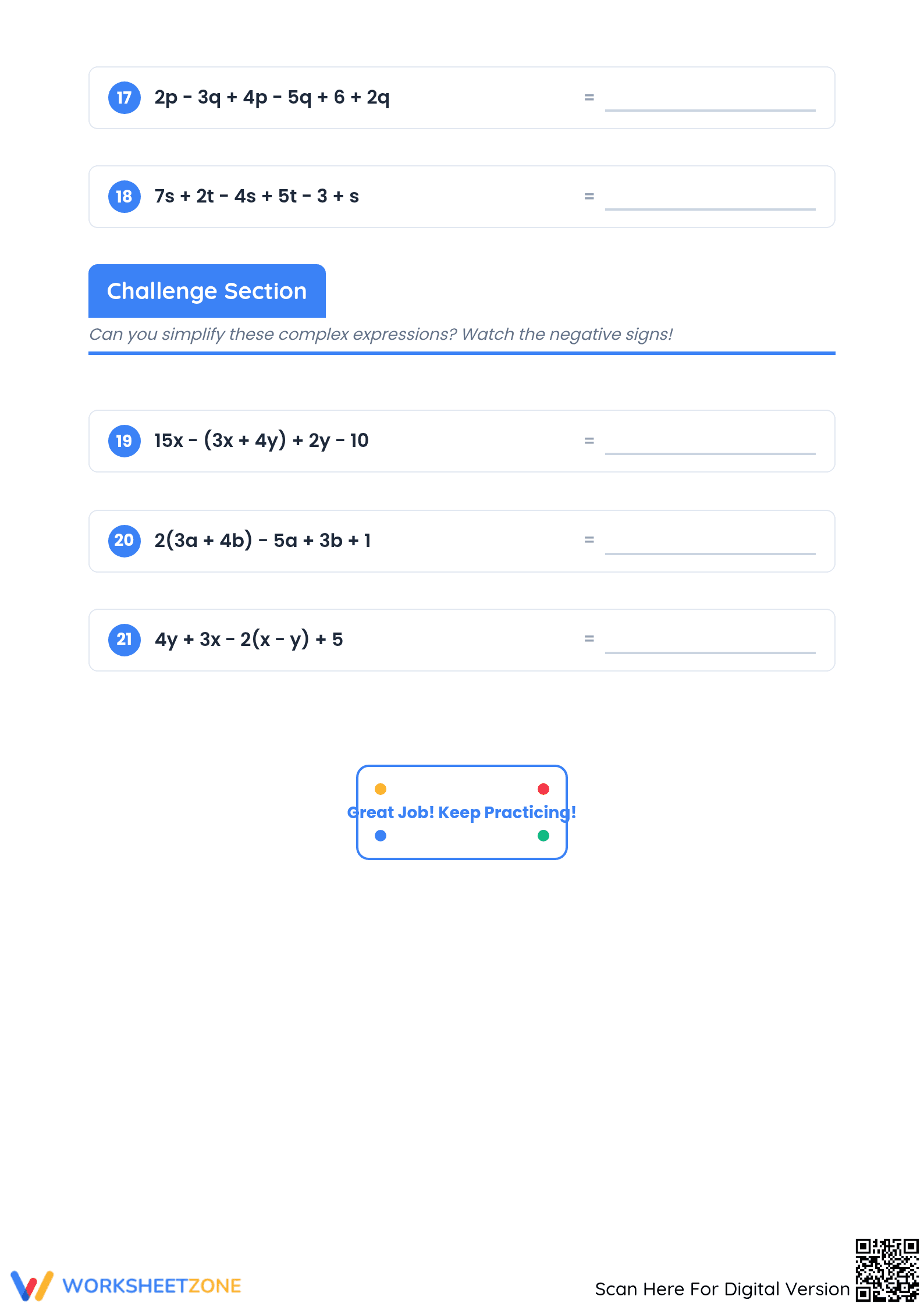
This Grade 7 algebraic expressions worksheet helps students master the fundamental skill of combining like terms. By simplifying 21 structured problems, learners develop the fluency needed to solve complex equations. The resource moves from basic variable grouping to challenging distributive property applications, ensuring students achieve mastery through a logical, scaffolded progression of mathematical tasks.
At a Glance
- Grade: 7 · Subject: Math
- Standard:
CCSS.MATH.CONTENT.7.EE.A.1— Apply properties of operations to add and subtract linear expressions with rational coefficients- Skill Focus: Combining Like Terms
- Format: 3 pages · 21 problems · Answer key included · PDF
- Best For: Independent practice or sub plans
- Time: 30–45 minutes
What's Inside
This 3-page PDF features 21 problems across four sections. Part 1 covers basic variables. Part 2 introduces mixed constants. Part 3 provides intermediate practice with longer expressions. The Challenge Section uses parentheses and negative signs to test mastery. A complete answer key is included for rapid grading and immediate student feedback.
Zero-Prep Workflow
- Print (1 minute): Select the practice pages and answer key for your class size.
- Distribute (1 minute): Hand out as a warm-up, main activity, or homework assignment.
- Review (5 minutes): Use the key for whole-class review or student self-correction.
Total teacher prep time is under 2 minutes, making this ideal for busy classrooms or emergency sub plans.
Standards Alignment
This resource is aligned to CCSS.MATH.CONTENT.7.EE.A.1, which requires students to apply properties of operations as strategies to add, subtract, factor, and expand linear expressions. It also supports 6.EE.A.3 by generating equivalent expressions through variable grouping. Both standard codes can be copied directly into lesson plans, IEP goals, or district curriculum mapping tools.
How to Use It
Use this worksheet during the "You Do" phase of a gradual release lesson on algebraic simplification. It serves as an excellent formative assessment tool; observe students during Part 2 to see if they correctly associate the sign (+ or -) with the term following it. Expected completion time ranges from 30 minutes for proficient students to 45 minutes for those requiring more support.
Who It's For
This resource is designed for general education 7th-grade math students, but it is also highly effective for 8th-grade review or 6th-grade accelerated learners. It pairs naturally with an anchor chart demonstrating "like" vs. "unlike" terms or a direct instruction lesson on the commutative property of addition.
The ability to simplify expressions by combining like terms is a critical prerequisite for algebraic success. This worksheet aligns with CCSS.MATH.CONTENT.7.EE.A.1, focusing on the plain-English skill of adding and subtracting linear expressions to create equivalent forms. According to the RAND AIRS 2024 report, structured practice that transitions from basic variable identification to complex multi-step simplification significantly improves student retention of algebraic properties. By providing 21 problems that increase in complexity, this resource ensures students move beyond rote memorization toward procedural fluency. Research from Fisher & Frey (2014) emphasizes that scaffolded independent practice is essential for the gradual release of responsibility, allowing teachers to identify misconceptions in variable grouping before moving to equation solving. This PDF provides the necessary repetition and challenge to bridge the gap between arithmetic and formal algebra, making it a reliable tool for middle school mathematics instruction and assessment.


