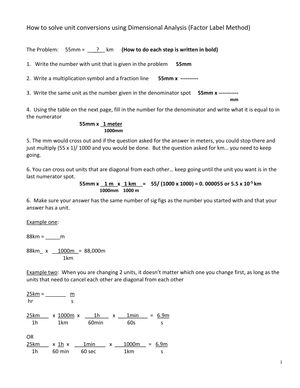
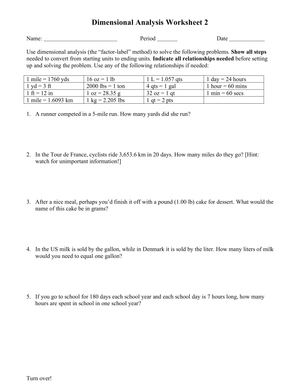
Unit conversion and dimensional analysis get lumped together, but the factor-label method asks students to reason about which unit goes in the numerator and which goes in the denominator before they ever touch a calculator. A worksheet built around this method forces students to write out the conversion factor, check that units cancel diagonally, and only then compute. That sequencing is what separates a student who can convert 12 feet to inches from one who can chain three conversion factors to find a rate in a different unit system.
Where This Fits in the Math Standards
CCSS 6.RP.A.3.d asks sixth graders to use ratio reasoning to convert measurement units and to manipulate and transform units appropriately when multiplying or dividing quantities. That is the standard most middle school dimensional analysis worksheets are built to serve, and it is worth anchoring your unit plan there rather than treating conversion practice as a filler activity between ratio lessons.
The jump from 6.RP.A.3.d to high school work is more of a jump than it looks on paper. CCSS HSN-Q.A.1 expects students to use units to guide problem solving in multi-step contexts, which means a worksheet at this level should include chained conversions and rate problems, not just single-step length or mass conversions. Teachers who skip straight from grade 6 single-step practice to high school multi-step problems often see students who understand the concept but cannot manage the bookkeeping across three or four factors.
Scaffolding From Single-Step to Multi-Step Problems
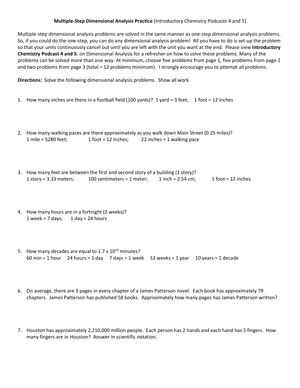
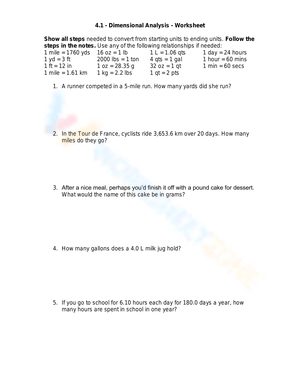
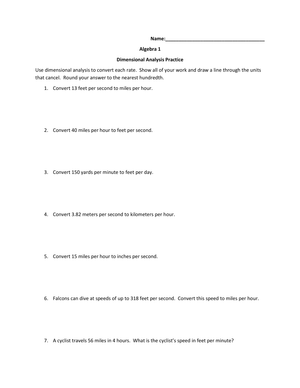
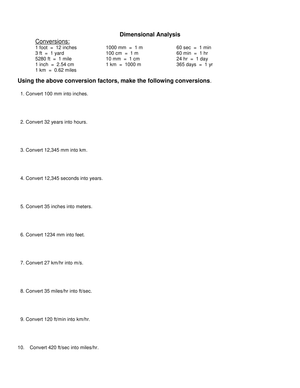
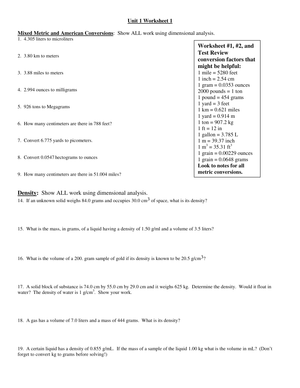
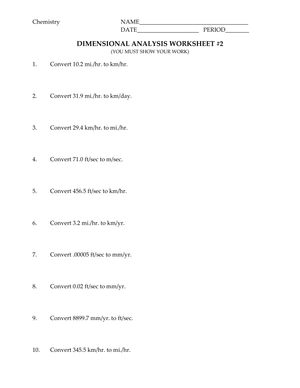
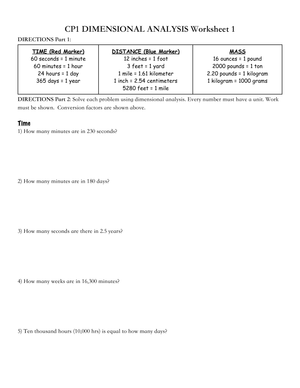
A worksheet sequence that works well in practice starts with same-system, single-step conversions, such as converting minutes to seconds. From there, move to cross-system conversions like miles to kilometers, then to multi-step chains such as converting a speed in miles per hour to feet per second. Each stage should keep the factor-label setup visible so students see the scaffolding rather than jumping to a shortcut formula.
- Stage 1: single-step, same measurement system (grams to kilograms)
- Stage 2: single-step, cross-system with a given conversion factor (liters to gallons)
- Stage 3: two-step chained conversions (minutes to hours to days)
- Stage 4: rate conversions requiring two conversion factors applied at once (speed, density, unit pricing)
Classroom Implementation
Dimensional analysis worksheets work best in short, frequent doses rather than one long practice set. A five-problem warm-up twice a week keeps the factor-label habit active without eating into new content time. Error-analysis tasks are especially effective here: give students a worked problem where a unit was flipped in the wrong direction, and ask them to identify where the setup breaks down before fixing it. This targets the setup step specifically, which is where most errors originate, rather than the final arithmetic.
For small-group intervention, pull students who can compute correctly once units are set up but who struggle to identify which conversion factor to use first. For enrichment, extend fast finishers into real-world rate problems, such as converting a car's fuel efficiency between miles per gallon and kilometers per liter, which requires two conversion factors and a numerator/denominator flip.
Frequently Asked Questions
1. What grade level should introduce dimensional analysis worksheets?
Most math teachers introduce factor-label based unit conversion in grade 6, aligned to CCSS 6.RP.A.3.d, then build toward the multi-step reasoning in CCSS HSN-Q.A.1 during high school algebra and science courses.
2. How do dimensional analysis worksheets align with CCSS 6.RP.A.3.d and HSN-Q.A.1?
6.RP.A.3.d covers using ratio reasoning to convert units and manipulate units during multiplication or division, while HSN-Q.A.1 extends that skill to multi-step problems where units guide the solving process, making the two standards a natural progression across a worksheet sequence.
3. What is the difference between unit conversion and dimensional analysis practice?
Unit conversion practice often focuses on getting the correct numeric answer, while dimensional analysis practice emphasizes the setup: identifying and arranging conversion factors so units cancel correctly before any computation happens.
4. How can teachers use these worksheets to prepare students for chemistry or physics?
Using the same factor-label vocabulary and problem structure that science teachers rely on for stoichiometry and formula-based problems gives students a consistent method they can transfer directly into those courses.
5. What common errors do students make on dimensional analysis problems and how can worksheets target them?
Students frequently flip a conversion factor upside down or lose track of which unit should cancel, and error-analysis style worksheet items that ask students to find and correct a flawed setup target this specific mistake more directly than standard practice problems.