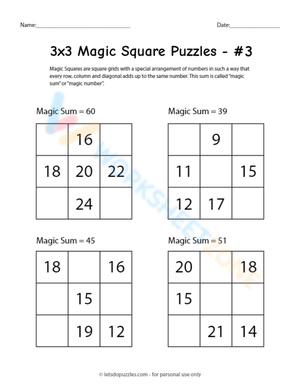
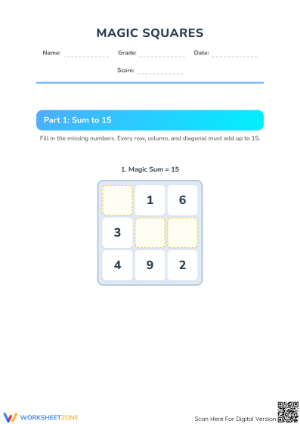
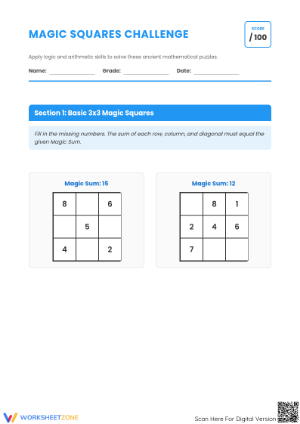
Magic square worksheets turn number practice into a puzzle students actually want to solve. Instead of simply answering a row of addition problems, learners must place numbers carefully so every row, column, and diagonal adds up to the same total. That “magic” total gives the activity a built-in challenge, encouraging students to think, test, revise, and try again. For classrooms, homeschool lessons, or enrichment activities, these worksheets make math feel more like a strategy game than a standard assignment.
The beauty of magic squares is that they combine several skills at once. Students practice addition, number sense, logical reasoning, pattern recognition, and problem-solving without needing a long explanation. A beginner worksheet might include a 3x3 grid with several numbers already filled in. More advanced versions may ask students to complete larger grids, use missing numbers, or work with higher sums. As learners search for the correct placement, they begin to notice relationships between numbers and develop stronger mental math habits.
Magic square worksheets are also great for students who enjoy challenges beyond routine computation. They invite learners to slow down and ask questions: Which number is missing? What row already has enough? Which space affects more than one direction? This type of thinking supports perseverance and flexible problem-solving. Teachers who want to add more puzzle-style practice to math lessons can also explore this collection of math brain teasers for extra activities that keep students curious and engaged.
These worksheets fit easily into many classroom routines. They can be used as warm-ups, early finisher tasks, math centers, homework, enrichment pages, small-group challenges, or quiet independent work. Younger students can use simple magic squares to strengthen basic addition, while older learners can solve more complex grids that require multi-step reasoning. If students need extra support with the foundation behind these puzzles, this addition properties practice set can help reinforce the rules and patterns that make number combinations easier to manage.
Worksheetzone’s magic square worksheets give students a fun way to practice math while building confidence and focus. Each puzzle encourages careful checking because one misplaced number can affect the whole grid. That makes the activity ideal for helping learners develop accuracy, patience, and independent problem-solving habits. Whether used for review, enrichment, or a quick brain workout, magic squares bring a fresh layer of excitement to everyday math practice.
Frequently Asked Questions
Question 1: What are magic square worksheets used for?
Magic square worksheets are used to help students practice addition, number sense, logical thinking, and problem-solving. Students complete grids so each row, column, and diagonal adds up to the same total. This makes the activity both mathematical and puzzle-based.
Question 2: What grade levels are magic square worksheets best for?
These worksheets are useful for upper elementary and middle school students, though simpler versions can support younger learners who are confident with addition. More advanced grids can challenge older students who are ready for enrichment, strategy practice, or math puzzle activities.
Question 3: How do magic squares help improve math skills?
Magic squares strengthen mental math, addition fluency, pattern recognition, and logical reasoning. Students must test number combinations, check totals, and adjust their answers, which helps them build accuracy and persistence while solving problems.
Question 4: How can teachers use magic square worksheets in class?
Teachers can use them as warm-ups, math centers, early finisher activities, homework, enrichment tasks, or group challenges. They are especially helpful when teachers want students to practice computation in a more engaging and thoughtful format.