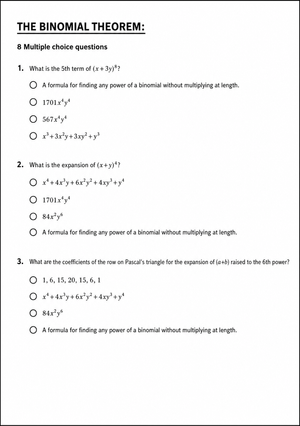
If you searched for binomial theorem worksheets, you are probably standing in front of a Polynomials and Polynomial Functions unit, trying to figure out how to get students from a shaky handle on Pascal's Triangle to confident expansion of expressions like (x+y)^n. This standard shows up late in most Algebra 2 sequences, right when students are already juggling factoring, rational exponents, and function notation. A worksheet set that isolates binomial expansion lets you slow down on just this one skill without derailing the rest of your unit pacing.
Worksheetzone builds these sets for the classroom reality of mixed-readiness Algebra 2 and Precalculus rooms: some students need repeated practice multiplying out (x+y)^3 by hand, while others are ready to jump to the general term formula. Having both levels in one worksheet family means you are not scrambling to build separate practice sets the night before a lesson.
The Standard Behind the Skill: CCSS.HSA.APR.C.5
The binomial theorem is codified as CCSS.Math.Content.HSA.APR.C.5, which asks students to know and apply the theorem for expansion of (x+y)^n for a positive integer n, with coefficients determined by Pascal's Triangle. Worksheets built around this standard should explicitly connect the triangle to the coefficients students are generating, rather than presenting expansion as a memorized shortcut disconnected from where the numbers come from.
One detail that changes how you should schedule this unit: HSA.APR.C.5 is marked with a plus symbol in the Common Core, meaning it is an additional standard intended for students pursuing advanced or STEM-focused coursework rather than a universal high school requirement. That matters for lesson planning because it tells you this is not a topic every Algebra 2 student needs to master to the same depth. You can safely treat binomial theorem worksheets as enrichment or advanced-track material rather than core reteach content for students who are behind on more foundational standards.
Where This Fits in the Algebra 2 and Precalculus Sequence
The theorem is most commonly taught within the Algebra 2 unit on Polynomials and Polynomial Functions, often alongside Pascal's Triangle and combinatorics using nCr notation. If your course sequence puts combinatorics before polynomials, you have an easier on-ramp; if not, expect to spend a day bridging nCr notation before students can make sense of the general term formula. Worksheets that sequence problems from triangle-based expansion to formula-based expansion mirror this natural progression and reduce the number of separate handouts you need to prep.
For Precalculus teachers, binomial theorem worksheets also function as a review tool. Students arriving from Algebra 2 often have inconsistent exposure to this standard because of its plus-standard status, so a short diagnostic set at the start of a Precalculus polynomials review can quickly show you who needs a refresher before you move into series, sequences, or probability topics that assume this fluency.
Scaffolding From Expansion to Specific Terms and Coefficients
Typical worksheet skill progression moves from expanding small binomials by hand, to using Pascal's Triangle for coefficients, to using the general term formula to find a specific coefficient or term without full expansion. This progression matters pedagogically because jumping straight to the term formula without the hand-expansion stage tends to produce students who can plug into a formula but cannot explain what the formula represents.
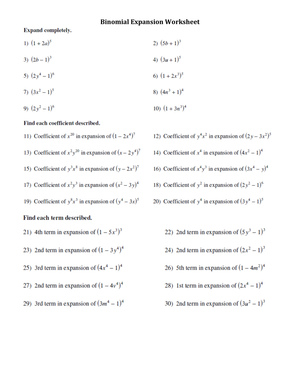
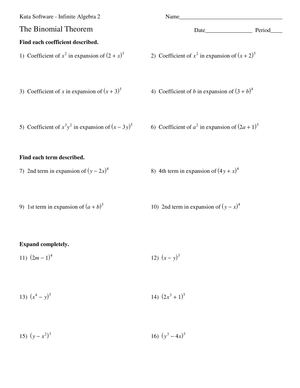
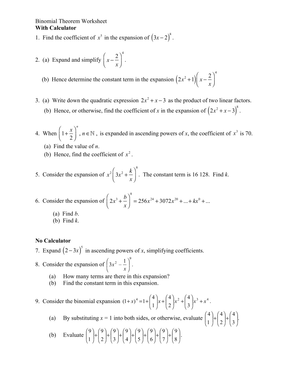
A well-sequenced worksheet set should include at least three problem types: full expansion of low-degree binomials such as (x+y)^4, coefficient identification using Pascal's Triangle rows, and isolated term-finding problems such as identifying the fourth term of (2x-3)^6 using nCr notation. Mixing these types on a single practice sheet, rather than separating them entirely, helps students see how each method connects to the others.
Classroom Implementation
Start a binomial theorem lesson with a Pascal's Triangle warm-up, even if students have seen the triangle before in an earlier unit; this keeps the coefficient-to-triangle connection fresh before students see the formal theorem statement. From there, model one full expansion problem step by step, narrating where each coefficient, exponent, and sign comes from, before releasing students to a worksheet with a similar first problem.
Sequence your assigned problems so students do not encounter a term-finding problem until they have completed at least two or three full expansions correctly. For advanced or STEM-track sections, consider adding an extension problem that asks students to justify why the coefficients match Pascal's Triangle, since the theorem can be proved by mathematical induction or by a combinatorial argument, both of which work well as proof-based extension activities for students who finish early. Save a short answer-key review at the end of class specifically for the term-finding problems, since sign errors and off-by-one term-numbering mistakes are the most common error type on this skill.
Frequently Asked Questions
1. What grade level typically covers the binomial theorem?
It is most commonly taught in Algebra 2, typically grades 10-11, within the Polynomials and Polynomial Functions unit, and is often revisited as review in Precalculus, typically grade 11 or 12.
2. Is the binomial theorem required for all Algebra 2 students or only advanced students?
CCSS.HSA.APR.C.5 is marked with a plus symbol, meaning it is an additional standard intended for students pursuing advanced or STEM-focused coursework rather than a requirement for every Algebra 2 student.
3. How do binomial theorem worksheets connect to Pascal's Triangle practice?
The coefficients in a binomial expansion are the same numbers found in the corresponding row of Pascal's Triangle, so worksheets that pair triangle-building with expansion problems help students see the coefficients are generated by a pattern rather than memorized separately.
4. What prerequisite skills should students have before these worksheets?
Students should be comfortable with exponent rules for combining like terms and with basic combinatorics or nCr notation, since the general term formula relies on both.
5. How can teachers use these worksheets for differentiated or small-group instruction?
Use a quick diagnostic item to sort students by whether their gap is in exponent fluency or in combinatorics, then assign expansion-heavy or term-finding-heavy practice accordingly, saving proof-based extension problems for students who finish core practice early.