


























Views
Downloads
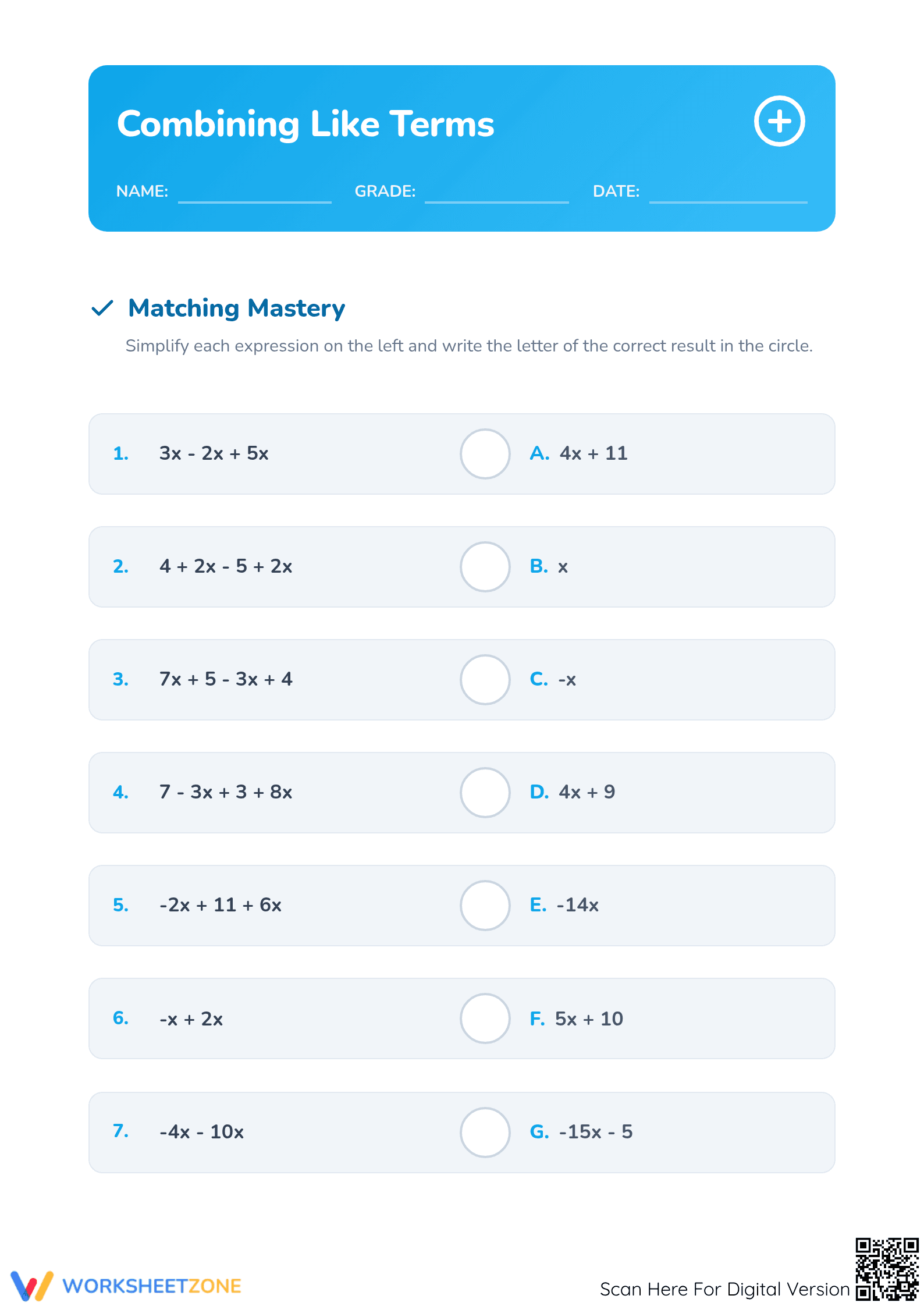


Combining Like Terms Worksheet | Grade 5 Printable
Paste this activity's link or code into your existing LMS (Google Classroom, Canvas, Teams, Schoology, Moodle, etc.).
Students can open and work on the activity right away, with no student login required.
You'll still be able to track student progress and results from your teacher account.
This combining like terms worksheet provides targeted practice for students learning to simplify algebraic expressions. By matching unsimplified expressions with their equivalent simplified forms, students build foundational algebra skills. This resource helps learners recognize like variables and constants, ensuring they can confidently reduce complex expressions to their simplest terms.
At a Glance
- Grade: 5 · Subject: Math
- Standard:
CCSS.MATH.CONTENT.6.EE.A.3— Apply properties of operations to generate equivalent expressions- Skill Focus: Combining Like Terms
- Format: 2 pages · 15 problems · Answer key included · PDF
- Best For: Independent practice and review
- Time: 15–20 minutes
Inside this resource, you will find a two-page matching activity featuring 15 algebraic expressions. Students simplify expressions on the left and write the corresponding letter of the correct answer from the right. The clean layout minimizes distractions. A complete answer key is provided to make grading quick for teachers or to allow for student self-checking.
Skill Progression
- Guided practice: Begin by working through the first few matching problems together as a class, demonstrating how to identify terms with the same variable and combine their coefficients.
- Supported practice: Allow students to work in pairs for the next set of expressions, encouraging them to discuss their reasoning when dealing with negative signs and subtraction.
- Independent practice: Assign the remaining problems on the second page for individual completion to assess mastery of the concept.
This structure perfectly supports a gradual-release, I Do, We Do, You Do instructional model.
Standards Alignment
This worksheet is aligned to primary standard CCSS.MATH.CONTENT.6.EE.A.3: Apply the properties of operations to generate equivalent expressions. While often introduced as an extension in fifth grade, this skill is crucial for middle school math readiness. Students demonstrate this standard by identifying and combining terms with identical variables. Both standard codes can be copied directly into lesson plans, IEP goals, or district curriculum mapping tools.
How to Use It
Use this worksheet as an independent practice assignment following direct instruction on algebraic properties. It also serves as excellent morning work for students needing a quick refresher. As a formative assessment tip, observe whether students correctly carry negative signs when combining subtracted terms, a common error point. The activity takes 15 to 20 minutes to complete.
Who It's For
This resource is primarily designed for fifth-grade students ready for early algebra concepts, as well as sixth-grade students needing standard-aligned practice. To differentiate for learners who need extra support, provide highlighters so they can color-code matching variables before attempting the math. For advanced students, challenge them to write their own complex expressions that simplify to the answers provided in the right-hand column. This worksheet pairs perfectly with an anchor chart detailing the definitions of variables, coefficients, and constants.
Mastering early algebraic concepts requires consistent, targeted repetition to build long-term fluency. According to EdReports 2024, instructional materials that provide explicit opportunities to practice simplifying expressions significantly improve students' transition into advanced middle school mathematics. This worksheet directly supports CCSS.MATH.CONTENT.6.EE.A.3 by requiring learners to apply properties of operations to generate equivalent expressions. By isolating the specific skill of combining like terms, students can focus entirely on the mechanics of variables and coefficients without the added cognitive load of solving full multi-step equations. Structured matching activities like this one offer immediate self-correction opportunities, as students can quickly identify if their simplified answer does not appear in the provided option bank. This targeted approach builds mathematical confidence, reinforces attention to detail with positive and negative signs, and ensures learners are adequately prepared for more complex algebraic reasoning in subsequent grade levels.


