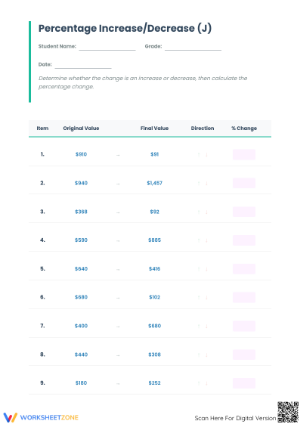
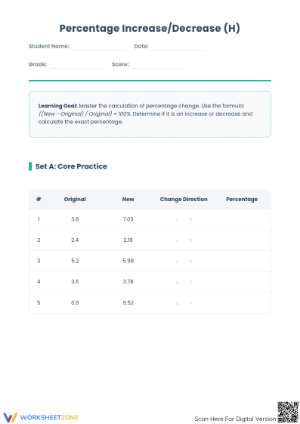
If you teach grade 6, 7, or 8 math, you already know percent change trips up students who otherwise handle basic percent-of-a-number problems just fine. Increasing and decreasing percentages worksheets give students the repeated, scaffolded reps they need to move from calculator guesswork to genuine proportional reasoning. These worksheets work well as a warm-up, a review station, or a small-group intervention tool when a unit test shows students are shaky on percent change specifically.
The searches teachers run for this topic usually come from one of two places: planning a proportional relationships unit, or building review material tied to sales tax, markup, discount, and tip problems that show up on state assessments. A worksheet set that covers both the mechanics and the applied contexts saves you from stitching together multiple resources.
How These Worksheets Align to CCSS 7.RP.A.3
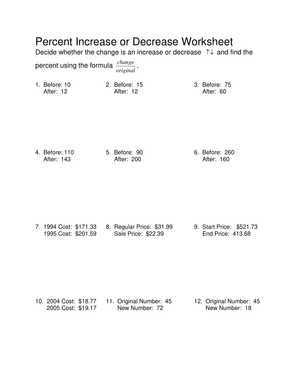
CCSS.Math.Content.7.RP.A.3 requires students to use proportional relationships to solve multistep ratio and percent problems, and it explicitly names percent increase and decrease, markups, markdowns, and simple interest as example contexts. That means a worksheet asking students to find a new price after a 15 percent markdown is not just a nice real-world tie-in; it is directly assessing the standard as written.
Grade 7 Ratios and Proportional Relationships (CCSS.Math.Content.7.RP.A.3) is unusual among percent standards because it names the applied contexts directly in the standard language rather than leaving them to curriculum writers. That specificity is useful for lesson planning: a worksheet built around tax, tip, discount, and markup problems is not a loose real-world add-on, it is assessing the standard as written, which means you can point to student work on these worksheets as direct standards-aligned evidence during a data meeting or IEP progress review.
Because percent change is introduced in grade 6 as a basic percent skill and formalized in grade 7 as part of the Ratios and Proportional Relationships domain, these worksheets also work as a bridge resource. Sixth grade teachers can use simpler versions to preview the skill, and seventh grade teachers can use the same worksheet family to reinforce it once proportional reasoning has been formally taught.
Tiered Practice From Basic Tables to Multistep Word Problems
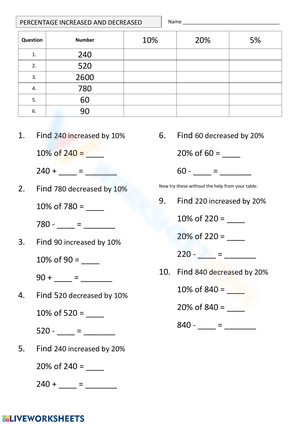
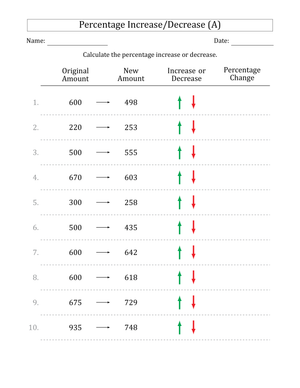
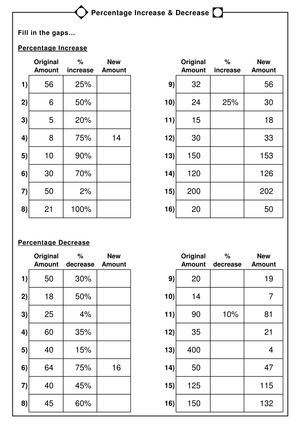
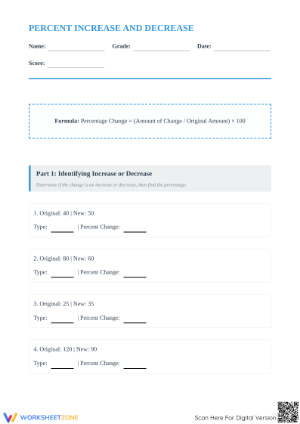
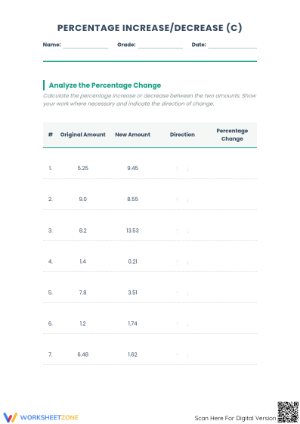
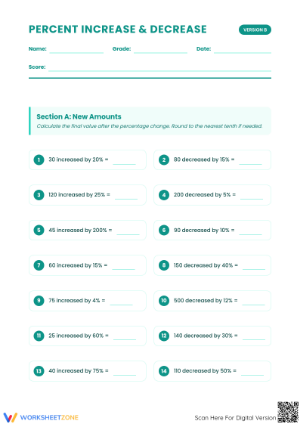
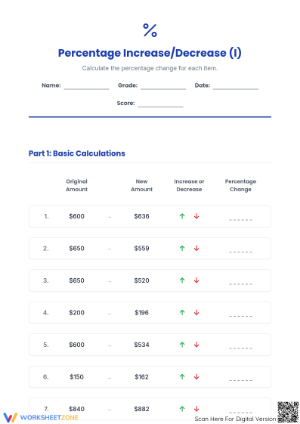
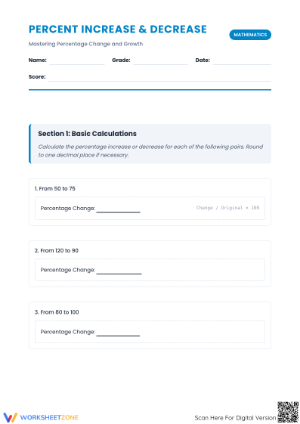
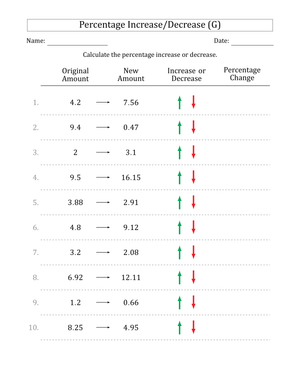
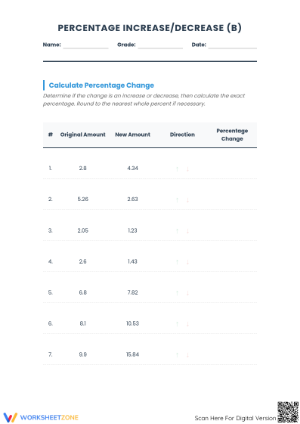
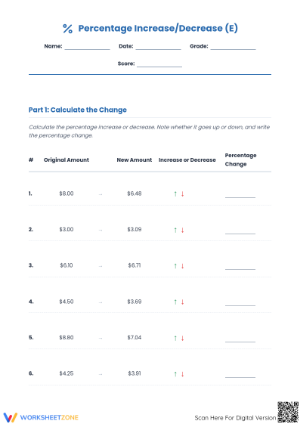
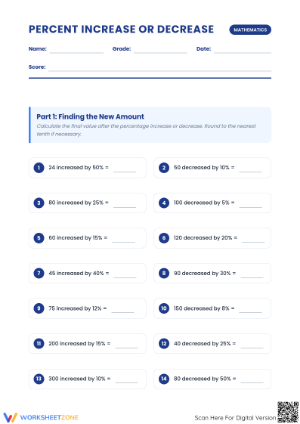
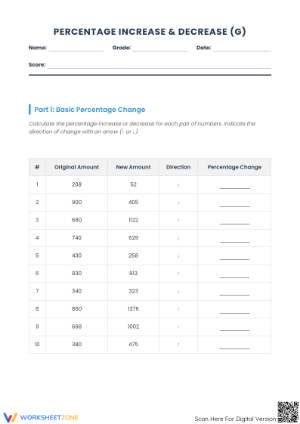
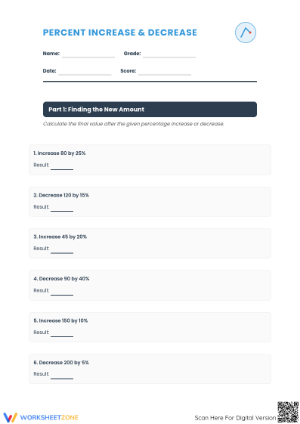
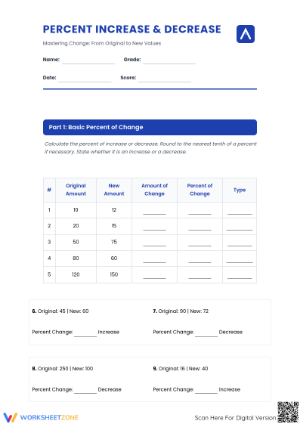
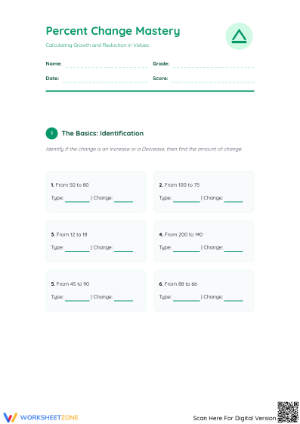
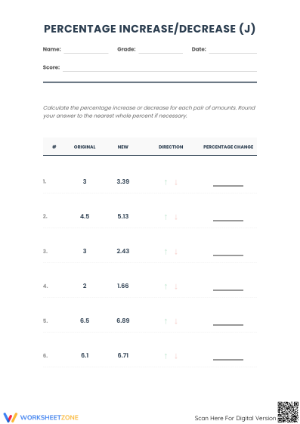
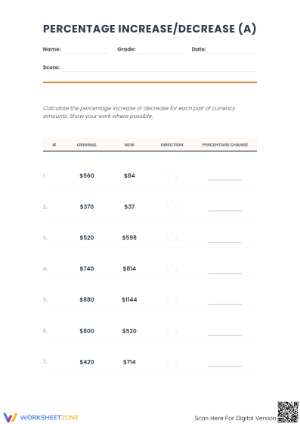
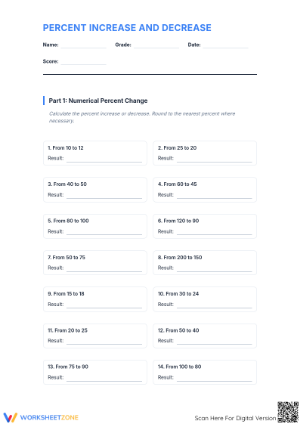
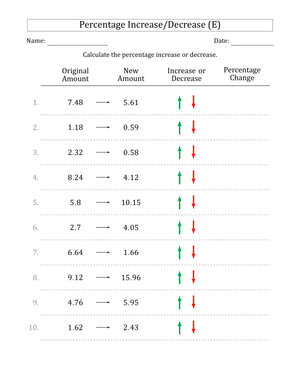
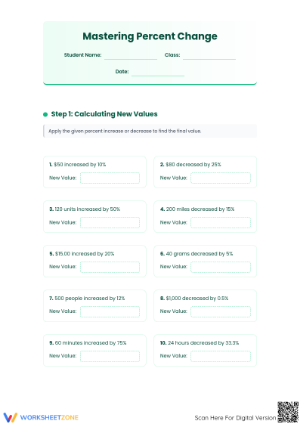
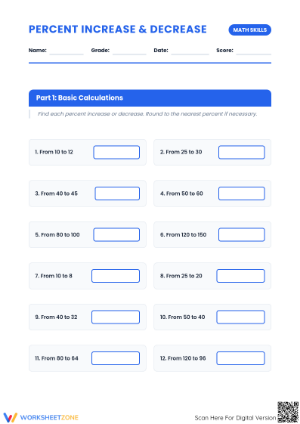
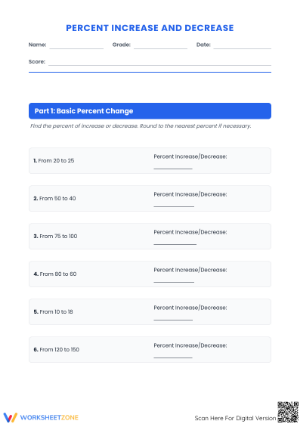
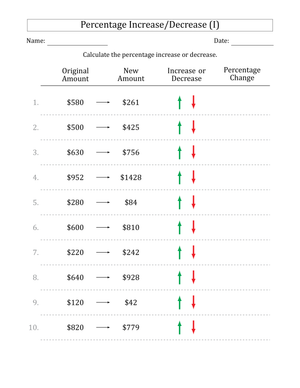
The most useful worksheet sets are built in tiers. Start with straightforward tables: increase 80 by 25 percent, decrease 240 by 10 percent. These isolate the calculation itself so you can quickly spot which students do not yet understand that percent increase means adding a portion of the original amount, not just finding that portion.
Once students are consistent with the basic tables, move to contextual word problems that mirror state test item styles: sales tax on a purchase, a markup a store applies before reselling an item, a tip calculated at a restaurant, or a commission based on total sales. This tiered structure lets you differentiate within a single class period. Students who need more foundational reps stay on the table-style problems while others move into the applied word problems, all without you needing separate lesson plans.
Addressing the Percent-of-a-Number Versus Percent Change Mix-Up
One of the most common misconceptions in this unit is students confusing percent of a number with percent change. A student asked to find 20 percent of 50 will often apply the same thinking to a percent increase problem, calculating 20 percent of the original amount and stopping there instead of adding it back to the original value.
Worksheets that place a percent-of-a-number problem directly next to a percent increase problem using the same numbers can make this distinction visible. When students see 20 percent of 50 equals 10 right next to a 50 increased by 20 percent equals 60 problem, the contrast helps correct the misconception faster than isolated practice on either skill alone.
Should Students Use Calculators for Percent Change Practice
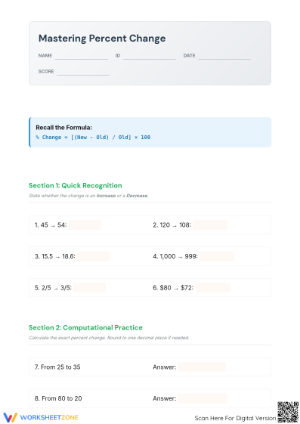
Non-calculator percent change worksheets are commonly used specifically to check whether students understand the underlying proportional relationship rather than just calculator mechanics. If your goal is to assess conceptual understanding, ask students to complete at least one section without a calculator, using friendly numbers like 10 percent, 25 percent, or 50 percent so the arithmetic stays manageable.
Once you have confirmed conceptual understanding, calculator use becomes appropriate for the multistep, real-world word problems where the goal shifts to application and efficiency rather than mental math. This two-phase approach, no calculator first, then calculator for applied problems, gives you a clearer read on where each student actually stands.
Classroom Implementation
To build a full lesson or intervention block around increasing and decreasing percentages worksheets, consider this sequence:
- Open with a five-minute non-calculator warm-up using basic percent increase and decrease tables to check for retention.
- Introduce or review one real-world context per session, such as sales tax one day and discounts the next, rather than mixing all four contexts at once early on.
- Use a side-by-side percent-of-a-number and percent-change problem pair to directly address the common misconception.
- Move to multistep word problems with calculator access once students show consistency on single-step practice.
- Reserve a short small-group station for students who need more reps, using the same worksheet tiers but with additional teacher modeling on the first problem.
For grading or quick progress checks, a five-question non-calculator worksheet works well as an exit ticket. It is short enough to grade between classes and gives you a fast signal about which students are ready to move on to multistep, applied practice.
Frequently Asked Questions
1. What grade level are increasing and decreasing percentages worksheets appropriate for?
These worksheets fit grade 6 through grade 8 math classrooms. Grade 6 teachers can use simpler versions to introduce percent change as an extension of basic percent skills, while grade 7 and 8 teachers can use tiered versions to formally address proportional reasoning and applied percent problems.
2. How do these worksheets align with Common Core standard 7.RP.A.3?
CCSS.Math.Content.7.RP.A.3 explicitly names percent increase and decrease, along with markups, markdowns, and simple interest, as contexts for solving multistep ratio and percent problems using proportional relationships. Worksheets built around these exact contexts directly support this standard.
3. What real-world problem types should be included in percent change practice?
Sales tax, discounts, tips, and markups are the most common and standard-aligned contexts to include. Rotating through these four contexts across a unit gives students broad exposure to how percent change shows up outside the classroom.
4. How can teachers use these worksheets for intervention versus enrichment?
For intervention, start with basic percent change tables and non-calculator practice to isolate the core skill, adding teacher modeling as needed. For enrichment, move directly to multistep, multi-context word problems that require students to apply percent change more than once within a single scenario.
5. Should students use calculators when practicing percent increase and decrease?
Non-calculator practice is useful early in a unit to confirm students understand the underlying proportional relationship rather than relying on calculator mechanics. Once that understanding is established, calculator use is appropriate for multistep, real-world word problems where efficiency matters more than mental math.