


























Views
Downloads

Printable Combining Like Terms Worksheet | Grade 6 Math
Paste this activity's link or code into your existing LMS (Google Classroom, Canvas, Teams, Schoology, Moodle, etc.).
Students can open and work on the activity right away, with no student login required.
You'll still be able to track student progress and results from your teacher account.
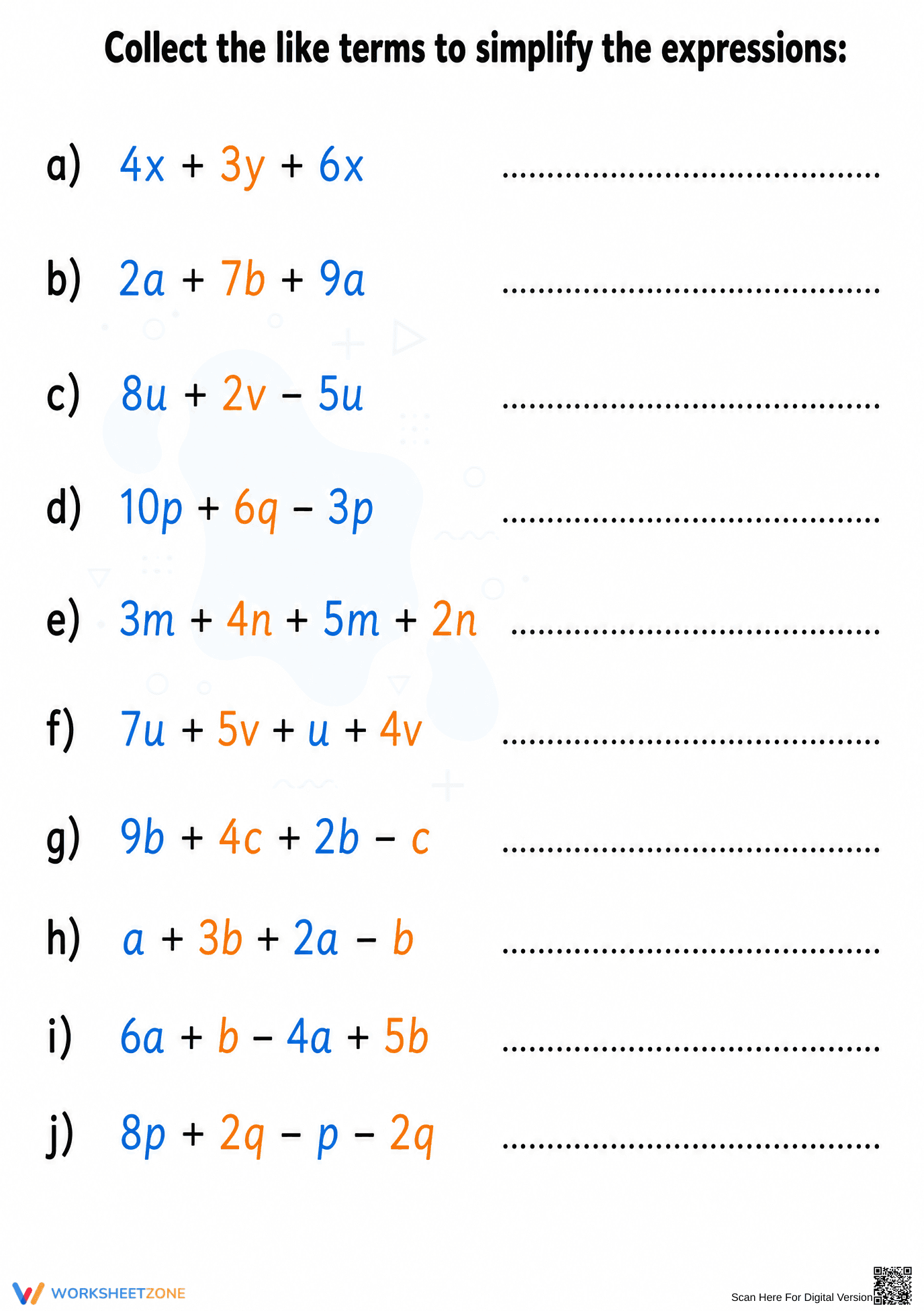
This Grade 6 math worksheet provides targeted practice on simplifying algebraic expressions by combining like terms. Students will identify terms with identical variables and apply basic operations to condense them into their simplest forms, building essential foundational skills for advanced algebra and equation solving.
At a Glance
- Grade: 6 · Subject: Math
- Standard:
CCSS.MATH.CONTENT.6.EE.A.3— Apply properties of operations to generate equivalent expressions- Skill Focus: Combining Like Terms
- Format: 1 page · 10 problems · Answer key included · PDF
- Best For: Independent practice
- Time: 10–15 minutes
Inside this resource, educators will find a single-page assignment featuring ten carefully structured algebraic expressions. Each problem requires students to collect and combine terms with matching variables, such as condensing 4x + 3y + 6x into 10x + 3y. The worksheet includes a mix of addition and subtraction operations across multiple variables, complete with a full answer key for quick grading.
Zero-Prep Workflow
- Print (1 minute): Download the PDF and print copies for your entire class. The clean, black-and-white design saves ink.
- Distribute (1 minute): Hand out the worksheets as a warm-up, homework assignment, or independent practice activity. No additional materials are required.
- Review (3 minutes): Use the included answer key to quickly check student work or display it on the board for self-grading.
Total teacher prep time is under two minutes, making this an excellent option for emergency sub plans or last-minute lesson additions.
Standards Alignment
This resource is directly aligned with CCSS.MATH.CONTENT.6.EE.A.3: Apply the properties of operations to generate equivalent expressions. By combining like terms, students demonstrate their understanding of how variables and coefficients interact within mathematical operations. Both standard codes can be copied directly into lesson plans, IEP goals, or district curriculum mapping tools.
How to Use It
Deploy this worksheet during direct instruction as an immediate application activity. After modeling how to identify and group similar variables, assign these ten problems to gauge initial comprehension. Alternatively, use it as a focused homework assignment to reinforce classroom learning. As a formative assessment tip, observe whether students correctly carry the subtraction sign to the term immediately following it, as this is a common point of error. Expected completion time is 10 to 15 minutes.
Who It's For
This practice sheet is designed for sixth-grade math students and pre-algebra learners who are just beginning to manipulate variables. For students needing differentiation, consider highlighting like terms in matching colors before they begin calculating. It pairs perfectly with an introductory anchor chart on the parts of an expression, including terms, coefficients, and constants.
Mastering the ability to apply properties of operations to generate equivalent expressions is a critical stepping stone in middle school mathematics. According to a 2024 report by EdReports, students who achieve early fluency in simplifying expressions by combining like terms demonstrate significantly higher success rates when transitioning to multi-step equations and linear functions. This targeted practice aligns directly with CCSS.MATH.CONTENT.6.EE.A.3, ensuring learners build the necessary cognitive frameworks for abstract algebraic reasoning. By isolating this specific skill, educators can effectively identify and correct common misconceptions regarding variables, constants, and coefficients before introducing more complex mathematical concepts. Consistent, focused repetition of these core procedures reduces cognitive load, allowing students to tackle advanced problem-solving tasks with greater confidence and accuracy in subsequent grade levels. Providing structured opportunities to practice this foundational skill is essential for long-term mathematical proficiency.


