


























Views
Downloads
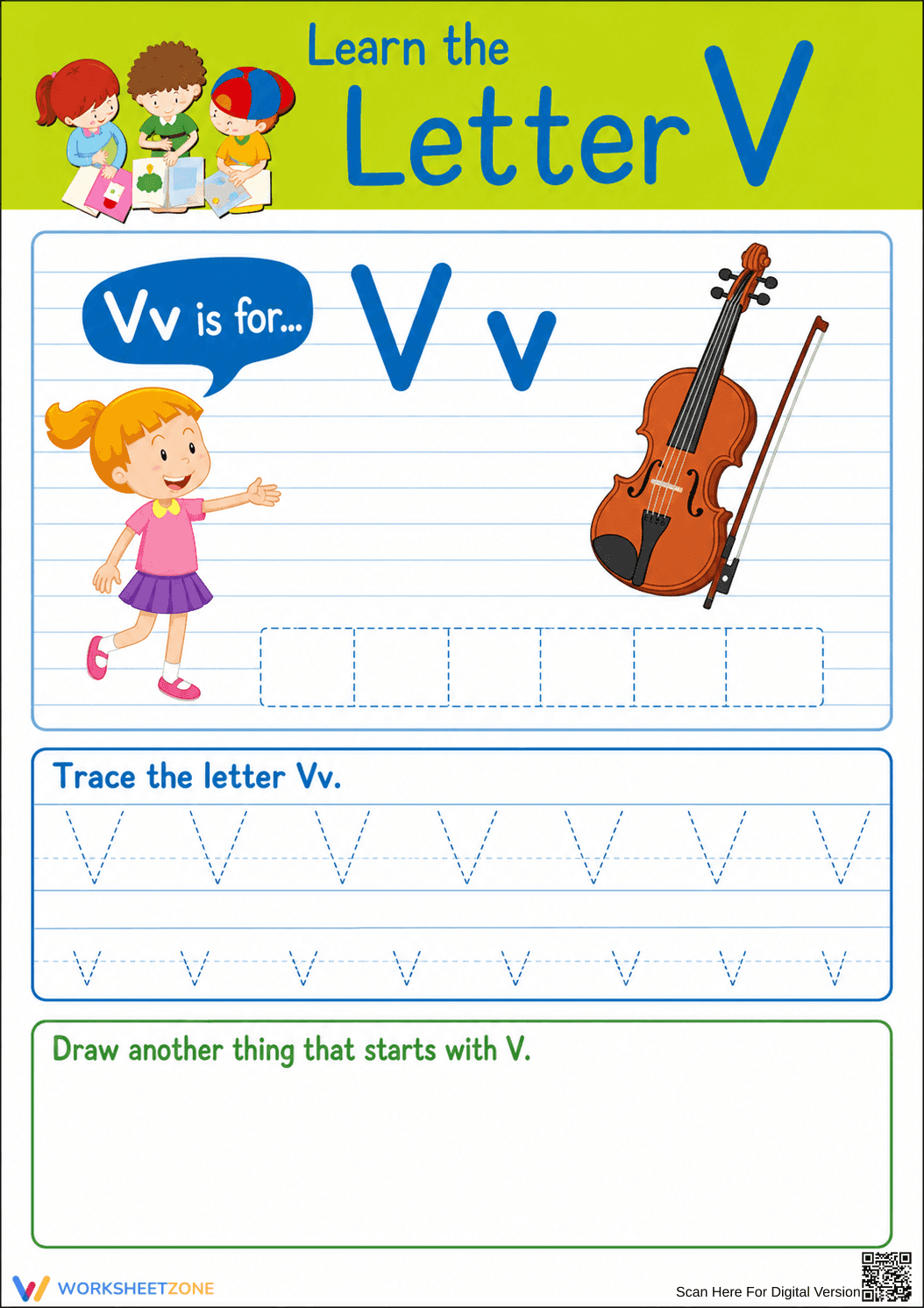

Printable Letter V Beginning Sound Worksheet | Grade K
Paste this activity's link or code into your existing LMS (Google Classroom, Canvas, Teams, Schoology, Moodle, etc.).
Students can open and work on the activity right away, with no student login required.
You'll still be able to track student progress and results from your teacher account.
This foundational phonics worksheet helps early learners master the letter V and its corresponding beginning sound. Students practice letter recognition, handwriting, and phonemic awareness through targeted activities. By tracing uppercase and lowercase letters and identifying vocabulary, children build the essential literacy skills required for reading readiness.
At a Glance
- Grade: K · Subject: ELA
- Standard:
CCSS.ELA-LITERACY.RF.K.3.A— Produce the primary sound for each consonant- Skill Focus: Letter V Beginning Sound
- Format: 1 page · 3 problems · PDF
- Best For: Independent practice
- Time: 10–15 minutes
Inside this single-page resource, educators will find three distinct task types designed to reinforce letter V concepts. The page begins with a visual vocabulary prompt featuring a violin, followed by two dedicated lines for tracing both uppercase and lowercase Vv. Finally, a creative drawing section allows students to illustrate their own word starting with the target letter, reinforcing sound-to-meaning connections without requiring an answer key.
This resource is designed for immediate classroom implementation with a streamlined workflow:
- Print (1 minute): Generate copies directly from the PDF file. The clear layout ensures high-quality black-and-white or color printing.
- Distribute (1 minute): Hand out the single page to students with pencils and crayons. No additional manipulatives or teacher setup are required.
- Review (3 minutes): Quickly check student tracing accuracy and their original drawing for comprehension.
With under two minutes of total teacher prep time, this material serves as an excellent emergency sub plan or quick morning work activity.
This material aligns directly with CCSS.ELA-LITERACY.RF.K.3.A: Demonstrate basic knowledge of one-to-one letter-sound correspondences by producing the primary sound or many of the most frequent sounds for each consonant. It also supports handwriting development by requiring students to print upper- and lowercase letters. Both standard codes can be copied directly into lesson plans, IEP goals, or district curriculum mapping tools.
Teachers can deploy this worksheet during morning arrival as a focused bell-ringer activity to settle students into the literacy block. Alternatively, it functions perfectly as an independent literacy center station following direct instruction on the letter V. While students work, teachers can conduct formative assessments by observing pencil grip during the tracing section and asking students to verbally identify the item they chose to draw in the final box. Expected completion time ranges from ten to fifteen minutes.
This printable is ideal for Kindergarten students, first graders needing foundational phonics review, and early intervention literacy groups. The clear visual cues and structured tracing lines provide built-in differentiation for learners developing fine motor skills. It pairs naturally with a classroom alphabet anchor chart or a read-aloud book heavily featuring the target consonant.
Developing strong phonemic awareness and letter-sound correspondence is a critical predictor of future reading success. According to research from the RAND AIRS 2024 literacy initiative, explicit instruction in phonics, combined with immediate application through writing and drawing, significantly improves early decoding skills. This worksheet directly supports CCSS.ELA-LITERACY.RF.K.3.A by requiring students to produce the primary sound for each consonant. By integrating handwriting practice with vocabulary identification, the activity reinforces the cognitive pathways necessary for fluent reading. The combination of tracing the letter V and generating an original drawing that starts with the same sound ensures that students are not merely copying, but actively applying their phonetic knowledge. This multimodal approach aligns with evidence-based practices for early childhood literacy, providing a structured yet creative outlet for foundational skill development.


