


























Views
Downloads

Printable Letter V Beginning Sound Worksheet | Grade K
Paste this activity's link or code into your existing LMS (Google Classroom, Canvas, Teams, Schoology, Moodle, etc.).
Students can open and work on the activity right away, with no student login required.
You'll still be able to track student progress and results from your teacher account.
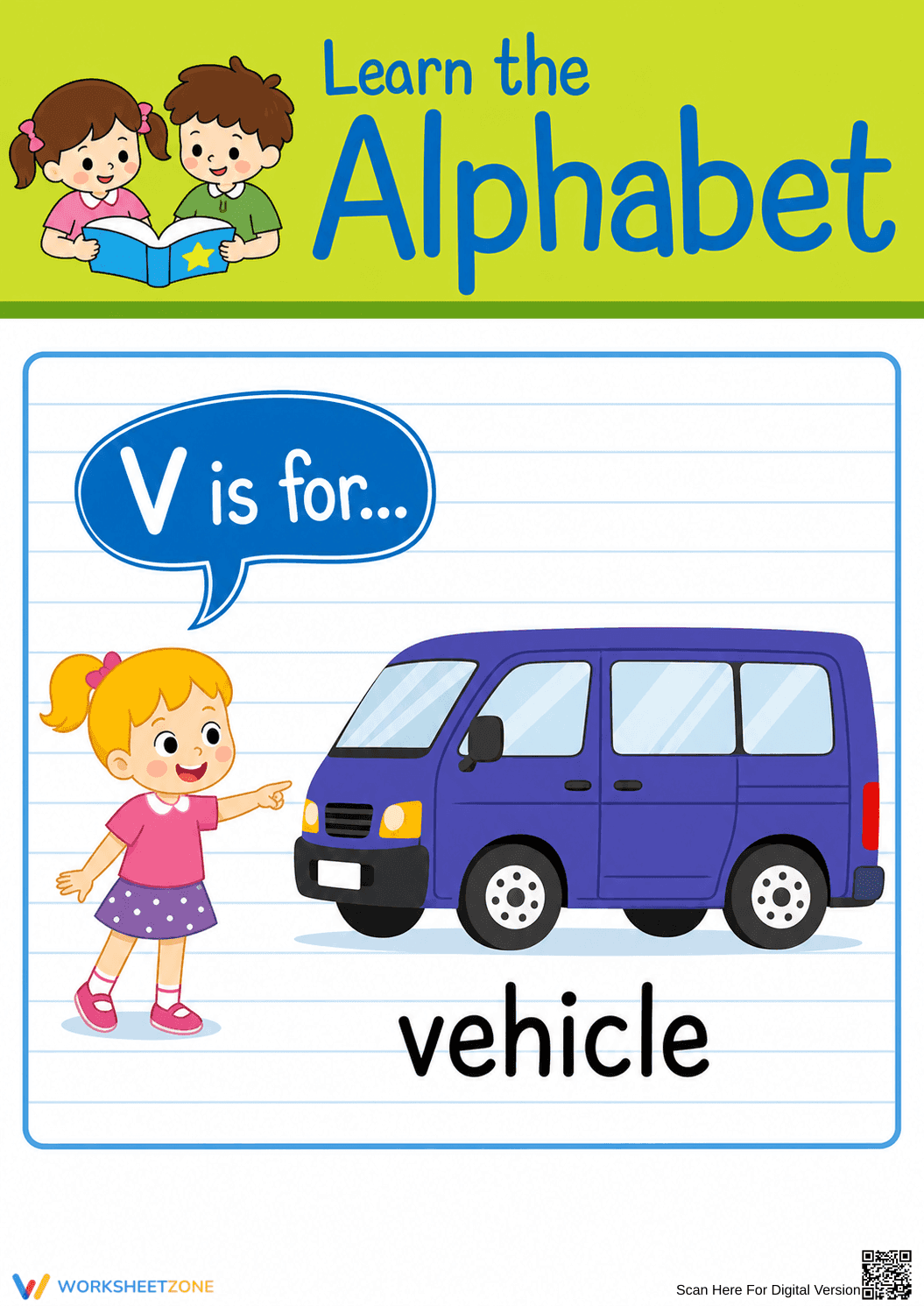
This printable Kindergarten phonics resource helps students master the beginning sound of the letter V. By connecting the visual representation of the letter with a familiar vocabulary word, early readers build foundational phonemic awareness. This single-page visual aid supports letter-sound correspondence, setting the stage for successful decoding and reading fluency.
At a Glance
- Grade: K · Subject: ELA
- Standard:
CCSS.ELA-LITERACY.RF.K.3.A— Produce primary sounds for consonants- Skill Focus: Letter V Beginning Sound
- Format: 1 page · 1 visual task · No answer key needed · PDF
- Best For: Whole group instruction
- Time: 5–10 minutes
Inside this resource, educators will find a single, vibrant page dedicated to the letter V. The layout features a clear, bold uppercase V alongside an engaging illustration of a vehicle. The target word "vehicle" is printed clearly at the bottom, providing a direct text-to-picture connection. This format serves perfectly as a classroom poster, a digital projection slide, or a printable reference sheet for individual student phonics folders.
Zero-Prep Workflow
- Print (1 minute): Simply download the PDF and print in full color for classroom display or black-and-white for student copies.
- Distribute (1 minute): Hand out to students during morning work or project it directly onto your smartboard.
- Review (3 minutes): Guide the class in chorally reading the letter and the corresponding word, emphasizing the initial /v/ sound.
Total teacher preparation time is under two minutes, making this an excellent addition to emergency sub plans or quick phonics mini-lessons.
Standards Alignment
This resource aligns directly with CCSS.ELA-LITERACY.RF.K.3.A: Demonstrate basic knowledge of one-to-one letter-sound correspondences by producing the primary sound or many of the most frequent sounds for each consonant. It also supports early vocabulary acquisition by introducing students to the word "vehicle" in a meaningful context. Both standard codes can be copied directly into lesson plans, IEP goals, or district curriculum mapping tools.
How to Use It
Use this visual aid during the direct instruction phase of your daily phonics block. Introduce the letter V by displaying the page and having students practice the "lip-biting" /v/ sound before saying the word "vehicle." As a formative assessment observation tip, watch students' mouths as they produce the sound to ensure correct articulation. Expected completion time for this introductory activity is 5 to 10 minutes.
Who It's For
This resource is designed primarily for Kindergarten and early Grade 1 students who are developing basic phonemic awareness and letter-sound correspondence. It is highly effective for English Language Learners (ELLs) who benefit from strong visual supports paired with new vocabulary. For a complete lesson, pair this visual with a hands-on letter V sorting activity or a tactile sand-tracing station.
Mastering consonant sounds is a critical milestone in early literacy development. According to Fisher & Frey (2014), explicit instruction in phonics, paired with clear visual models, significantly improves students' ability to decode unfamiliar words. This resource targets CCSS.ELA-LITERACY.RF.K.3.A, requiring students to produce primary sounds for consonants. By isolating the letter V beginning sound and linking it directly to a concrete image of a vehicle, educators reduce cognitive load and facilitate stronger memory retention. Early phonemic awareness activities like this one lay the groundwork for future reading comprehension and spelling proficiency. Consistent exposure to targeted letter-sound relationships ensures that young learners build the automaticity required for fluent reading. This targeted approach aligns with evidence-based practices for foundational literacy instruction in early childhood classrooms.


