


























Views
Downloads

Letter V Beginning Sound Worksheet | Essential Grade K-2
Paste this activity's link or code into your existing LMS (Google Classroom, Canvas, Teams, Schoology, Moodle, etc.).
Students can open and work on the activity right away, with no student login required.
You'll still be able to track student progress and results from your teacher account.
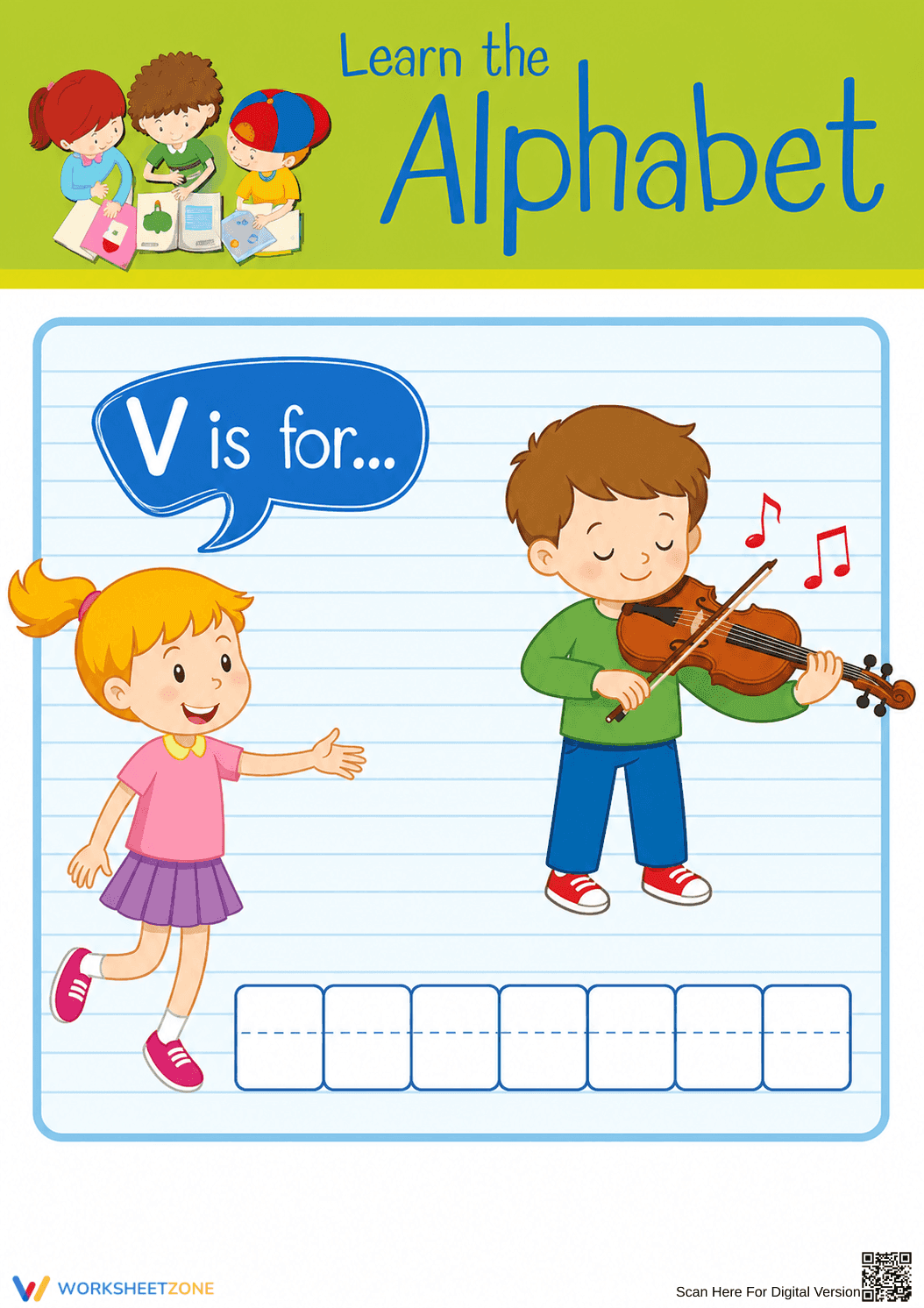
This Letter V beginning sound worksheet helps early learners connect the visual letter V with its specific phoneme through engaging imagery. By identifying the violin and filling in the letter boxes, students build the foundational phonemic awareness necessary for decoding and spelling fluency in primary grades. This resource simplifies complex phonics concepts into a single, manageable task.
At a Glance
- Grade: K-2 · Subject: ELA Phonics
- Standard:
CCSS.ELA-LITERACY.RF.K.3.A— Demonstrate basic knowledge of one-to-one letter-sound correspondences for consonants- Skill Focus: Initial sound /v/ recognition
- Format: 1 page · 1 primary task · Visual cues included · PDF
- Best For: Morning work or phonics centers
- Time: 5–10 minutes
This single-page PDF features a high-quality illustration of a child playing a violin, providing a clear context for the V sound. Below the image, seven individual letter boxes with dashed midlines guide students in writing the word violin, reinforcing both spelling and proper letter formation. The clean layout ensures that young students remain focused on the specific phonemic target without unnecessary distractions.
The worksheet follows a structured skill progression. First, students engage in Guided Practice by identifying the letter V in the speech bubble. Next, Supported Practice occurs as they associate the V sound with the violin graphic. Finally, Independent Practice is achieved when students write the letters into the provided boxes to complete the word, moving from sound recognition to orthographic representation. This gradual release ensures students feel confident at every step.
This resource is aligned with `CCSS.ELA-LITERACY.RF.K.3.A`, which requires students to demonstrate basic knowledge of one-to-one letter-sound correspondences by producing the primary sound for each consonant. It also supports RF.1.2.C by isolating and producing initial sounds in spoken single-syllable words. Both standard codes can be copied directly into lesson plans, IEP goals, or district curriculum mapping tools to ensure instructional compliance.
Use this as a quick formative assessment during your phonics block. After introducing the letter V, have students complete the page to check for sound-symbol association. It also works well as a quiet morning work activity or a literacy center station. Expect students to complete the task in 5 to 10 minutes depending on their fine motor development and familiarity with the instrument depicted.
This worksheet is designed for Kindergarten and Grade 1 students who are beginning their journey into phonics. It is particularly helpful for English Language Learners (ELLs) who benefit from the direct visual-to-word connection. Pair this with a physical violin demonstration or a letter V anchor chart to reinforce the lesson. The large, clear graphics make it accessible for students with diverse learning needs.
Research by Fisher & Frey (2014) emphasizes the importance of the gradual release of responsibility model in early literacy, where visual scaffolding supports the transition from oral language to written text. This worksheet applies those principles by using a familiar object—a violin—to anchor the phonemic concept of the letter V. By providing specific letter boxes, the resource reduces cognitive load, allowing students to focus on the specific phoneme-grapheme mapping required for early reading success. According to NAEP data, students who master these foundational letter-sound correspondences in the early grades are significantly more likely to achieve reading proficiency by the end of third grade. This targeted practice ensures that the initial V sound is internalized through both visual and kinesthetic pathways, creating a robust mental model for future decoding tasks and literacy development.


