


























Views
Downloads

Letter V Beginning Sound Worksheet | Essential Phonics
Paste this activity's link or code into your existing LMS (Google Classroom, Canvas, Teams, Schoology, Moodle, etc.).
Students can open and work on the activity right away, with no student login required.
You'll still be able to track student progress and results from your teacher account.
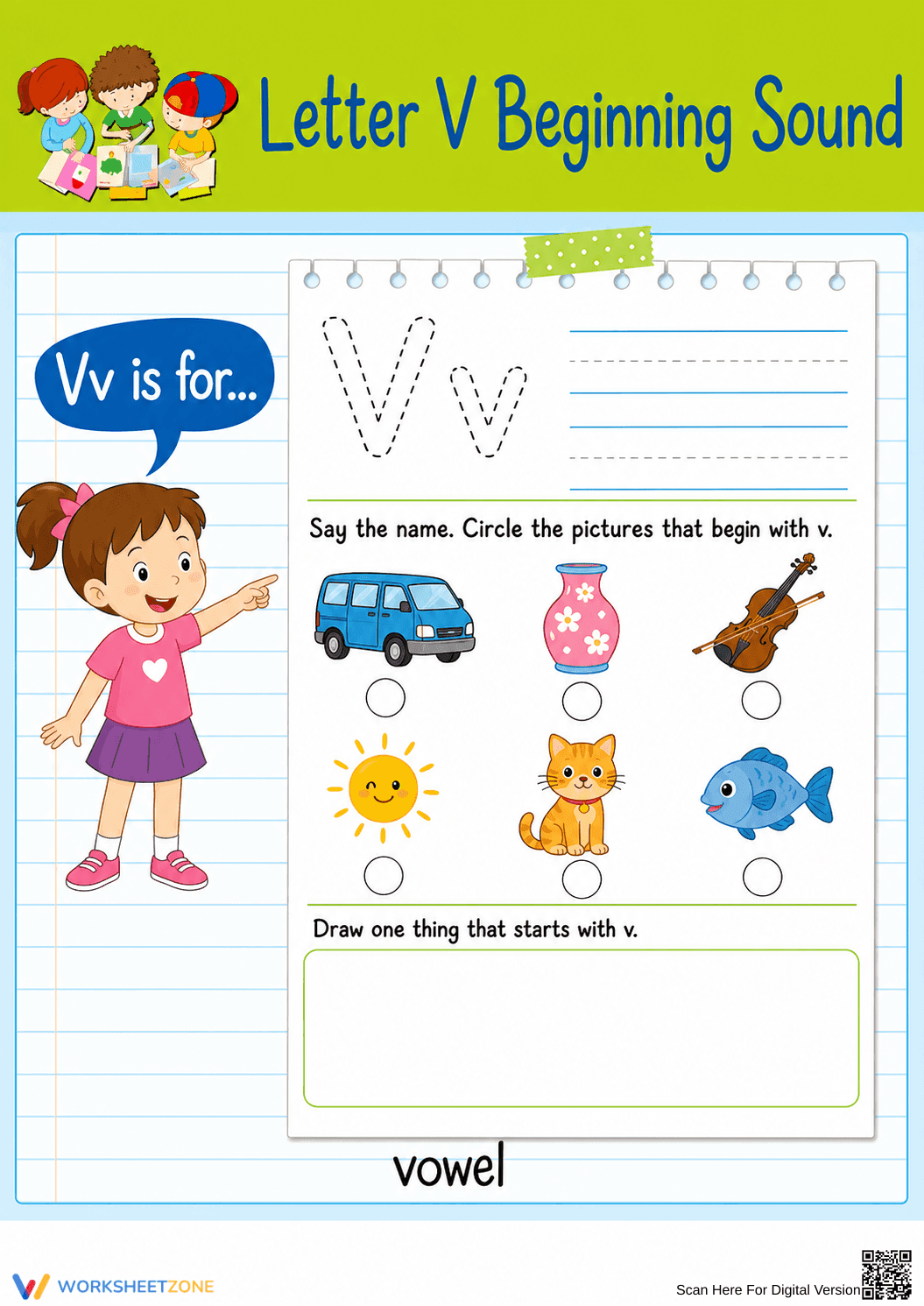
This Letter V beginning sound worksheet helps early learners identify and produce the /v/ sound through multi-sensory engagement. Students practice letter formation, auditory discrimination, and creative expression to solidify their phonemic awareness. By connecting the visual letter shape to its specific sound, children build the foundational skills necessary for fluent reading and writing.
At a Glance
- Grade: Kindergarten · Subject: ELA Phonics
- Standard:
CCSS.ELA-LITERACY.RF.K.3.A— Demonstrate basic knowledge of one-to-one letter-sound correspondences by producing the primary sound.- Skill Focus: Letter V Identification & Sound
- Format: 1 page · 3 tasks · Answer key included · PDF
- Best For: Initial phonics instruction and morning work
- Time: 10–15 minutes
What's Inside: This single-page PDF features three distinct activities designed for young learners. It begins with large-format tracing guides for both uppercase 'V' and lowercase 'v' to support fine motor development. The middle section contains six high-quality illustrations (van, vase, violin, sun, cat, fish) for sound discrimination. Finally, a dedicated drawing space allows students to demonstrate conceptual understanding by illustrating their own 'V' word.
Skill Progression
- Guided Practice: Students follow dashed lines to master the physical mechanics of the letter V, ensuring proper top-to-bottom stroke order.
- Supported Practice: Learners engage in auditory discrimination by circling pictures that start with /v/, requiring them to isolate the target sound from distractors.
- Independent Practice: The final task requires students to retrieve a 'V' word from memory and represent it visually, moving from recognition to production.
This sequence follows the gradual-release model to ensure students build confidence before working independently.
Standards Alignment
This resource is primarily aligned with `CCSS.ELA-LITERACY.RF.K.3.A`, which requires students to demonstrate basic knowledge of one-to-one letter-sound correspondences. It also supports `CCSS.ELA-LITERACY.RF.K.1.D` by reinforcing the recognition and naming of all upper- and lowercase letters of the alphabet. Both standard codes can be copied directly into lesson plans, IEP goals, or district curriculum mapping tools.
How to Use It
Use this worksheet during the "You Do" phase of a phonics lesson after introducing the letter V with an anchor chart. It serves as an excellent formative assessment; observe students during the circling task to see if they can distinguish the /v/ sound in "van" from the /s/ sound in "sun." Completion typically takes 10 to 15 minutes, making it ideal for literacy centers or independent desk work.
Who It's For
This resource is designed for Kindergarten students receiving Tier 1 instruction, though it provides valuable review for Grade 1 students or English Language Learners (ELLs) focusing on initial consonants. It pairs naturally with a "Letter of the Week" curriculum or a specific phonics reader focused on the /v/ sound.
According to the RAND AIRS 2024 report on early literacy, multi-modal phonics instruction that combines tracing, auditory sorting, and drawing significantly improves letter-sound retention in primary grades. This worksheet implements these evidence-based strategies by targeting the CCSS.ELA-LITERACY.RF.K.3.A standard through a structured three-step process. By requiring students to produce the /v/ sound while identifying objects like a van or violin, the activity strengthens the neural pathways between visual graphemes and auditory phonemes. Research from Fisher & Frey (2014) emphasizes that such gradual release models—moving from guided tracing to independent drawing—ensure that students move beyond rote memorization toward functional literacy. This printable resource provides the necessary repetition for mastery while maintaining high engagement for Kindergarten and Grade 1 learners. It is a reliable tool for building the phonemic foundations required for decoding complex texts in later elementary years.


