


























Views
Downloads

Printable Beginning Sounds Worksheet | Preschool Phonics
Paste this activity's link or code into your existing LMS (Google Classroom, Canvas, Teams, Schoology, Moodle, etc.).
Students can open and work on the activity right away, with no student login required.
You'll still be able to track student progress and results from your teacher account.
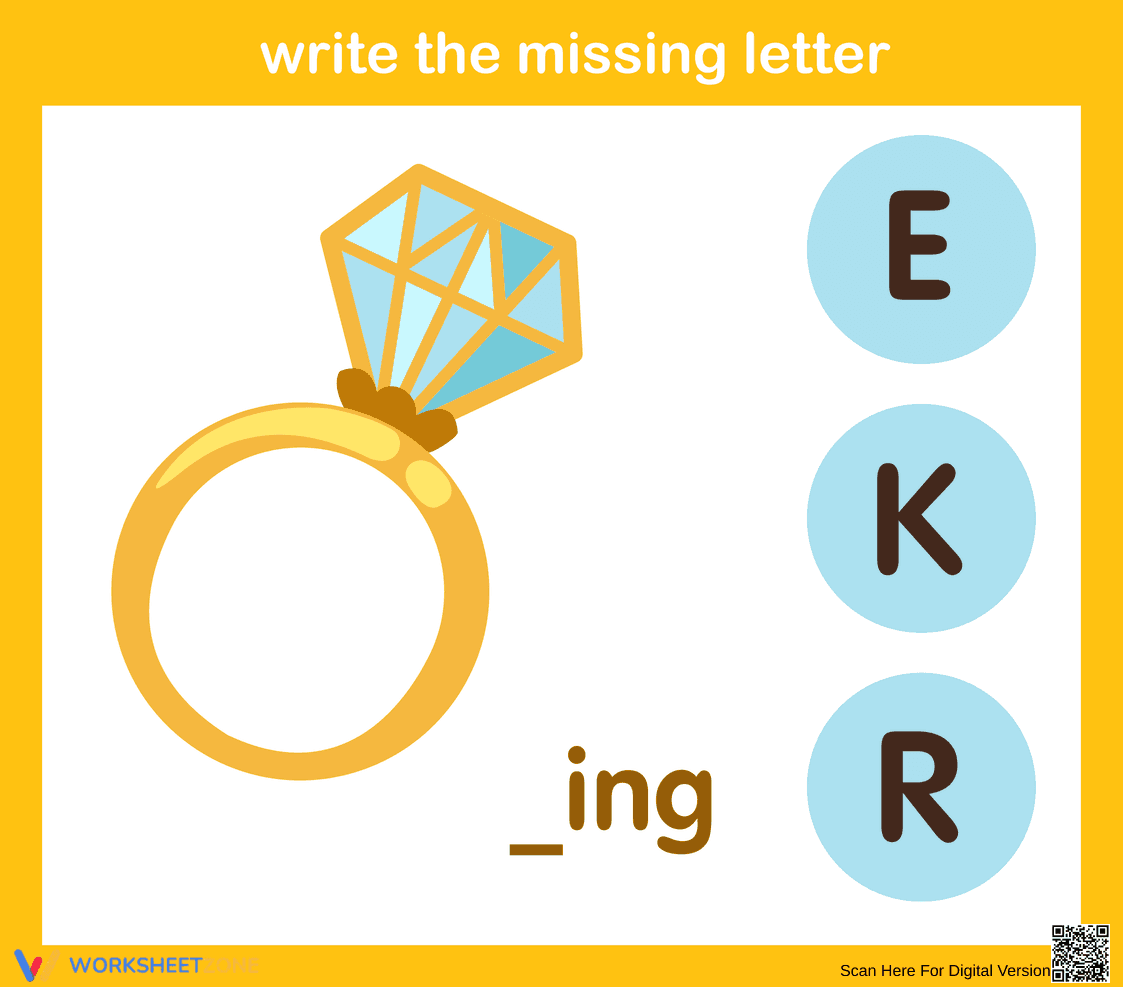
This printable beginning sounds worksheet helps preschool students practice one-to-one letter-sound correspondence by identifying the missing initial consonant for a familiar word. By looking at the visual cue and selecting the correct letter, early learners build essential phonemic awareness and phonics skills required for reading readiness.
At a Glance
- Grade: Preschool · Subject: ELA
- Standard:
CCSS.ELA-LITERACY.RF.K.3— Identify primary sounds for consonants- Skill Focus: Beginning Sounds
- Format: 1 page · 1 problem · PDF
- Best For: Independent practice or centers
- Time: 5–10 minutes
Inside this single-page phonics activity, educators will find a visual, straightforward task for early learners. It features a colorful illustration of a ring alongside the incomplete word "_ing". Students choose from three distinct letters in clear circles. This multiple-choice format provides built-in scaffolding, allowing children to confidently select the correct initial consonant without the pressure of free-hand writing.
Zero-Prep Workflow
- Print (1 minute): Simply download the PDF and print the required number of copies. The bold graphics print clearly in both color and grayscale.
- Distribute (1 minute): Hand out the worksheet during morning work, literacy centers, or as a quick transition activity.
- Review (1 minute): Quickly check student selections to gauge phonemic awareness.
With total teacher prep time under two minutes, this resource is highly effective for busy mornings or substitute teacher plans.
Standards Alignment
This resource aligns with CCSS.ELA-LITERACY.RF.K.3, which requires students to know and apply grade-level phonics and word analysis skills in decoding words, specifically demonstrating basic knowledge of one-to-one letter-sound correspondences. By isolating the initial sound of a familiar object, children practice producing the primary sound for consonants. Both standard codes can be copied directly into lesson plans, IEP goals, or district curriculum mapping tools.
How to Use It
This worksheet is highly versatile for early childhood classrooms. Use it during small group literacy centers after direct instruction on the letter "R", allowing students to apply their new knowledge immediately. Alternatively, it serves as an excellent morning work activity to activate prior knowledge as students settle into the classroom. For formative assessment, observe if students sound out each letter option before selecting. Expected completion time is five to ten minutes.
Who It's For
This activity is primarily designed for preschool and pre-K students who are beginning to explore letter-sound relationships. It also serves as a helpful intervention tool for kindergarten students needing extra reinforcement with initial consonants. For differentiation, teachers can provide physical letter manipulatives for tactile learners to place over the missing space. This worksheet pairs perfectly with a direct instruction lesson on the alphabet or an anchor chart featuring common objects starting with the letter R.
Developing strong phonemic awareness through targeted activities is a critical component of early literacy instruction. This worksheet directly supports CCSS.ELA-LITERACY.RF.K.3 by helping students identify primary sounds for consonants. According to a recent EdReports 2024 analysis of foundational reading programs, explicit practice with one-to-one letter-sound correspondence significantly improves later decoding and reading fluency. When young learners engage with visual cues and isolate beginning sounds, they build the cognitive pathways necessary for orthographic mapping. Providing focused, single-task activities reduces cognitive overload, allowing preschoolers to concentrate entirely on the phonological task at hand. By integrating this evidence-based approach into daily routines, educators can ensure students establish a robust foundation for future reading success. This resource offers a practical, research-backed method for reinforcing essential phonics skills in early childhood settings.


