


























Views
Downloads
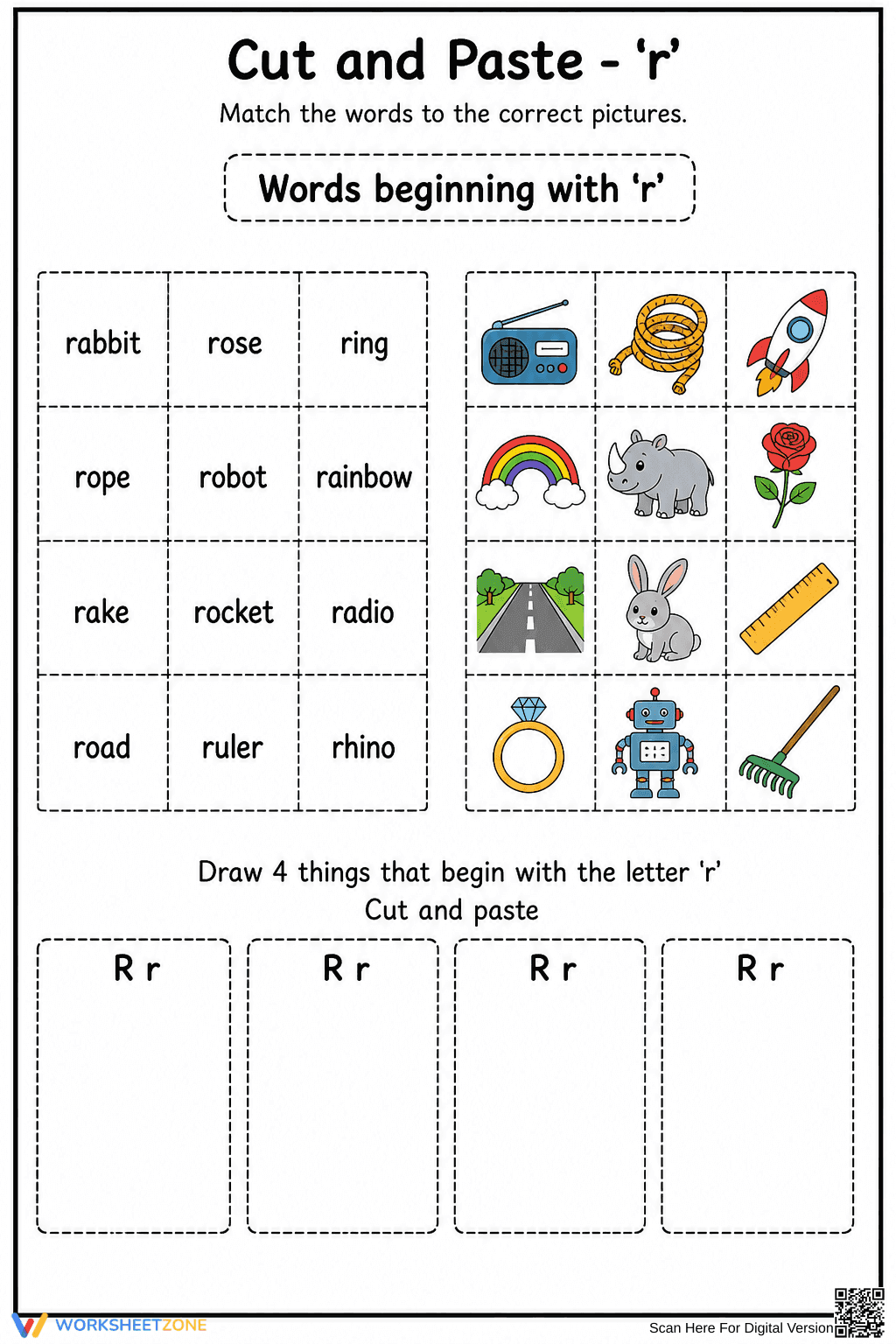

Letter R Beginning Sounds Printable Worksheet
Paste this activity's link or code into your existing LMS (Google Classroom, Canvas, Teams, Schoology, Moodle, etc.).
Students can open and work on the activity right away, with no student login required.
You'll still be able to track student progress and results from your teacher account.
This foundational phonics worksheet helps early readers master the beginning sound of the letter R. Students actively match printed words to corresponding images and draw their own examples, reinforcing letter-sound correspondence through hands-on practice. This targeted activity builds essential phonemic awareness required for fluent decoding.
At a Glance
- Grade: K-1 · Subject: ELA
- Standard:
CCSS.ELA-LITERACY.RF.K.3.A— Produce primary sounds for consonants- Skill Focus: Beginning Sounds (Letter R)
- Format: 1 page · 16 problems · PDF
- Best For: Independent practice centers
- Time: 15–20 minutes
This single-page resource features a visual layout for young learners. The top section contains twelve decodable words starting with R, alongside twelve illustrations like a rabbit and rocket. Students cut out the images and paste them next to the matching text. The bottom section provides four blank boxes where children draw and label their own objects beginning with the target sound.
This activity is designed for immediate classroom implementation. The zero-prep workflow ensures instructional time is maximized:
- Print (1 minute): Generate copies directly from the PDF.
- Distribute (1 minute): Hand out pages, scissors, and glue. Instructions are self-explanatory.
- Review (3 minutes): Check work as they paste, or review whole-class.
Total teacher preparation takes under two minutes, making this an excellent option for sub plans or literacy centers.
This worksheet aligns to CCSS.ELA-LITERACY.RF.K.3.A: Demonstrate basic knowledge of one-to-one letter-sound correspondences by producing the primary sound for each consonant. By requiring students to connect the visual letter R with its auditory sound, the task supports early decoding. Both standard codes can be copied directly into lesson plans, IEP goals, or district curriculum mapping tools.
Deploy this worksheet during morning work to establish a calm, focused routine while reinforcing phonics instruction from the previous day. Alternatively, use it as an independent station during guided reading rotations. While students are cutting and pasting, teachers can conduct quick formative assessments by asking individual children to point to a picture and verbally produce the initial /r/ sound. Expected completion time ranges from fifteen to twenty minutes, depending on scissor skills.
This resource is primarily designed for Kindergarten and first-grade students developing their foundational phonics skills. It serves as an excellent intervention tool for older students who need targeted review of consonant sounds. The visual supports make it highly accessible for English Language Learners building basic vocabulary. Pair this activity with a read-aloud focused on the letter R or a classroom anchor chart displaying common R-words to maximize retention.
Mastering initial consonant sounds is a critical milestone in early literacy development. This resource directly supports CCSS.ELA-LITERACY.RF.K.3.A, requiring students to produce primary sounds for consonants. According to a comprehensive EdReports 2024 analysis of foundational reading programs, explicit and systematic instruction in letter-sound correspondence, paired with immediate hands-on application, significantly accelerates decoding proficiency in primary grades. By integrating tactile activities like cutting and pasting with visual word recognition, this worksheet engages multiple learning modalities. This multimodal approach helps solidify the neural pathways necessary for automatic word recognition. Early mastery of these isolated phonemes provides the essential scaffolding students need before progressing to more complex blending and segmenting tasks. Consistent practice with targeted resources ensures that young readers build the automaticity required for long-term reading comprehension and academic success.


