


























Views
Downloads

Beginning Sounds Worksheet | Grade K Essential
Paste this activity's link or code into your existing LMS (Google Classroom, Canvas, Teams, Schoology, Moodle, etc.).
Students can open and work on the activity right away, with no student login required.
You'll still be able to track student progress and results from your teacher account.
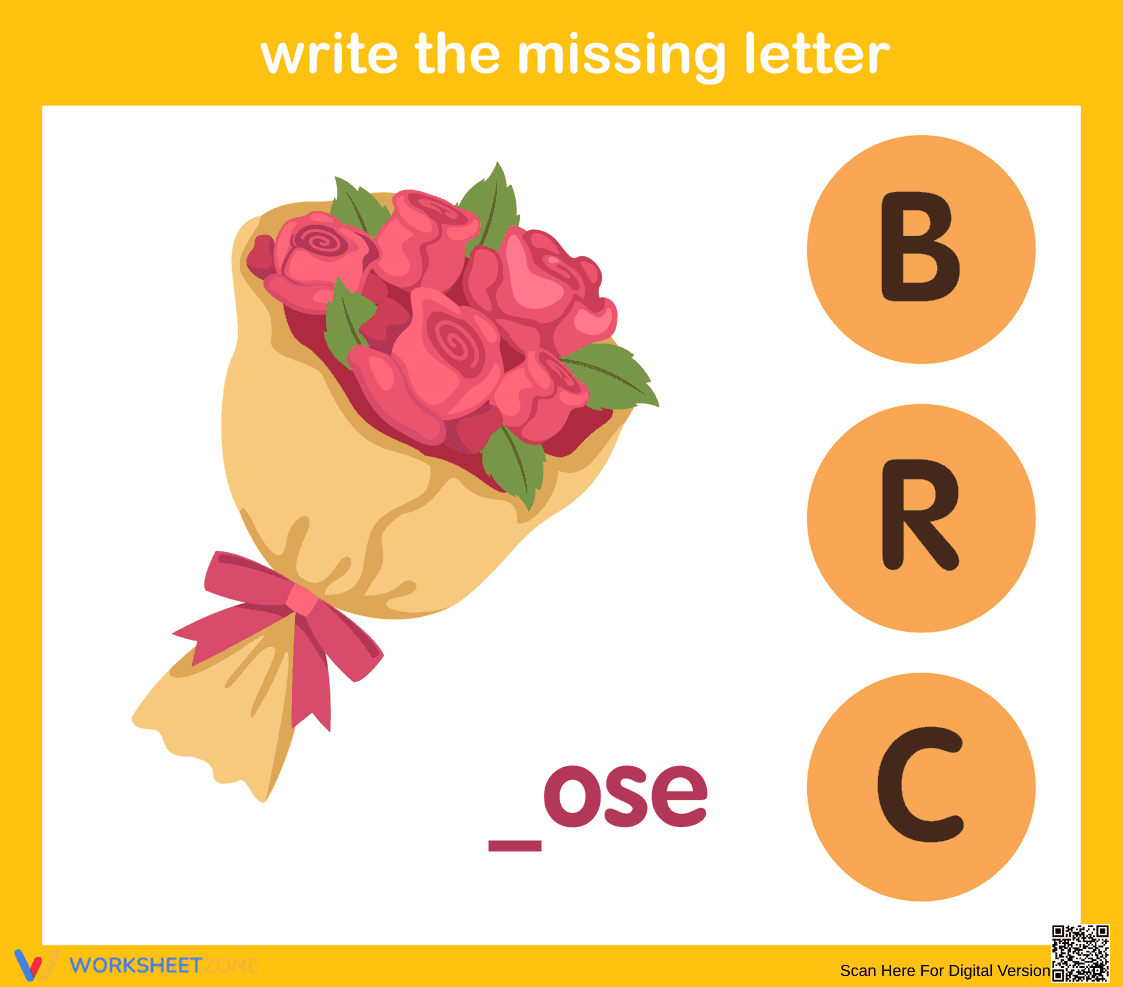
This Kindergarten beginning sounds worksheet helps early learners master initial consonant identification through visual cues. By connecting the image of a rose to its starting letter, students strengthen phonemic awareness and letter-sound correspondence. It provides a clear, focused task to build foundational reading confidence and decoding skills.
At a Glance
- Grade: Kindergarten · Subject: ELA Phonics
- Standard:
CCSS.ELA-LITERACY.RF.K.2.D— Isolate and pronounce the initial sounds in three-phoneme words- Skill Focus: Initial Consonant Identification
- Format: 1 page · 1 task · Answer key included · PDF
- Best For: Morning work or quick phonics checks
- Time: 2–5 minutes
This single-page PDF features a high-quality illustration of a rose bouquet paired with a partial word and three letter choices (B, R, C). The large, clear font and vibrant colors are designed for young learners. It includes a dedicated space for writing the missing letter, reinforcing fine motor skills alongside phonics. The layout is intentionally simple to prevent overstimulation.
The worksheet follows a focused skill progression. First, students engage in visual recognition by identifying the object in the picture. Next, they perform auditory isolation by saying the word "rose" aloud to hear the starting phoneme. Finally, they demonstrate independent mastery by selecting and writing the correct letter from the provided options. This simple "See, Say, Write" method ensures high success rates for early readers through a gradual-release approach.
This resource aligns with `CCSS.ELA-LITERACY.RF.K.2.D`, which requires students to isolate and pronounce the initial, medial vowel, and final sounds in CVC words. It specifically targets the initial sound isolation component. This standard code can be copied directly into lesson plans, IEP goals, or district curriculum mapping tools to ensure instructional alignment.
Use this as a quick formative assessment during your phonics block. After introducing the letter 'R', hand this out to see if students can apply the sound to a familiar object. It also works well as a "ticket out the door" or a simple center activity. Expect completion in under 5 minutes, making it an efficient tool for busy classrooms.
This is ideal for Preschool, Kindergarten, and Grade 1 students who need targeted practice with beginning sounds. It is particularly helpful for English Language Learners (ELL) to build vocabulary through visual association. Pair this with a physical alphabet anchor chart or a letter-tracing activity for a comprehensive phonics lesson that supports diverse learning needs.
Research from Fisher & Frey (2014) emphasizes the importance of visual scaffolding in early literacy, noting that pairing images with phonemic tasks accelerates the transition from oral language to print. This worksheet utilizes that principle by providing a clear "rose" graphic to anchor the phoneme /r/. According to the RAND AIRS 2024 report, consistent exposure to initial sound isolation tasks is a primary predictor of later reading fluency. By focusing on a single, high-frequency word, this resource reduces cognitive load, allowing students to focus entirely on the letter-sound relationship. The inclusion of multiple-choice distractors (B and C) further challenges students to discriminate between similar-looking or sounding letters, a critical step in the CCSS.ELA-LITERACY.RF.K.2.D mastery path. This printable is a reliable tool for building the phonological foundations necessary for decoding more complex text structures in later primary grades.


