


























Views
Downloads
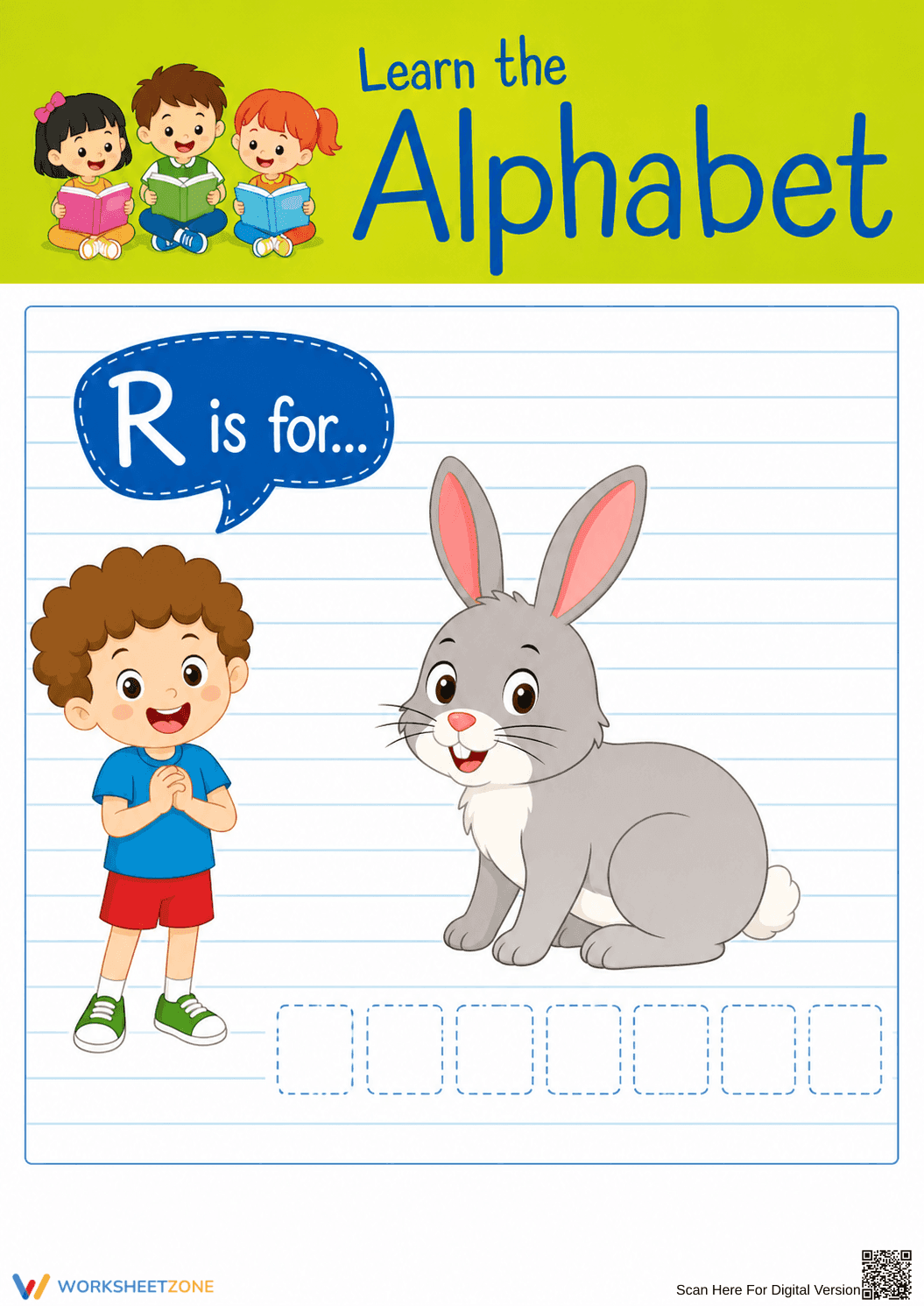

Letter R Beginning Sound Worksheet | Essential Grade K-2
Paste this activity's link or code into your existing LMS (Google Classroom, Canvas, Teams, Schoology, Moodle, etc.).
Students can open and work on the activity right away, with no student login required.
You'll still be able to track student progress and results from your teacher account.
This Letter R beginning sound worksheet helps early learners master the foundational phonics skill of letter-sound correspondence. By connecting the visual of a rabbit with the initial /r/ phoneme, students build the phonological awareness necessary for decoding and spelling. This resource provides a clear, focused environment for mastering one of the most common consonants in the English language.
At a Glance
- Grade: Kindergarten · Subject: ELA Phonics
- Standard:
CCSS.ELA-LITERACY.RF.K.3.A— Demonstrate basic knowledge of one-to-one letter-sound correspondences by producing the primary sound- Skill Focus: Beginning Sound Letter R
- Format: 1 page · 1 task · Answer key included · PDF
- Best For: Initial phonics instruction and letter recognition
- Time: 5–10 minutes
Inside this printable PDF, you will find a high-quality visual representation of a rabbit paired with the "R is for..." sentence starter. The worksheet features 7 individual letter boxes designed to help students map the word "RABBIT" or practice writing the uppercase and lowercase letter R. The clean layout minimizes distractions, making it ideal for students who require a focused learning environment.
Skill Progression
- Guided Practice: Students engage in visual identification by connecting the large letter "R" to the rabbit illustration.
- Supported Practice: Learners use the provided 7-box grid to organize their writing and practice letter formation.
- Independent Practice: Students vocalize the /r/ sound and complete the spelling task without additional prompts.
This gradual-release model ensures that learners move from recognition to production with confidence.
Standards Alignment
This resource is aligned with `CCSS.ELA-LITERACY.RF.K.3.A`, which requires students to demonstrate basic knowledge of one-to-one letter-sound correspondences. It also supports RF.K.1.D by reinforcing the recognition of uppercase and lowercase letters. Both standard codes can be copied directly into lesson plans, IEP goals, or district curriculum mapping tools.
How to Use It
Use this worksheet during your morning meeting as a "Letter of the Day" activity to introduce the /r/ sound. It also serves as an excellent formative assessment tool during small-group phonics rotations; observe if students can produce the /r/ sound before they begin writing. Expect most students to complete the activity within 5 to 10 minutes.
Who It's For
This activity is designed for Kindergarten and Grade 1 students, as well as English Language Learners (ELLs) who are building their initial vocabulary. It pairs naturally with an alphabet anchor chart or a read-aloud book featuring animals. The large visual cues provide necessary scaffolding for students who are still developing their fine motor skills.
Research from RAND AIRS 2024 emphasizes that explicit phonics instruction, particularly focusing on letter-sound correspondence like the /r/ sound in this worksheet, is a critical predictor of later reading fluency. By isolating the beginning sound and providing a concrete visual anchor, this resource aligns with evidence-based practices for early literacy development. The use of a 7-box grid supports orthographic mapping, a process where the brain links the sounds of a word to its written form. This specific worksheet provides the repetition needed for students to move the /r/ phoneme into long-term memory. According to the NAEP, students who master these foundational skills in the early grades are significantly more likely to meet reading proficiency benchmarks by the end of third grade. This printable tool offers a practical application of these research-backed strategies for any classroom.


