




























1 / 2
0
Views
0
Downloads

Save
0 Likes
Share
Understanding Atomic Theory Timeline
0 Views
0 Downloads

Paste this activity's link or code into your existing LMS (Google Classroom, Canvas, Teams, Schoology, Moodle, etc.).
Students can open and work on the activity right away, with no student login required.
You'll still be able to track student progress and results from your teacher account.
Information
Description
What It Is:
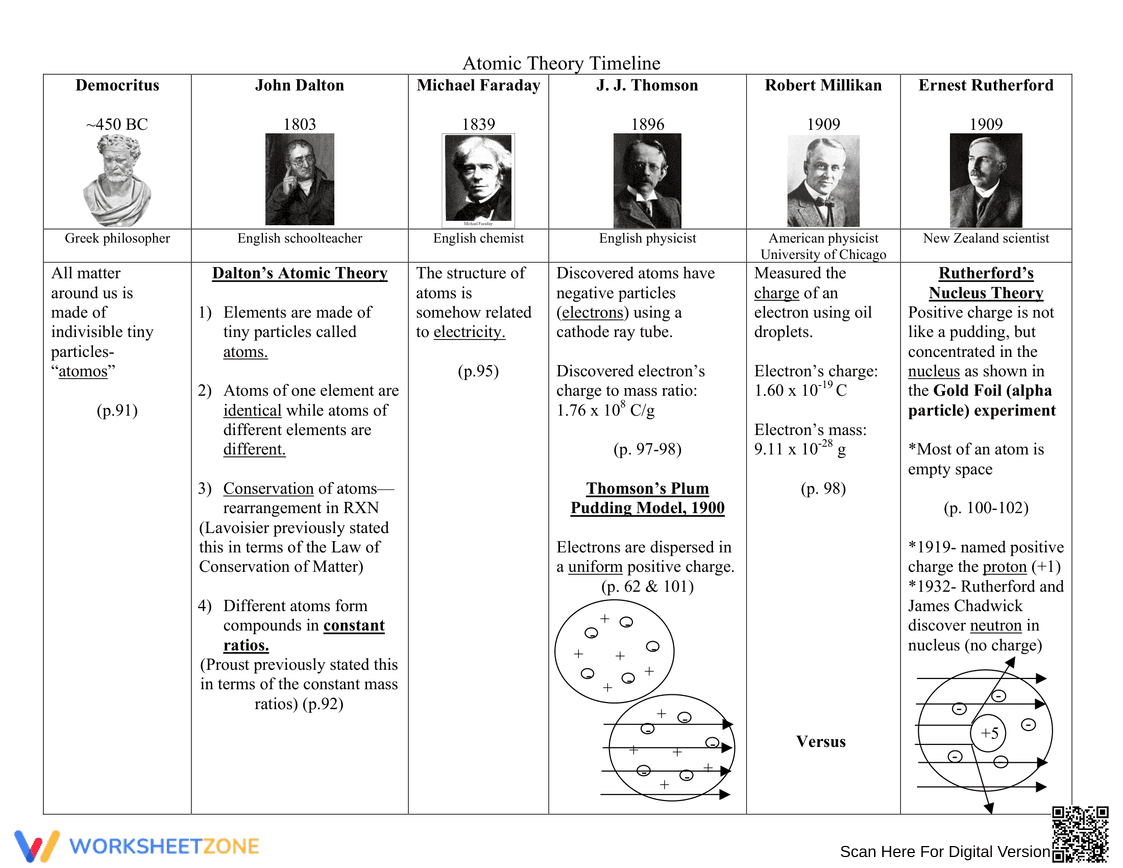
This is an educational worksheet displaying an 'Atomic Theory Timeline.' It showcases key scientists and their contributions to the development of atomic theory, including Democritus, John Dalton, Michael Faraday, J.J. Thomson, Robert Millikan, and Ernest Rutherford. Each entry includes a portrait of the scientist, their dates, and a summary of their relevant discovery or contribution, such as Dalton's Atomic Theory, Thomson's Plum Pudding Model, and Rutherford's Nuclear Theory. The worksheet includes brief explanations of concepts like elements, atoms, conservation of atoms, and the charge of an electron, along with references to page numbers.
Grade Level Suitability:
This worksheet is most suitable for grades 9-12 (high school) and introductory college-level chemistry or physics courses. The concepts and terminology used, such as 'conservation of atoms' and 'electron's charge to mass ratio,' require a foundational understanding of science principles typically taught at these levels.
Why Use It:
This worksheet provides a visual and concise timeline of the development of atomic theory. It helps students understand the historical context of scientific discoveries and how different scientists built upon each other's work. It also reinforces key concepts and terminology related to atomic structure.
How to Use It:
This worksheet can be used as a study guide, a review activity, or a classroom handout. Students can use it to trace the evolution of atomic theory, identify the key contributions of each scientist, and understand the relationship between different concepts. It could also be used as a basis for further research or discussion.
Target Users:
The target users are high school and college students studying chemistry or physics. It is also suitable for teachers looking for a visual aid to teach the history of atomic theory.
This is an educational worksheet displaying an 'Atomic Theory Timeline.' It showcases key scientists and their contributions to the development of atomic theory, including Democritus, John Dalton, Michael Faraday, J.J. Thomson, Robert Millikan, and Ernest Rutherford. Each entry includes a portrait of the scientist, their dates, and a summary of their relevant discovery or contribution, such as Dalton's Atomic Theory, Thomson's Plum Pudding Model, and Rutherford's Nuclear Theory. The worksheet includes brief explanations of concepts like elements, atoms, conservation of atoms, and the charge of an electron, along with references to page numbers.
Grade Level Suitability:
This worksheet is most suitable for grades 9-12 (high school) and introductory college-level chemistry or physics courses. The concepts and terminology used, such as 'conservation of atoms' and 'electron's charge to mass ratio,' require a foundational understanding of science principles typically taught at these levels.
Why Use It:
This worksheet provides a visual and concise timeline of the development of atomic theory. It helps students understand the historical context of scientific discoveries and how different scientists built upon each other's work. It also reinforces key concepts and terminology related to atomic structure.
How to Use It:
This worksheet can be used as a study guide, a review activity, or a classroom handout. Students can use it to trace the evolution of atomic theory, identify the key contributions of each scientist, and understand the relationship between different concepts. It could also be used as a basis for further research or discussion.
Target Users:
The target users are high school and college students studying chemistry or physics. It is also suitable for teachers looking for a visual aid to teach the history of atomic theory.


