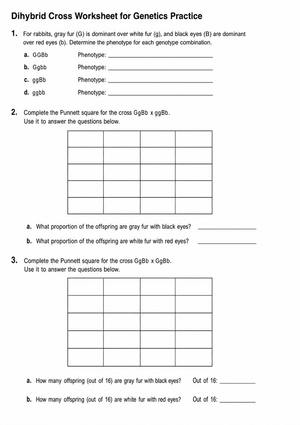
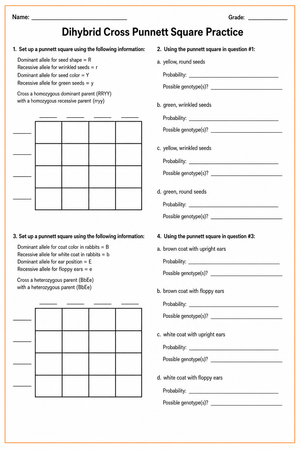
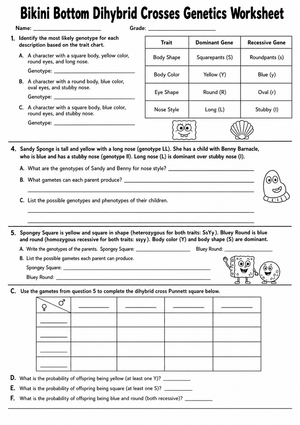
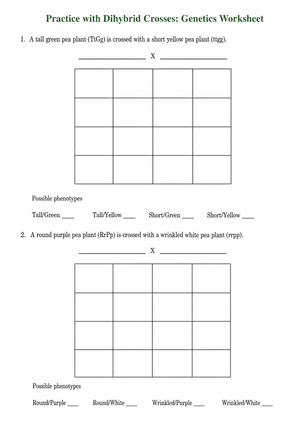
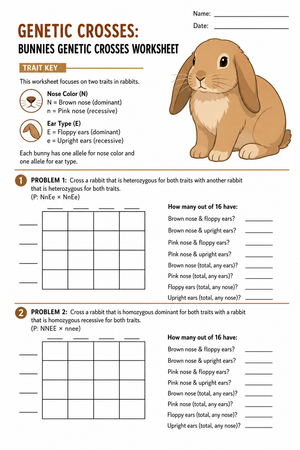
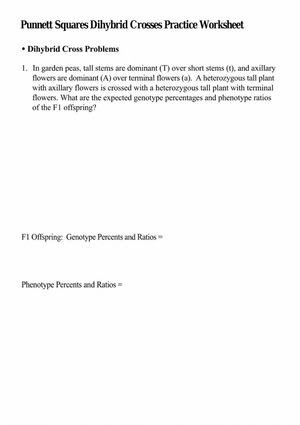
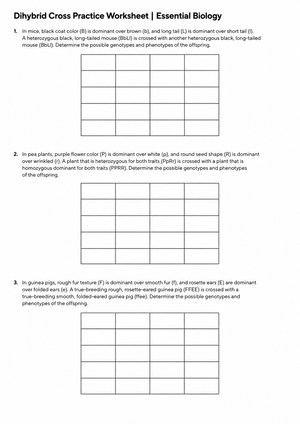
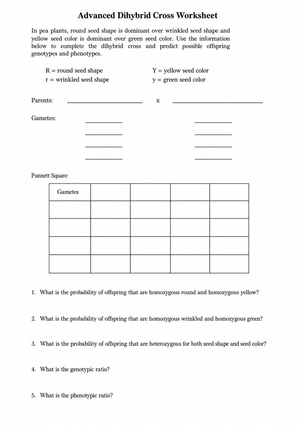
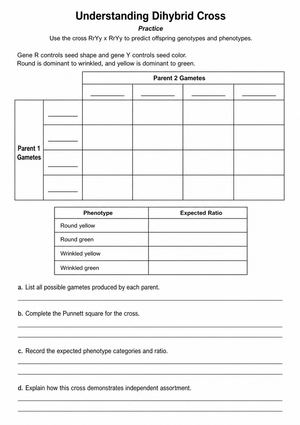
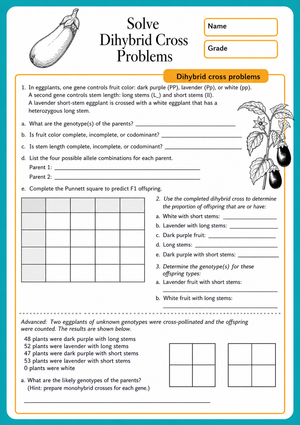
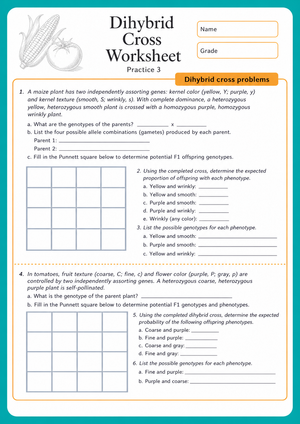
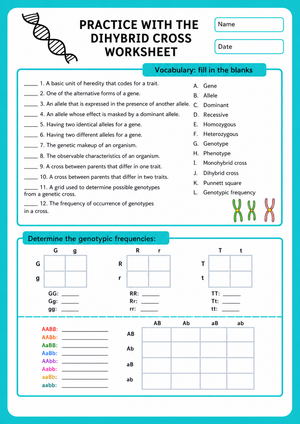
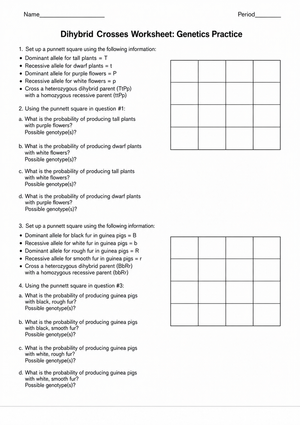
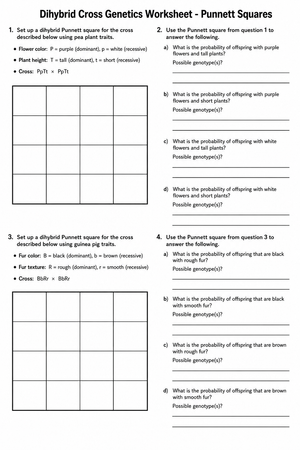
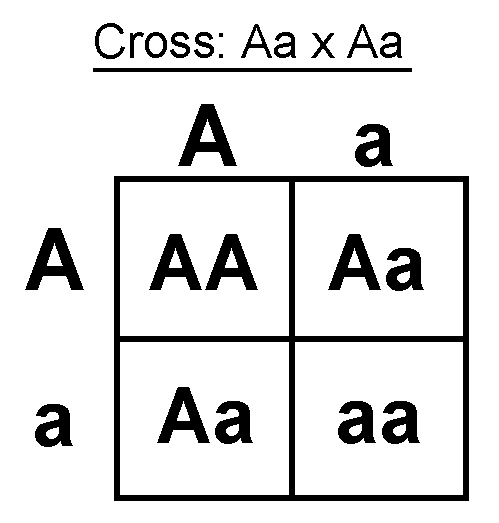
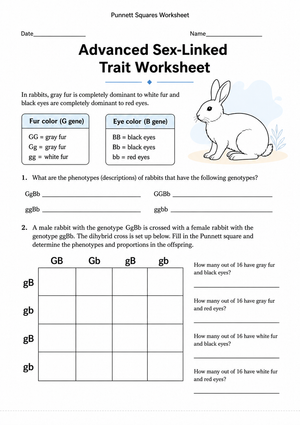
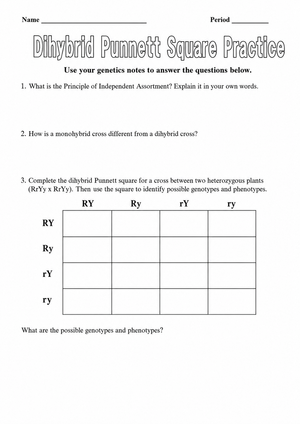
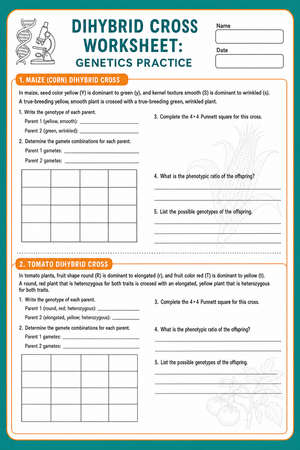
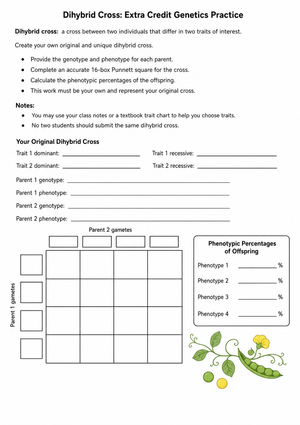
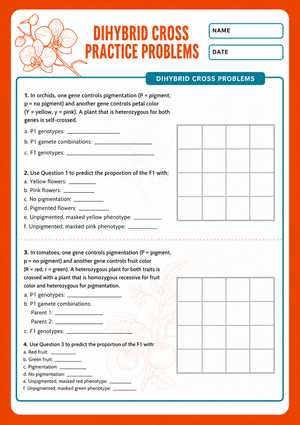
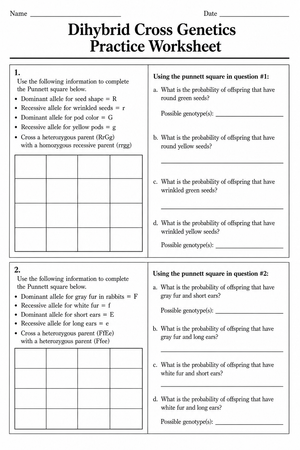
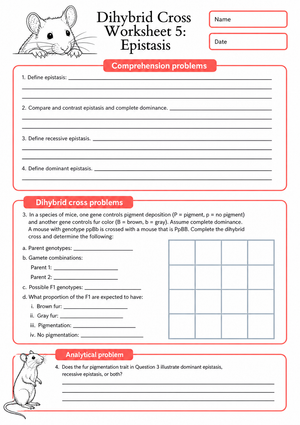
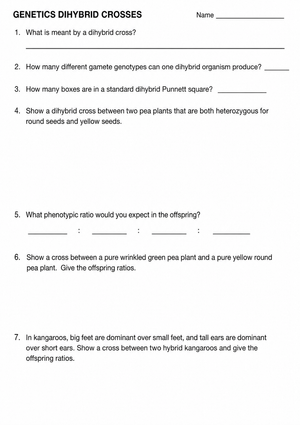
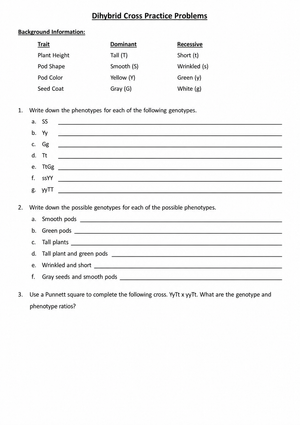
These 10th grade dihybrid cross printable worksheets give biology teachers a ready-to-use practice sequence that moves students through the full process — parental genotype identification, gamete determination, 16-square Punnett grid completion, and final ratio analysis. Each worksheet stands alone, so it drops cleanly into a lesson as a warm-up, guided practice, or independent check without requiring any reshuffling of the larger unit.
What Students Work Through on Each Worksheet
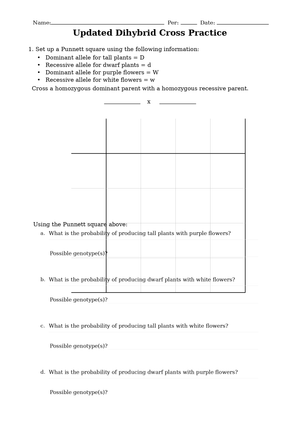
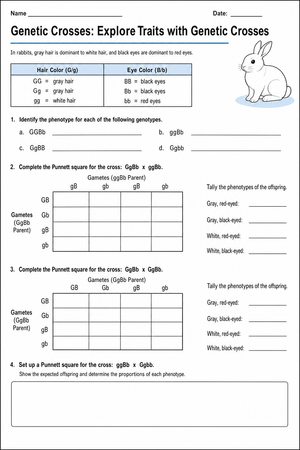
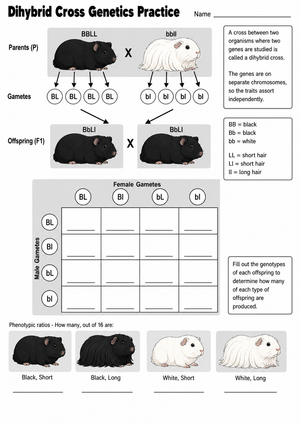
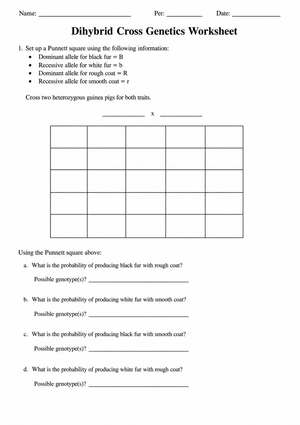
The work follows the actual sequence a student needs to internalize. Students read a genetics problem, write out the parental genotypes, identify all four possible gametes for each parent, place those gametes on the grid axes, and fill every cell — always writing the dominant allele before the recessive for each trait pair. Once the grid is complete, they tally phenotypes by category and record both the genotypic ratio and the 9:3:3:1 phenotypic ratio that a standard heterozygous-by-heterozygous cross produces.
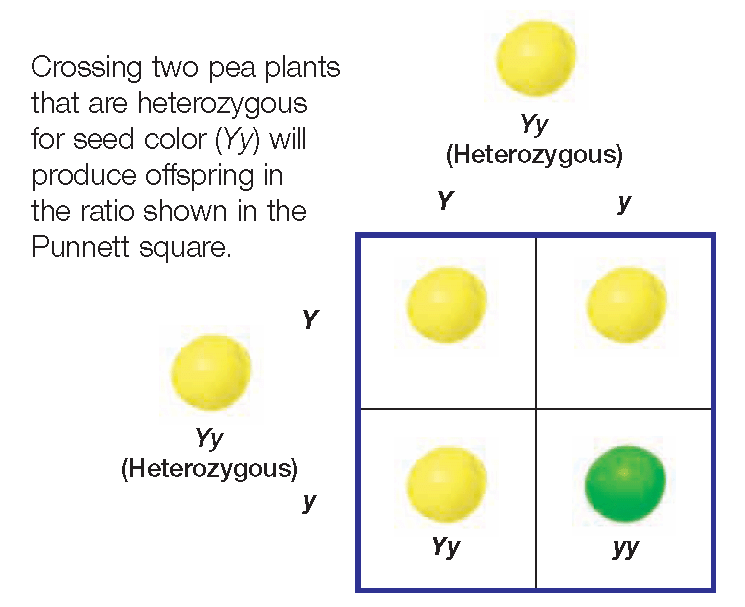
The problems vary in how much starting information students receive. Some worksheets state the parental genotypes directly and ask students to determine gametes and build the grid from there. Others present a biological scenario — two heterozygous pea plants, a dog breeding question, a cat coat color problem — and require students to extract the genotypes before beginning. That range matters: students who can execute the grid mechanics but stumble on reading a word problem for genetic information need exactly that practice before any unit test.
Mistakes Students Make That These Worksheets Help You Catch
The single most common error at this level is gamete formation. Students who breeze through monohybrid crosses regularly write gametes like "Rr" or "YY" for a parent with genotype RrYy — they grab a chunk of the genotype instead of selecting one allele from each gene. You will spot this immediately while circulating because their grid totals will not resolve to any recognizable ratio. The fix is requiring students to write all four gametes as a distinct step before touching the grid, rather than building them inside the header row as they go.
A second persistent problem is allele-order inconsistency inside grid cells. A student writes "RrYy" in one cell and "rRyY" three cells over — technically the same genotype but impossible to scan when tallying phenotypes. When they try to count the nine "dominant for both traits" outcomes, inconsistent notation causes missed cells and double-counts. Enforcing the convention — dominant allele always before recessive, first gene before second — during guided practice rather than after the test prevents the miscounting that follows.
Students also underestimate how much the final phenotype tally depends on marking the grid as they go. Those who try to hold the 9:3:3:1 distribution in their heads while scanning 16 cells produce messier counts than students who mark each cell with a quick shorthand — "DD," "Dr," "dR," "dd" — before totaling. This is a small habit with a meaningful payoff in accuracy.
Lesson-Planning Strategies for Getting the Most From These Worksheets
The most effective placement for these resources is directly after students demonstrate accuracy on monohybrid crosses — not the same day they first encounter dihybrid cross notes. The cognitive jump from a 4-square grid to a 16-square grid is real. Students who are still shaky on dominant/recessive notation will freeze when they see 32 allele-pair slots to fill. Give the concept a day to settle before using these as independent practice.
Within a class period, two configurations work well. In the first, the teacher works through gamete determination at the board while students complete their own worksheet simultaneously, then pauses so students finish the grid independently — a gradual release that keeps the class together through the hardest step while still requiring individual production. In the second, pairs swap completed worksheets and check each other's grid cell by cell, then verify the ratios. Students catch errors more readily in someone else's work than in their own, so the peer-check format produces genuine correction, not just social comparison.
Exit tickets work particularly well here. A single dihybrid problem on a half-sheet at the close of class gives immediate formative data. If more than a third of the class produces incorrect ratios, the next day's warm-up needs to revisit gamete formation specifically — that is almost always where the breakdown happened, not in the grid fill itself.
Standard Alignment
These worksheets align directly with NGSS HS-LS3-3 (Heredity: Inheritance and Variation of Traits), which requires students to apply statistics and probability to explain variation in expressed traits in a population. Completing a 16-square Punnett grid makes the probability mechanics visible rather than abstract: students are not simply memorizing a 9:3:3:1 ratio but generating it from the combinatorial logic of independent assortment. That process — building probability from first principles rather than recalling a pattern — is what HS-LS3-3 targets, and it is what repeated practice on each worksheet reinforces.
Adjusting the Set for a Range of Learners
For students who are still uncertain about allele notation, start with a version where the gametes are already written on the grid axes. The task becomes grid-fill accuracy and ratio calculation — both learnable before gamete determination is fully reliable. As accuracy improves, shift those students to problems where they determine gametes themselves but still receive the parental genotypes explicitly stated.
Students who finish the standard problems quickly benefit from test cross problems — crossing an unknown genotype against a homozygous recessive parent and inferring the unknown's genotype from offspring ratios. This runs the Punnett square logic in reverse and demands a more flexible understanding of genotype-phenotype relationships. Asking advanced students to write their own dihybrid cross problem and produce an answer key also pushes the skill further: generating a well-formed genetics question requires more command of the material than solving one already written.
For students with enlarged-print accommodations, the 10th grade dihybrid cross printable worksheets in this set include grid templates that reproduce cleanly at increased size without losing the cell boundaries that students rely on for organization. For IEP students with processing accommodations, pre-completing the first row of grid cells reduces the entry barrier without removing the core practice of filling and tallying the remaining squares.
Frequently Asked Questions
How should students determine all four gametes for a dihybrid parent?
The most reliable classroom method is systematic pairing: take one allele from the first gene and pair it with one allele from the second gene, cycling through every combination. For genotype RrYy, that produces RY, Ry, rY, and ry. Some teachers use the FOIL mnemonic — First, Outer, Inner, Last — borrowed from algebra to make the pairing procedure feel methodical. Either approach works as long as students complete this as a written step before touching the grid. Students who skip it and try to build gametes while filling in cells make errors at a much higher rate, and those errors are harder to trace after the fact.
What ratio should students expect from a standard dihybrid cross, and how can they use it to check their work?
A cross between two heterozygous parents — AaBb x AaBb — produces offspring in a 9:3:3:1 ratio: nine expressing both dominant phenotypes, three expressing the first dominant and second recessive, three expressing the first recessive and second dominant, and one expressing both recessive phenotypes. The sum must equal 16. If a student's tally does not add to 16, or if the distribution looks like 10:2:3:1, there is a grid or gamete error. Teaching students to treat the ratio as a self-check rather than just a final answer builds useful verification habits before they encounter chi-square analysis later in the course.
How do these dihybrid cross problems connect to the Law of Independent Assortment?
The 16-square grid works precisely because alleles for two different genes assort independently during meiosis — the allele a gamete carries for seed shape does not influence which seed-color allele accompanies it. Every possible gamete combination appears with equal probability, which is what the grid models by assigning equal weight to every cell. Students who fill in the grid correctly are demonstrating independent assortment through calculation, not just restating it as a definition, which is a meaningful distinction when they need to explain the concept on a free-response question.
Are these appropriate for students who have not yet mastered monohybrid crosses?
No. The set assumes familiarity with basic dominance relationships and 4-square Punnett squares. Using the 10th grade dihybrid cross printable worksheets with students who are still uncertain about which allele is dominant or how to write a heterozygous genotype produces frustration rather than learning — managing two simultaneous traits carries enough cognitive load without sorting out the foundational notation at the same time. A targeted review of monohybrid mechanics first makes the transition to 16-square problems significantly smoother.