




























Views
Downloads

Printable Dihybrid Cross Worksheet | Grade 9-12 Biology

Paste this activity's link or code into your existing LMS (Google Classroom, Canvas, Teams, Schoology, Moodle, etc.).
Students can open and work on the activity right away, with no student login required.
You'll still be able to track student progress and results from your teacher account.
This high school biology worksheet provides focused practice on Mendelian genetics, specifically targeting dihybrid crosses. Students will set up 4x4 Punnett squares to predict the probability of offspring inheriting two distinct traits simultaneously. By calculating genotypic and phenotypic ratios, learners solidify their understanding of independent assortment and genetic inheritance.
At a Glance
- Grade: 9-12 · Subject: Biology
- Standard:
HS-LS3-3— Apply probability to explain trait variation and distribution- Skill Focus: Dihybrid Crosses & Punnett Squares
- Format: 4 pages · 4 problems · PDF
- Best For: Independent practice and review
- Time: 30–45 minutes
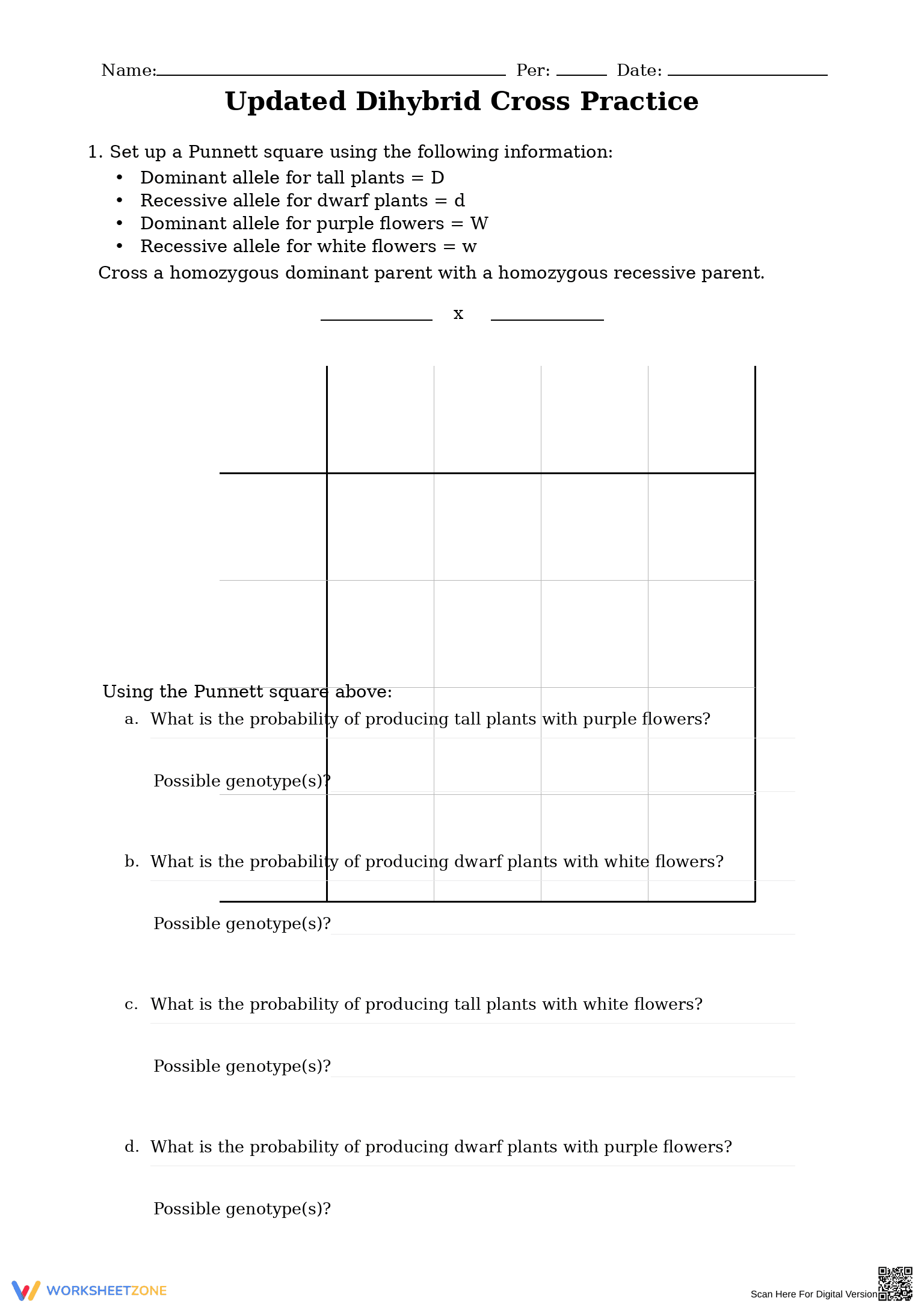
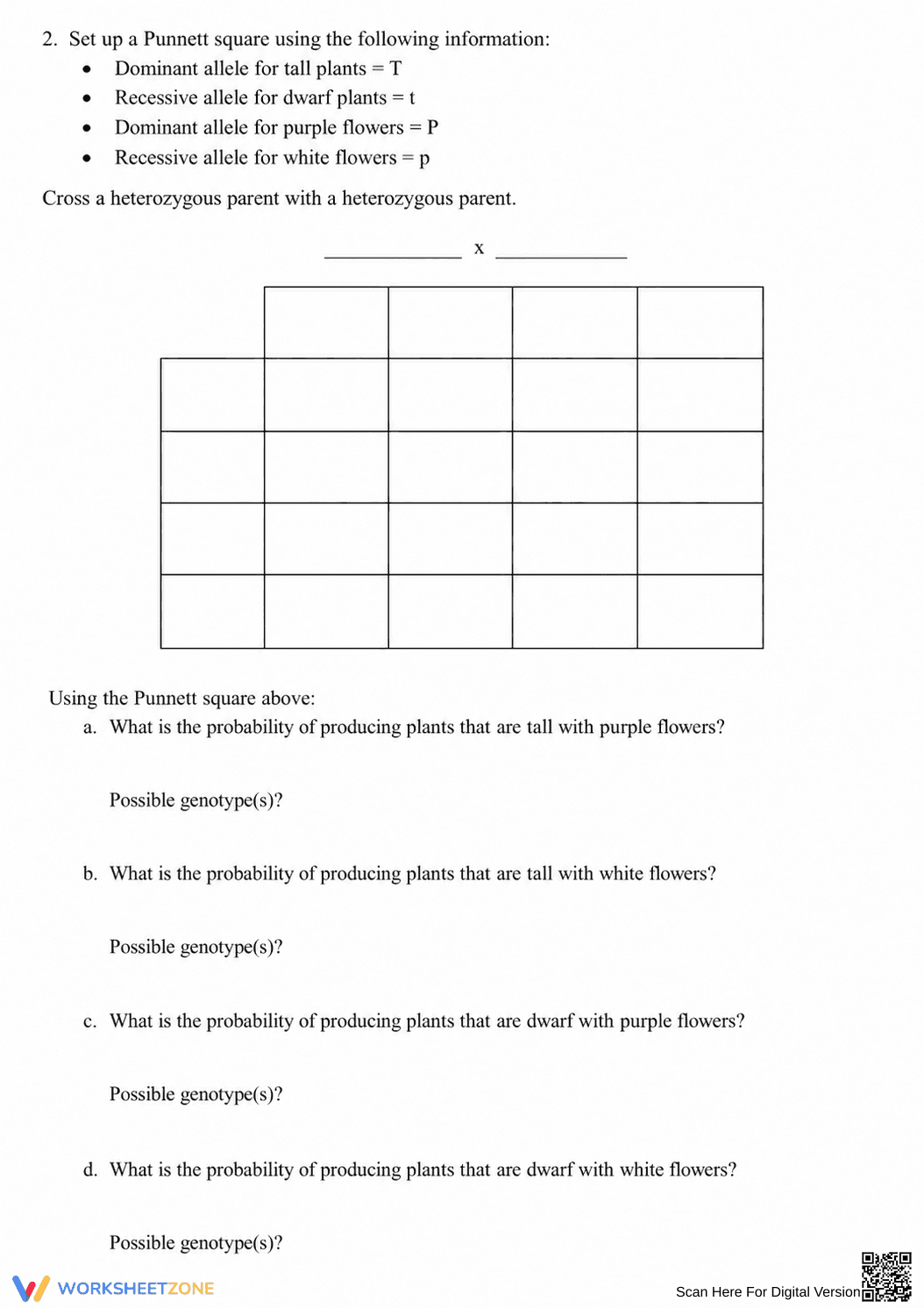
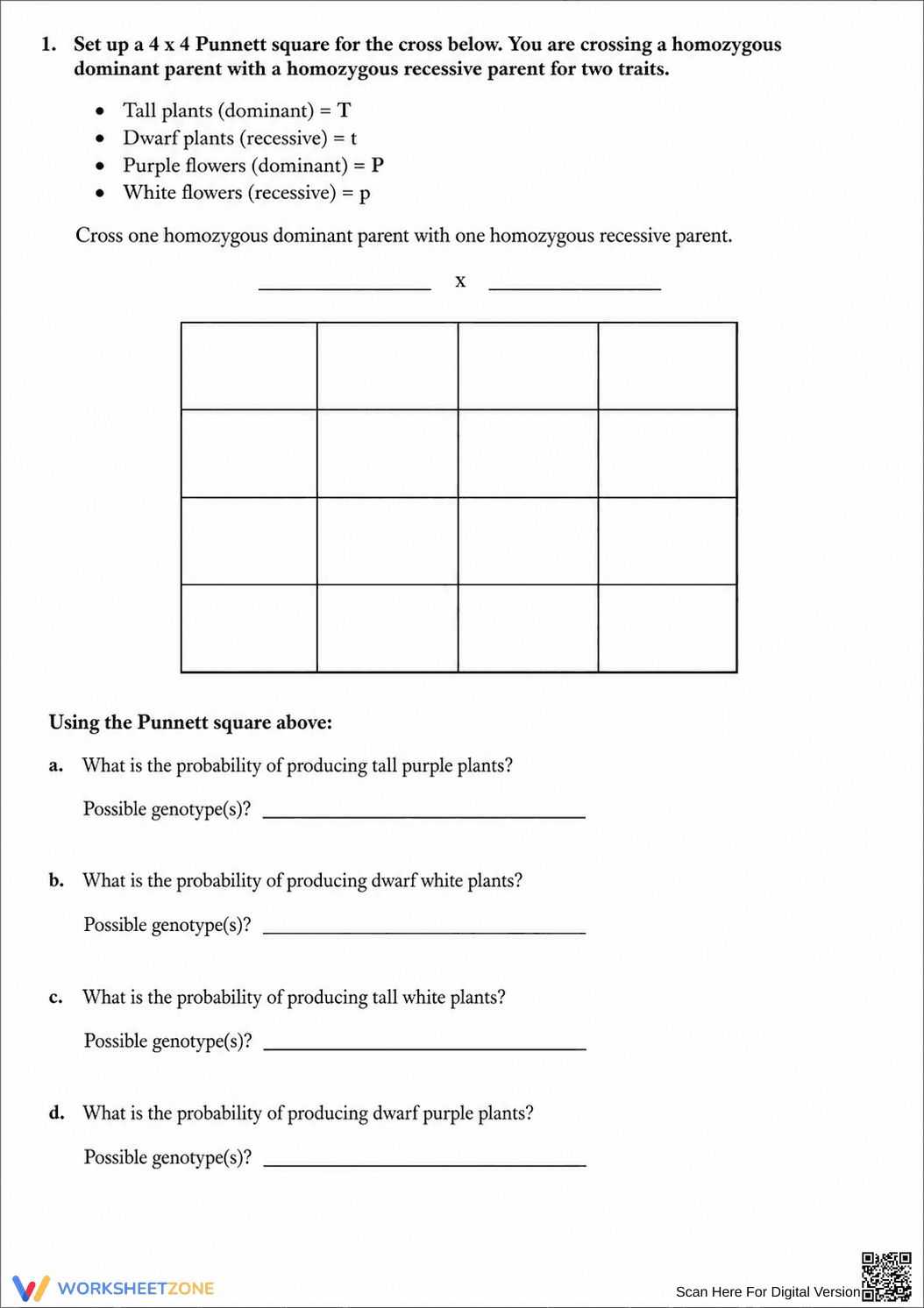
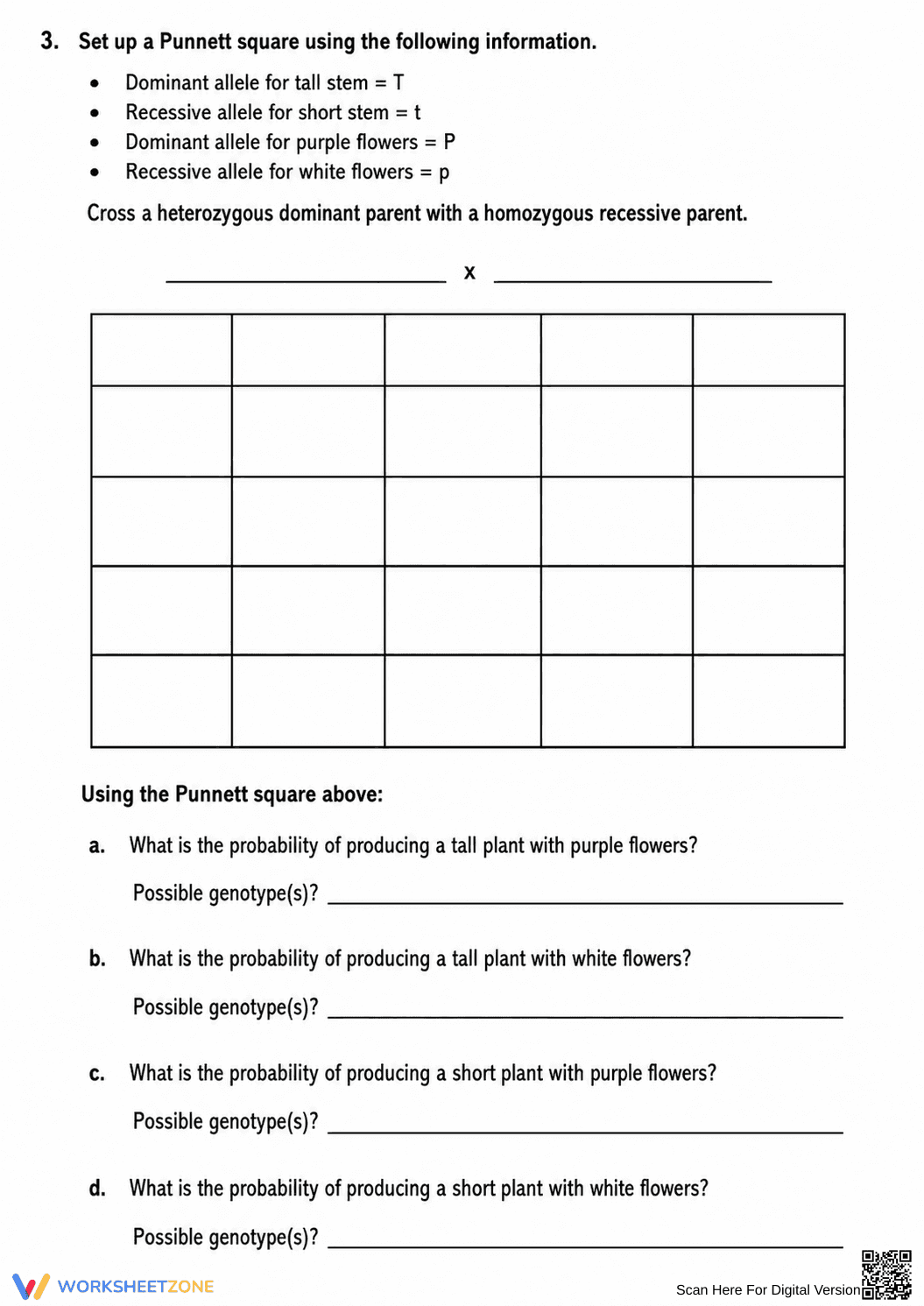
This four-page packet contains four comprehensive dihybrid cross scenarios. Each page presents a unique genetic cross, such as homozygous dominant crossed with homozygous recessive, or heterozygous crossed with heterozygous. Students are provided with the dominant and recessive alleles for two traits (like plant height and flower color) and must construct a 16-box Punnett square. Following the square, four targeted questions prompt students to calculate the specific probabilities and identify the possible genotypes for various trait combinations.
- Guided Setup: Initial problems define dominant and recessive alleles, providing a structured framework to identify parent genotypes before building the squares.
- Supported Practice: Students encounter different parent combinations, requiring them to carefully distribute alleles across the 4x4 grid.
- Independent Analysis: Learners independently extract data from completed Punnett squares to determine phenotypic probabilities and list corresponding genotypes.
This progression ensures students build confidence applying the I Do, We Do, You Do model to complex genetic probability tasks.
Aligned to primary standard HS-LS3-3: Apply concepts of statistics and probability to explain the variation and distribution of expressed traits in a population. This resource directly supports students in using mathematical reasoning to predict genetic outcomes based on Mendelian laws. Both standard codes can be copied directly into lesson plans, IEP goals, or district curriculum mapping tools.
Deploy this worksheet during a genetics unit after introducing the law of independent assortment. It serves as an excellent in-class independent practice assignment where teachers can circulate and check for understanding. As a formative assessment tip, observe whether students are correctly determining the four possible allele combinations for each parent before they begin filling in the 16-box grid. Expected completion time is 30 to 45 minutes, depending on the students' prior familiarity with Punnett squares.
This resource is designed for high school biology students in grades 9 through 12. It is easily differentiated by allowing struggling learners to work in pairs or providing them with pre-filled parent allele combinations on the axes of the Punnett square. It pairs perfectly with a direct instruction lesson on Mendelian genetics or a visual anchor chart demonstrating how to use the FOIL method for dihybrid crosses.
Mastering complex genetic inheritance requires repeated, structured practice with mathematical models. According to a ScienceDirect TpT Analysis (2024), students who engage with visual organizers like Punnett squares show significantly higher retention of abstract genetic concepts compared to those who only read text-based descriptions. This worksheet directly addresses the HS-LS3-3 standard, challenging students to apply probability to explain trait variation and distribution. By requiring learners to calculate specific phenotypic ratios and identify corresponding genotypes across multiple dihybrid scenarios, the resource bridges the gap between theoretical biology and applied statistical reasoning. The structured format reduces cognitive overload, allowing students to focus on the mechanics of independent assortment. This targeted approach ensures learners can confidently predict genetic outcomes, building a strong foundation for advanced biological studies.


