




























Views
Downloads

Printable Dihybrid Cross Worksheet | Grade 9-12 Biology

Paste this activity's link or code into your existing LMS (Google Classroom, Canvas, Teams, Schoology, Moodle, etc.).
Students can open and work on the activity right away, with no student login required.
You'll still be able to track student progress and results from your teacher account.
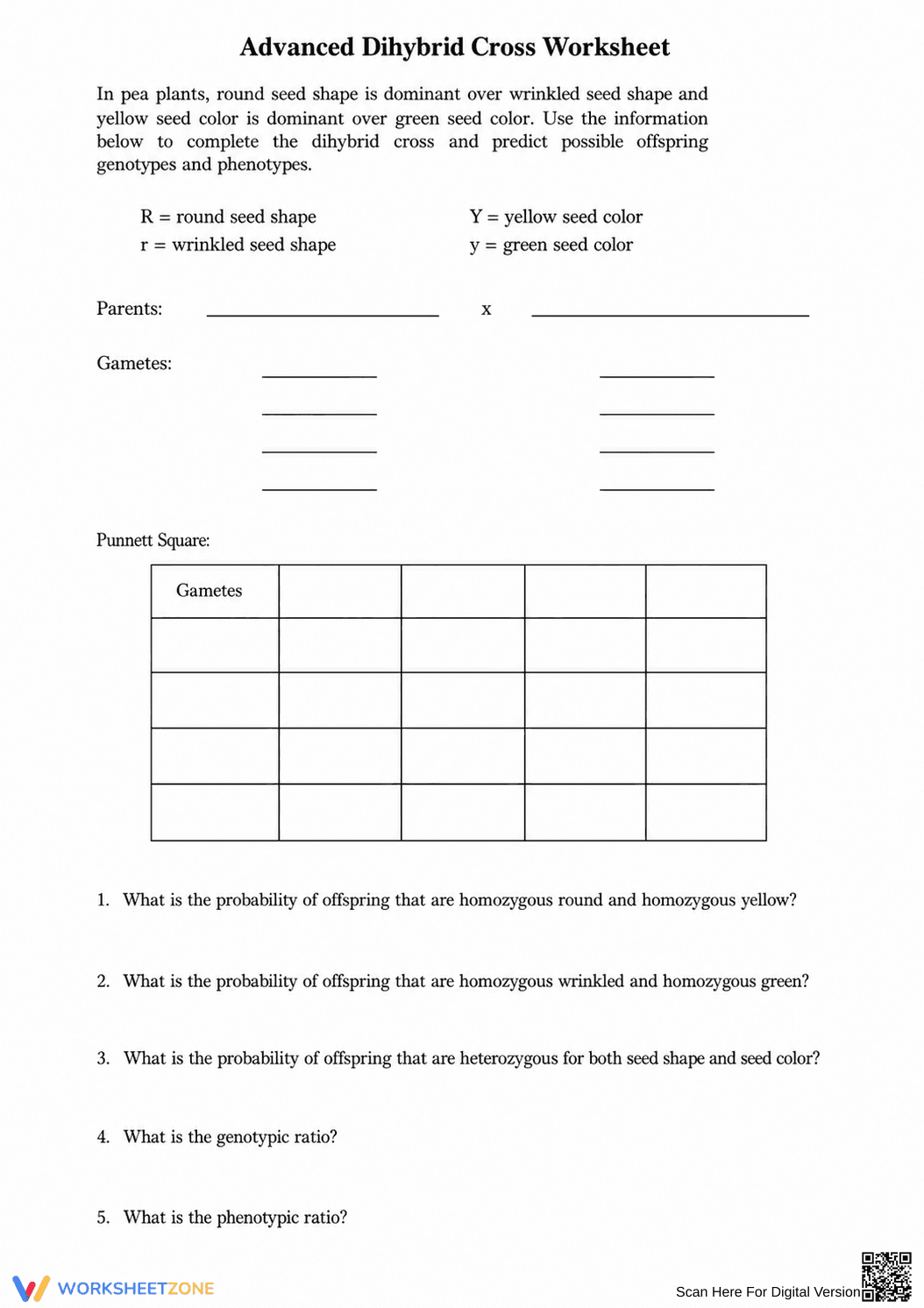
This advanced genetics worksheet helps high school biology students master dihybrid crosses and predict offspring traits. By completing Punnett squares and calculating ratios, learners develop a strong foundation in Mendelian genetics. The structured format ensures students can confidently analyze two-trait inheritance patterns.
At a Glance
- Grade: 9-12 · Subject: Biology
- Standard:
HS-LS3-3— Apply statistics and probability to explain trait variation and distribution.- Skill Focus: Dihybrid Crosses & Punnett Squares
- Format: 2 pages · 16 problems · Answer key included · PDF
- Best For: Independent practice and review
- Time: 30–45 minutes
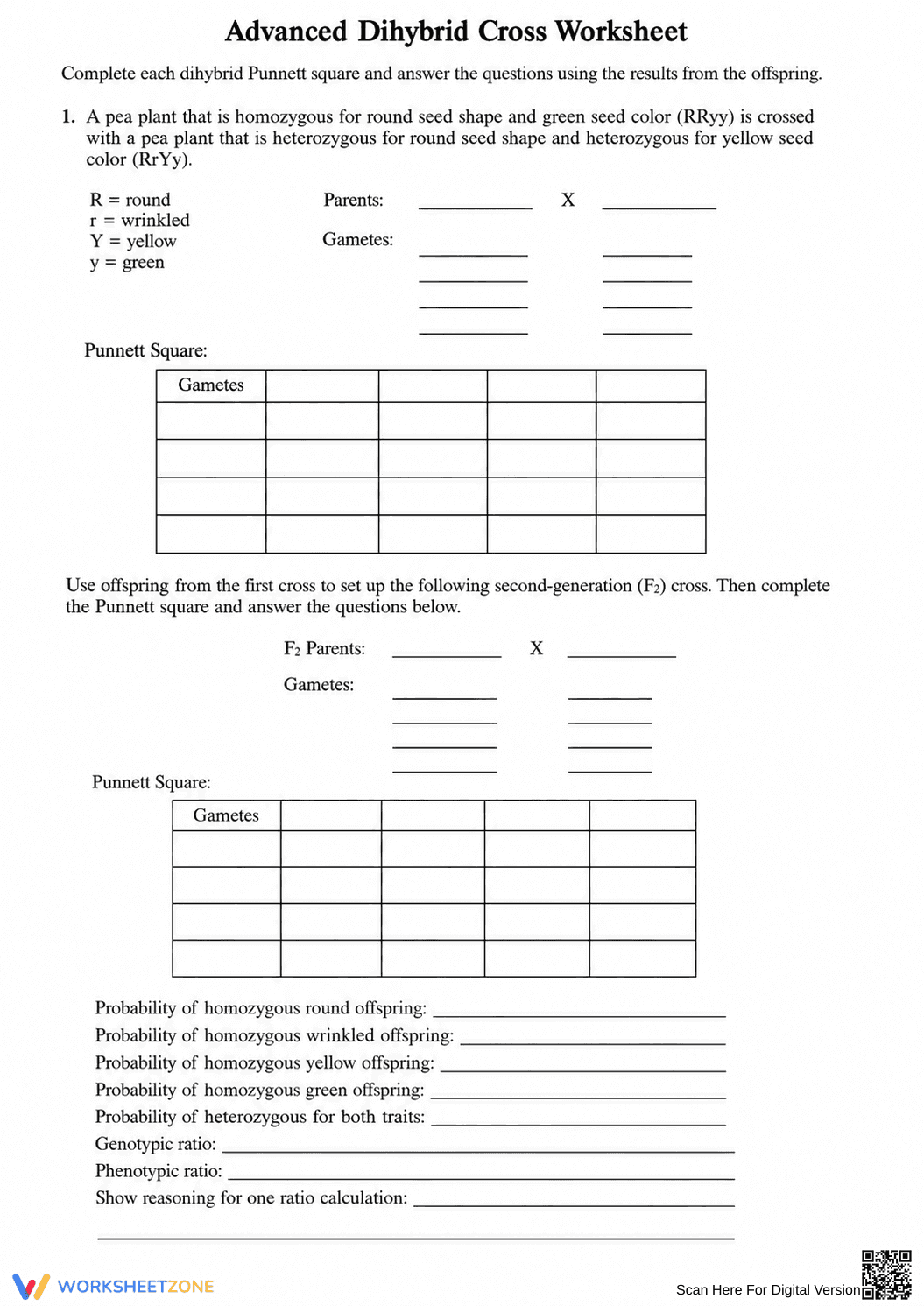
This two-page resource features three comprehensive dihybrid cross scenarios. The worksheet guides learners through identifying parent genotypes, determining possible gametes, and filling out 16-box Punnett squares. Following each cross, students must answer specific probability questions and calculate both genotypic and phenotypic ratios. The second page introduces an F1 to F2 generation cross, adding a layer of complexity that challenges students to apply their knowledge to multi-generational inheritance.
- Guided practice: The first section provides a clear setup for a standard dihybrid cross, prompting students to identify gametes before filling the Punnett square.
- Supported practice: Students then calculate specific probabilities for homozygous and heterozygous offspring, reinforcing the mathematical side of genetics.
- Independent practice: The final section requires students to set up an F2 generation cross entirely on their own and explain their reasoning for ratio calculations.
This gradual-release approach ensures students build confidence before tackling the most complex multi-generational genetics problems.
This resource is aligned to the Next Generation Science Standards, specifically HS-LS3-3: Apply concepts of statistics and probability to explain the variation and distribution of expressed traits in a population. It also supports foundational mathematical practices by requiring students to calculate complex ratios and percentages based on their Punnett square data. Both standard codes can be copied directly into lesson plans, IEP goals, or district curriculum mapping tools.
Deploy this worksheet during your genetics unit after introducing Mendelian inheritance and single-trait crosses. It serves as an excellent independent practice assignment or homework task to solidify understanding of two-trait crosses. As a formative assessment tip, monitor students while they determine the initial gametes; errors here will cascade through the entire Punnett square, making it the perfect intervention point. Expect students to complete this assignment in 30 to 45 minutes.
This worksheet is designed for high school biology students in grades 9 through 12. It is particularly beneficial for learners who need structured, step-by-step workspaces to organize complex genetic data. For students struggling with the math components, pair this resource with a quick review of fractions and probability. It also works perfectly alongside a visual anchor chart demonstrating the FOIL method for determining gametes.
Mastering complex inheritance patterns requires repeated, structured practice with statistical models. Aligned with HS-LS3-3, this resource helps students apply statistics and probability to explain trait variation and distribution. According to a ScienceDirect TpT Analysis, scaffolded problem sets significantly improve students' ability to transfer mathematical reasoning to biological concepts. By breaking down the dihybrid cross into discrete steps—from gamete formation to ratio calculation—this worksheet reduces cognitive overload and allows learners to focus on the underlying genetic principles. The inclusion of multi-generational crosses further deepens conceptual understanding, ensuring students can confidently predict outcomes across successive populations. This targeted approach to genetics instruction bridges the gap between abstract probability and concrete biological outcomes, fostering higher-order analytical skills essential for advanced high school science coursework.


