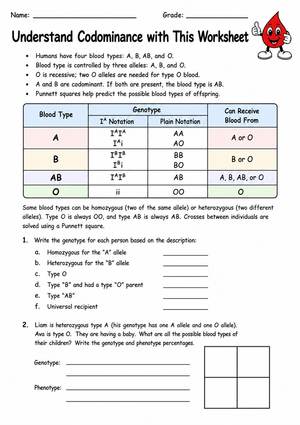
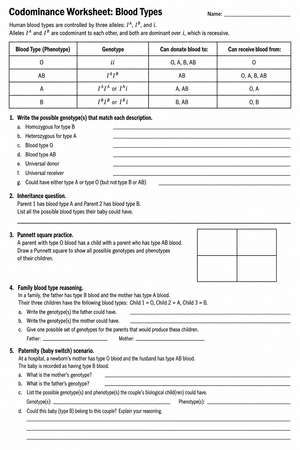
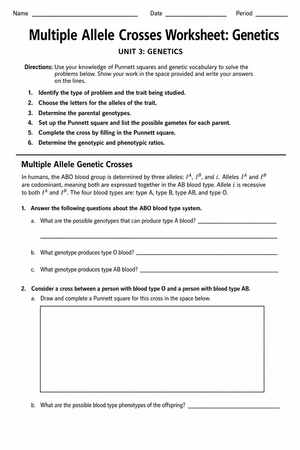
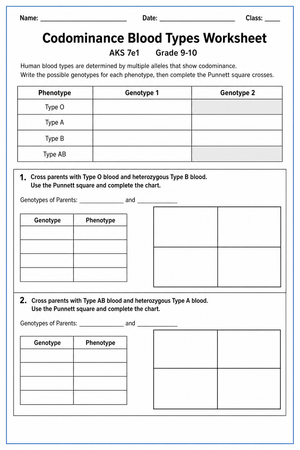
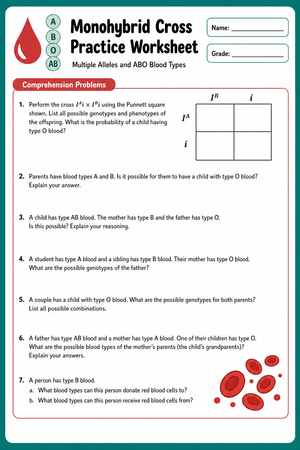
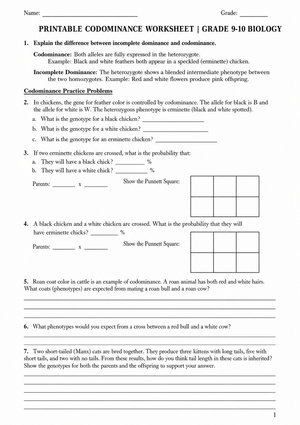
These codominance blood types printable worksheets for 10th grade give teachers structured practice for one of the more conceptually layered stops in a genetics unit — the ABO blood group system, where codominance and recessive inheritance operate simultaneously in the same organism. Each worksheet targets a distinct step in the reasoning chain students need, moving from allele notation through Punnett square construction to phenotype prediction. An answer key is included, which matters more than it sounds when instruction time is tight or a substitute is covering the class.
Genetics Skills These Worksheets Build
The ABO system asks students to hold three separate ideas at once: that a gene can have more than two alleles present in a population, that any individual inherits exactly two of those alleles — one from each parent, and that codominance means both alleles are expressed fully, not averaged into something in between. Most worksheets at this level drill one of those ideas in isolation. This set treats all three as connected, which is why the question types shift across each worksheet rather than repeating the same Punnett square format.
- Writing and interpreting allele notation for IA, IB, and i correctly
- Matching each ABO blood type to its possible genotype or genotypes
- Setting up and completing Punnett squares for crosses such as IAi × IBi
- Listing all possible offspring phenotypes along with expected frequencies
- Moving in both directions — from genotype to phenotype and from phenotype back to possible genotypes
- Distinguishing codominant expression from incomplete dominance in a short analysis task
That genotype-to-phenotype reversal deserves emphasis. Students who can only move one direction have memorized a procedure. Students who can move both directions understand the underlying logic, and that difference shows up clearly on unit assessments.
Mistakes Students Make That These Worksheets Help You Catch
The most persistent misconception at this level is treating codominance as blending. Students who have just finished a lesson on incomplete dominance arrive expecting type AB blood to be some kind of intermediate trait — something between A and B. The worksheets address this before any Punnett squares appear, by asking students to describe what is actually expressed in an AB individual. That early correction changes how students approach the cross problems.
A second error pattern involves genotype ambiguity. Students can usually tell you that type A blood can come from either IAIA or IAi, but when given a cross between two type-A parents, they default to the homozygous genotype because it looks cleaner. The result is a Punnett square showing only type A offspring — and no type O — when the heterozygous interpretation would change the outcome entirely. Each worksheet includes at least one problem where the parent genotype is not stated and must be inferred, which surfaces this habit quickly.
A third confusion: students regularly treat multiple alleles and codominance as synonyms. The existence of three alleles — IA, IB, and i — in the human population is a population-level statement. Codominance is a statement about what happens when IA and IB are both present in one individual. These are not the same idea, and the worksheet directions separate them explicitly rather than leaving students to sort it out from context.
Fitting These Worksheets Into a Genetics Unit
These resources work at three distinct points in a unit sequence. Early on, after an introductory lesson on Mendelian inheritance, a vocabulary-and-matching worksheet functions as a bell ringer — something students can start in the first five minutes while attendance is taken. Mid-unit, the Punnett square worksheets support partner work or station rotations, particularly when one station uses genotype reference cards and another focuses on parent-offspring crosses. Late in the unit, the inference problems — asking students to determine possible parent genotypes from a known child blood type — work as focused review before the unit test.
One classroom move worth trying: ask students to mark with a highlighter the two decision points in each problem where errors most often start — choosing the parent genotypes, and then converting offspring genotypes back into blood type names. Students who do this consistently catch their own mistakes before they finalize a wrong answer. It turns the worksheet from a completion task into a reasoning checkpoint.
The codominance blood types printable worksheets for 10th grade also pair naturally with a short class discussion about why phenotype alone does not reveal a single genotype. That conversation gives students a reason to care about the heterozygous-versus-homozygous distinction before they encounter it in the cross problems.
Standard Alignment
These codominance blood types printable worksheets for 10th grade align with NGSS HS-LS3-3, which calls on students to apply probability and statistics to explain variation in expressed traits across a population. At the classroom level, this standard goes beyond filling in squares — it requires students to interpret what outcome ratios mean, including why the same phenotype can result from more than one genotype. The ABO blood type system is a standard example for this performance expectation because it includes both a codominant allele pair (IA and IB) and a recessive allele (i), giving students a richer set of cross outcomes than basic single-trait problems produce.
Adjusting These Worksheets for a Range of Learners
For students still consolidating the notation system, keeping a reference box visible during the activity — listing each blood type alongside its possible genotypes — removes one barrier without changing the core reasoning task. Pulling that reference is the most effective adjustment for students who are ready for more challenge; it requires them to reconstruct genotype possibilities from logic rather than read them off a chart. Both versions can run in the same room at the same time without either group being aware of the difference.
For students working below grade level, breaking the cross prediction into labeled sub-steps helps more than simplifying the content itself. A version of the worksheet that separates "identify the parent genotypes," "complete the Punnett square," and "name each offspring blood type" as distinct numbered steps reduces the load of tracking multiple decisions simultaneously. The codominance blood types printable worksheets for 10th grade extend naturally for students working above grade level by adding a question on Rh factor — a separate gene with straightforward dominant-recessive inheritance — which lets students compare two inheritance patterns using the same parent scenario.
Frequently Asked Questions
What is the difference between codominance and incomplete dominance?
In codominance, both alleles are fully expressed. A person with genotype IAIB has type AB blood because both A and B antigens are present — not blended into a middle form. In incomplete dominance, the heterozygous phenotype falls between the two homozygous phenotypes. The ABO system works as a classroom example precisely because type AB makes the distinction concrete and unambiguous: there is no intermediate blood type.
Why can two type-A parents have a type-O child?
If both parents are heterozygous IAi, each parent has an equal chance of passing either the IA allele or the i allele. When both parents pass i, the child is ii — type O blood. This outcome surprises students who assume a child's phenotype must match one parent or the other, and it is one of the stronger teaching moments the set generates.
Is ABO blood type appropriate for a standard 10th-grade class, or is it more of an advanced topic?
It fits squarely in a standard 10th-grade genetics unit. Students who understand basic dominant-recessive inheritance are ready for this extension. The main instructional task is making sure students understand what codominance means — that both alleles are expressed, not blended — before the Punnett square work begins. No molecular-level knowledge is required.
How long does each worksheet take to complete?
Most students finish in 15 to 20 minutes, depending on how much written explanation the worksheet asks for. The inference and analysis worksheets run a bit longer and work well as independent practice or take-home assignments before a unit test. The vocabulary-and-matching worksheet is short enough to use as a warm-up during the opening minutes of class.