




























Views
Downloads
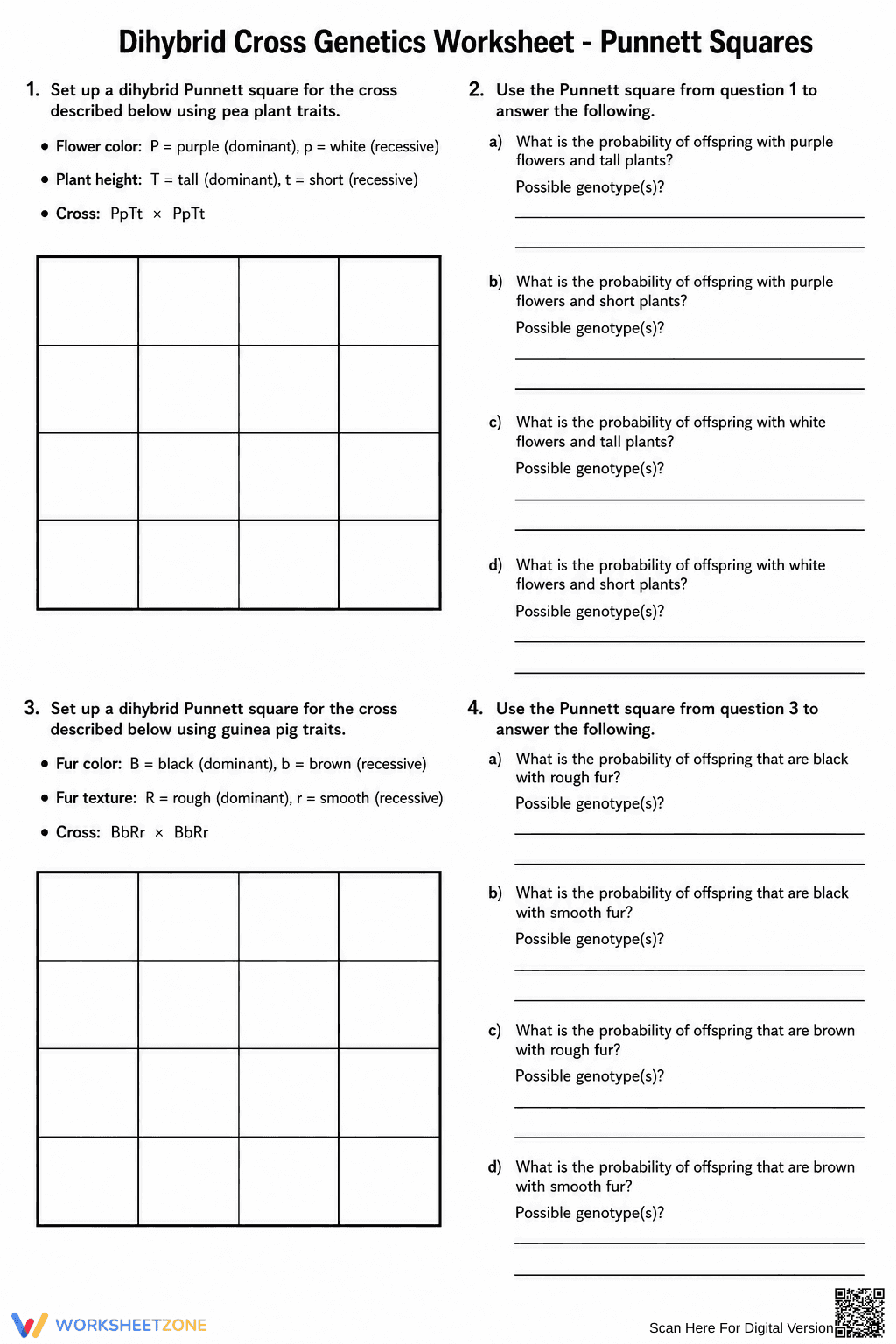

Essential Dihybrid Cross Worksheet | Grade 9-11 Biology

Paste this activity's link or code into your existing LMS (Google Classroom, Canvas, Teams, Schoology, Moodle, etc.).
Students can open and work on the activity right away, with no student login required.
You'll still be able to track student progress and results from your teacher account.
This Grade 9-11 biology worksheet provides targeted practice for mastering dihybrid crosses and Mendelian inheritance patterns. Students learn to predict phenotypic ratios and identify specific genotypes using complex 16-square Punnett grids. By calculating probabilities for traits in pea plants and guinea pigs, learners gain confidence in applying statistical models to biological inheritance.
At a Glance
- Grade: 9-11 · Subject: Biology
- Standard:
HS-LS3-3— Apply probability to explain the variation and distribution of expressed traits- Skill Focus: Dihybrid cross calculation
- Format: 1 page · 10 tasks · Answer key included · PDF
- Best For: Independent practice or formative assessment
- Time: 25–35 minutes
What's Inside
This single-page PDF features two comprehensive dihybrid cross scenarios. The first scenario utilizes classic Mendelian pea plant traits (flower color and height), while the second applies the same logic to guinea pig fur characteristics. Each section includes a blank 16-cell Punnett square and four multi-part analysis questions requiring students to determine both the probability and the specific genotypes of potential offspring.
Skill Progression
- Guided practice: The worksheet begins by defining dominant and recessive alleles for two traits, providing the parental genotypes (PpTt x PpTt) to ensure a successful setup.
- Supported practice: Students fill in the 16-cell grid, visually mapping the independent assortment of alleles across the matrix.
- Independent practice: Learners analyze the completed grid to calculate four distinct phenotypic probabilities and list all corresponding genotypes.
This gradual-release approach moves students from basic setup to high-level statistical analysis of genetic variation.
Standards Alignment
This resource is aligned with HS-LS3-3, which requires students to apply concepts of statistics and probability to explain the variation and distribution of expressed traits in a population. It also supports MS-LS3-2 for advanced middle school learners. Both standard codes can be copied directly into lesson plans, IEP goals, or district curriculum mapping tools.
How to Use It
Use this worksheet as a mid-unit formative assessment after students have mastered monohybrid crosses but before introducing non-Mendelian inheritance. During instruction, observe if students correctly apply the FOIL method to determine gametes for the Punnett square headers. This activity typically takes 30 minutes and serves as an excellent check for understanding before a unit exam.
Who It's For
This practice is designed for high school biology students, including those in Honors or AP tracks who need to solidify their understanding of Mendelian ratios. It pairs naturally with a lecture on the Law of Independent Assortment or a virtual genetics lab. For students needing extra support, provide a pre-filled gamete header for the first square.
According to the RAND AIRS 2024 report, structured practice with visual models like Punnett squares significantly improves student retention of complex inheritance patterns. This worksheet addresses the HS-LS3-3 standard by requiring students to translate abstract genetic codes into quantifiable phenotypic probabilities. By working through 10 distinct tasks, learners move beyond rote memorization toward a functional understanding of how traits are distributed across generations. Research from Fisher & Frey (2014) emphasizes that the gradual release of responsibility, as seen in the transition from guided setup to independent probability calculation, is essential for mastery in secondary science. This resource provides the necessary scaffolding to ensure students can accurately predict genetic outcomes in diverse biological contexts, making it a reliable tool for any high school biology curriculum focused on evidence-based genetics instruction.


