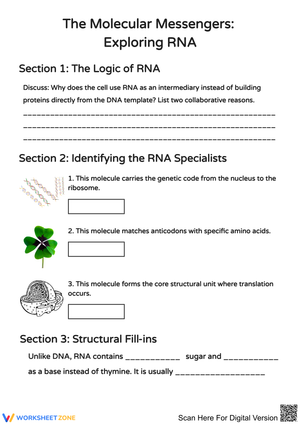
These 10th grade RNA worksheets give biology teachers a structured set of practice activities covering the structural differences between DNA and RNA, the roles of mRNA, tRNA, and rRNA, and the mechanics of transcription and translation. Each worksheet isolates a specific skill so students build competency through focused repetition rather than trying to hold the entire central dogma in mind at once.
What's Inside the Set
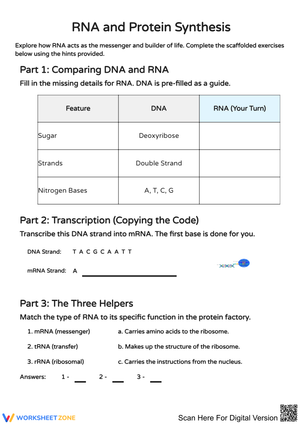
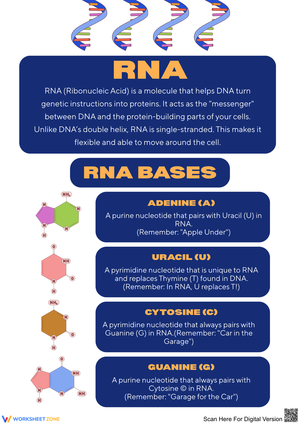
The worksheets address RNA at three levels of complexity. At the structural level, students label nucleotide components — phosphate group, ribose sugar, and the four nitrogenous bases — and compare them directly against a DNA diagram. The deliberate side-by-side format forces students to articulate the substitution of uracil for thymine and the shift from deoxyribose to ribose, two distinctions that are easy to state but harder to apply under pressure.
Transcription worksheets present a DNA template strand and ask students to write the complementary mRNA sequence, then identify the promoter region and note the direction of synthesis. Translation worksheets follow: students segment a completed mRNA strand into codons, use a codon table to identify the corresponding amino acids, and mark the start and stop signals. A separate set of concept-mapping worksheets asks students to place terms — nucleus, ribosome, RNA polymerase, tRNA anticodon — into a central dogma flowchart, which tests whether students understand sequence and location, not just vocabulary definitions.
Standard Alignment
These worksheets align with NGSS HS-LS1-1, which asks students to construct models that explain how DNA encodes the instructions for protein synthesis. In classroom terms, this standard appears in the 10th grade RNA unit as the expectation that students can trace a sequence from a DNA template through mRNA synthesis and into an amino acid chain — not just name the steps, but execute them accurately. The transcription and translation worksheets address that performance expectation directly. The structural comparison worksheets support HS-LS3-1, which focuses on how DNA and RNA interact in the inheritance and expression of genetic information.
Frequent Student Errors Worth Watching For
The most persistent error in transcription practice is copying the coding strand of DNA rather than reading the template strand. A student who scores perfectly on base-pairing flashcards will still write the wrong mRNA sequence if they grab the wrong DNA strand — the mRNA ends up being identical to the coding strand rather than complementary to the template, which looks almost right and is easy to miss in a quick review. These worksheets label both DNA strands explicitly and include a directional arrow so students practice identifying the template before they write a single base.
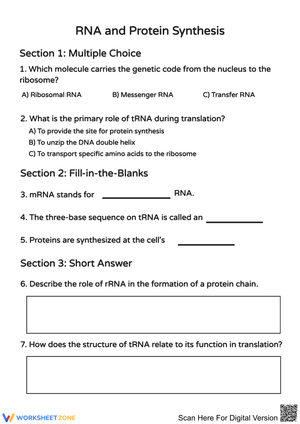
In translation, the codon table causes its own category of mistakes. Students routinely look up the tRNA anticodon on the chart instead of the mRNA codon, arriving at the right amino acid for the wrong reason — or the wrong amino acid entirely when the anticodon doesn't map cleanly. The worksheets address this by requiring students to circle the mRNA codon in one color before they touch the table, which slows down the lookup process enough to make the error visible before it compounds across a full protein sequence.
A third error pattern appears in concept mapping: students consistently place translation in the nucleus rather than at the ribosome. They know the ribosome is involved but underestimate its specificity as a location. Watching for nucleus/ribosome reversals in completed flowcharts is one of the faster formative reads on whether the class is ready to move forward.
How to Build These Worksheets Into Your Lesson Plans
Short transcription worksheets work well as Monday warm-ups at the start of a gene expression unit — five minutes, four base pairs, immediate feedback. Students who had the weekend between lessons and students who reviewed over the break show clearly different results, which gives useful early information without consuming a full class period.
The codon table worksheets are well-suited to station rotations. Set the translation worksheet at one station alongside a printed codon wheel, a second station with the structural labeling diagrams, and a third station with a short comparative writing prompt asking students to explain in two sentences why a cell needs all three RNA types rather than just mRNA. The rotation format keeps groups small enough that peer explanation happens naturally — students who have internalized the anticodon concept explain it to students who haven't, which is more durable than another teacher restatement.
Exit tickets using transcription sequences are a reliable formative check before the unit moves into protein synthesis disorders or biotechnology applications. If more than a quarter of the class is still confusing the template and coding strands on exit, that's the signal to revisit before introducing CRISPR or mutation consequences, where the error compounds significantly.
Adjusting the Worksheets for Different Student Levels
Students who are still building confidence with base-pairing can work with a partially completed mRNA strand — every third base is left blank rather than the entire sequence. This reduces the volume of transcription required without removing the cognitive demand of applying the pairing rules. Providing a reference card listing the RNA base-pairing rules alongside the worksheet (rather than requiring recall from memory) is a reasonable scaffold for the first few sessions; most students internalize the rules within a week of repeated practice and no longer need the card.
For students who move through transcription and translation quickly, the extension move is introducing a point mutation into the original DNA template and asking them to trace how it alters the mRNA codon, the amino acid, and potentially the protein function. This is not a separate enrichment worksheet — it is one added line on the existing translation activity, which keeps the classroom manageable and gives advanced students genuinely harder thinking without creating a separate assignment track. Students who work through a missense versus a silent mutation on the same codon table they just used for the base exercise leave with a concrete understanding of why some mutations matter and others don't.
Frequently Asked Questions
Do these worksheets cover all three types of RNA or only mRNA?
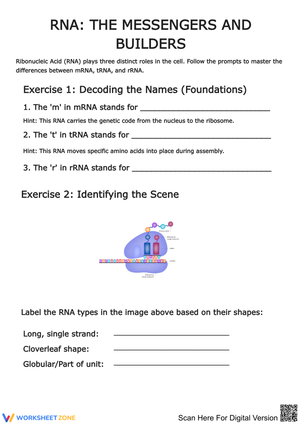
Each worksheet in the set addresses all three types — mRNA, tRNA, and rRNA — though the emphasis shifts depending on the skill being practiced. Structural worksheets compare the three molecules directly. Translation worksheets focus heavily on the mRNA-tRNA interaction at the ribosome, which requires students to understand rRNA's role in forming the ribosome itself before the codon-anticodon matching makes sense in context.
How long does a typical worksheet take to complete?
Most worksheets are designed to fit inside a 10-to-15-minute window, which makes them usable as warm-ups, exit tickets, or station activities without disrupting a 50-minute period. The full-sequence translation worksheets — where students transcribe a DNA template, segment the mRNA, and decode a complete amino acid chain — run closer to 20 minutes and are better suited to an in-class practice block than a quick formative check.
Can these be used with students who have not yet covered DNA structure?
The structural comparison worksheets assume students can identify the basic components of a DNA molecule, including the double helix, deoxyribose sugar, and the four DNA bases. Teachers who are introducing RNA before completing a full DNA unit should begin with the mRNA structure and function worksheets, which define each component from scratch, and return to the comparison diagrams once students have the DNA baseline to work from.