




























Views
Downloads



Essential Dihybrid Cross Worksheet | Grades 9-12 Biology

Paste this activity's link or code into your existing LMS (Google Classroom, Canvas, Teams, Schoology, Moodle, etc.).
Students can open and work on the activity right away, with no student login required.
You'll still be able to track student progress and results from your teacher account.
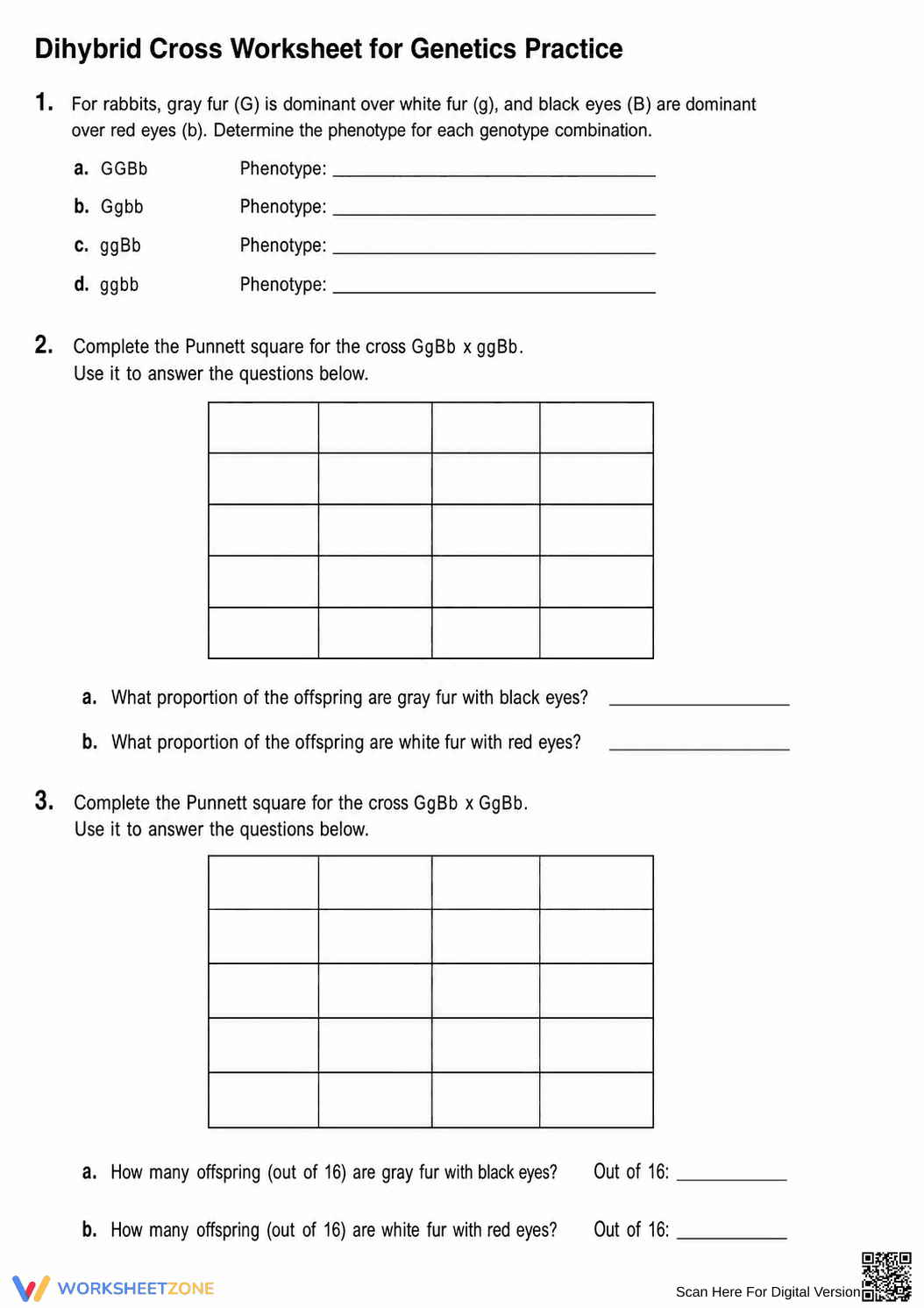
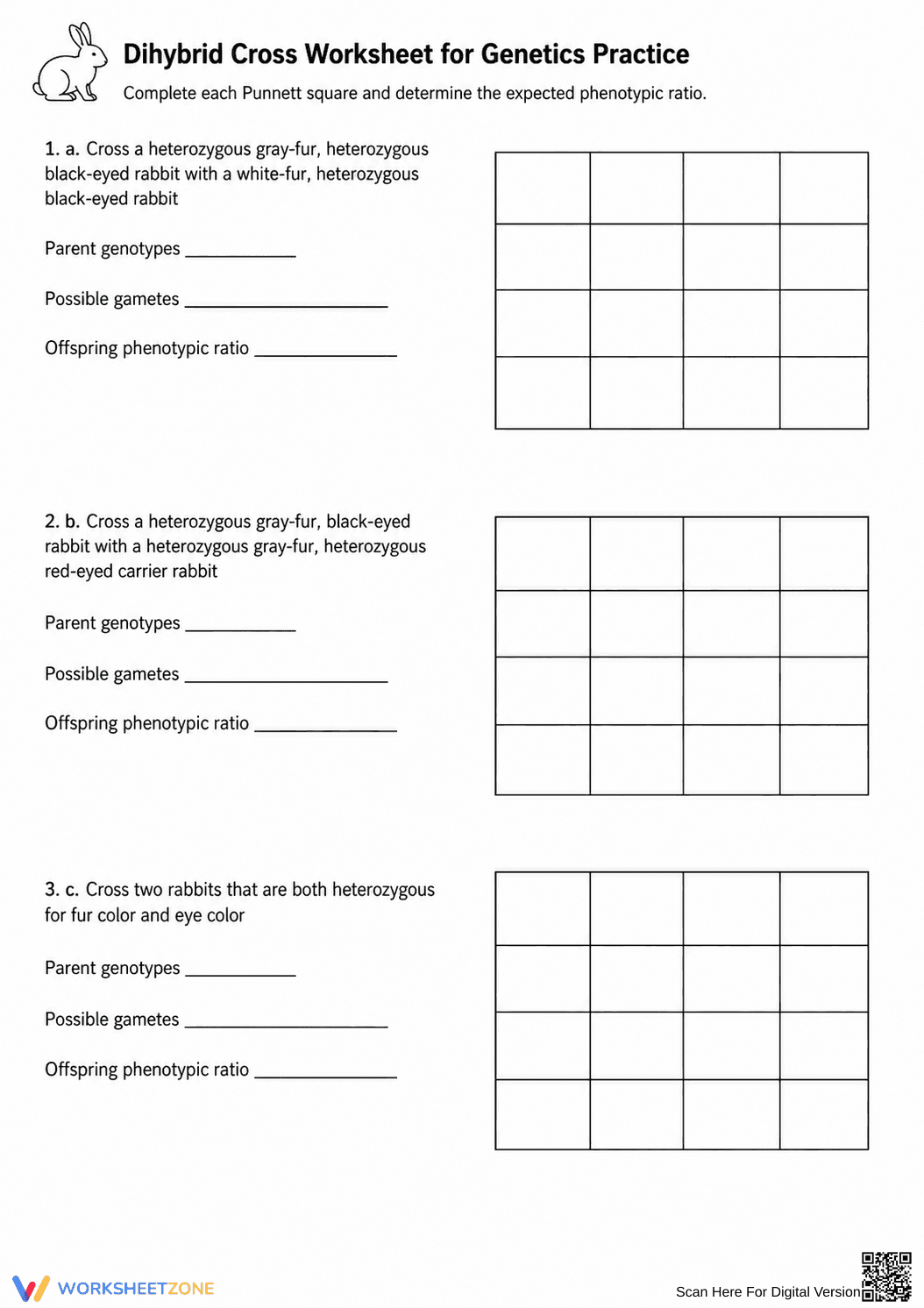
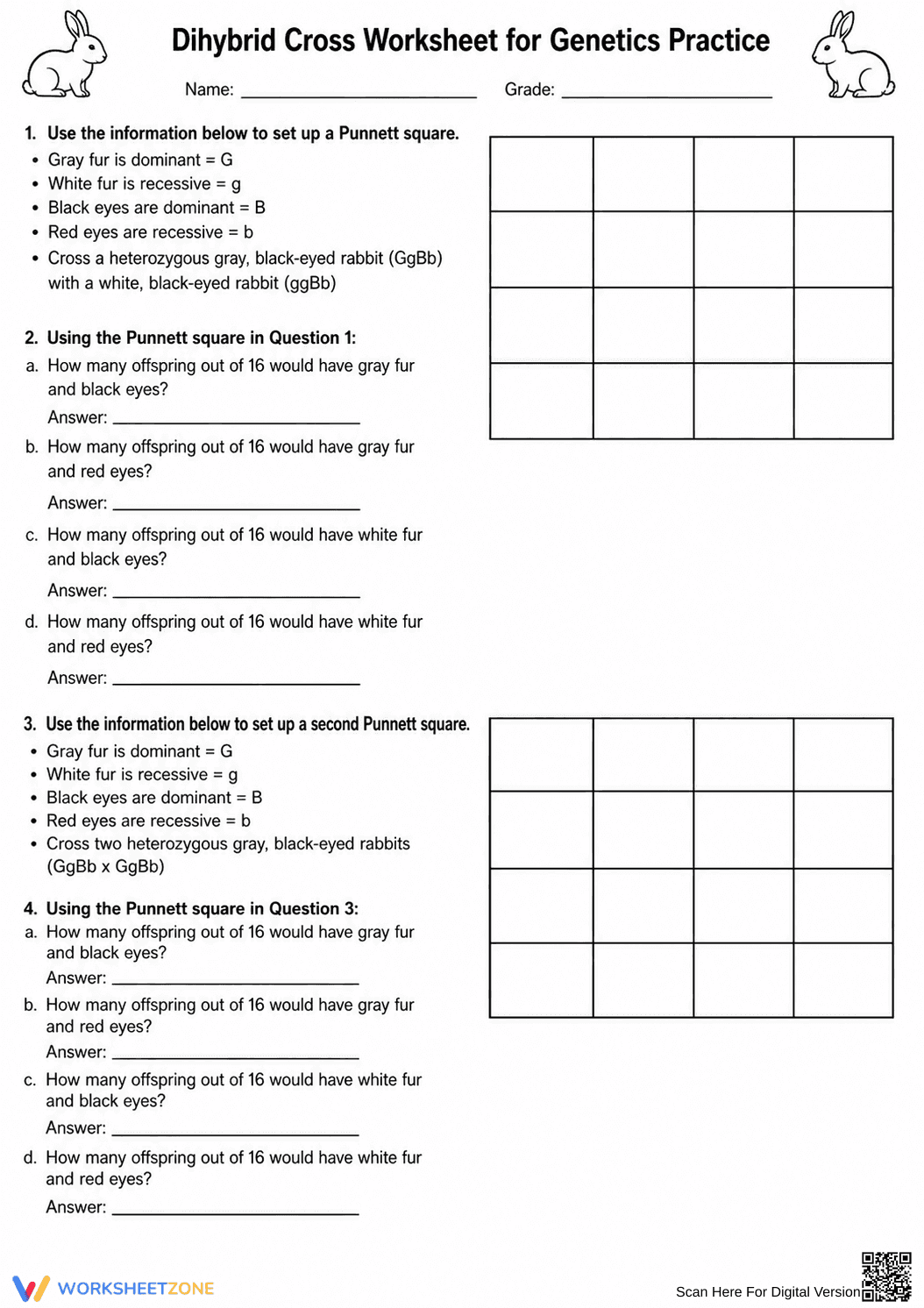
This comprehensive genetics resource provides students with rigorous practice in predicting offspring outcomes for two traits simultaneously. By calculating phenotypic ratios and filling 16-square Punnett grids, learners master the statistical foundations of Mendelian inheritance. This worksheet ensures students can accurately translate complex genotypes into observable physical traits.
At a Glance
- Grade: 9-12 · Subject: Biology
- Standard:
HS-LS3-3— Apply probability to explain the variation and distribution of expressed traits- Skill Focus: Dihybrid Punnett Squares
- Format: 6 pages · 12 problems · Answer key included · PDF
- Best For: Formative assessment of Mendelian inheritance
- Time: 30–45 minutes
Inside this 6-page PDF, you will find multiple versions of a dihybrid cross scenario involving rabbit fur and eye color. The resource includes structured Punnett squares, genotype-to-phenotype translation tables, and specific probability questions. A full answer key is provided to facilitate quick grading or student self-correction.
Differentiated Learning Levels
- Below Grade Level: Features pre-filled gametes and a simplified genotype key to support students who are still mastering the setup of 16-square grids.
- On Grade Level: Requires students to independently derive gametes from parental genotypes and complete the full Punnett square and phenotypic ratios.
- Above Grade Level: Includes extension questions that require students to calculate the probability of specific multi-trait combinations without visual prompts.
This resource is strictly aligned to HS-LS3-3. Students must apply concepts of statistics and probability to explain the variation and distribution of expressed traits in a population. This standard code can be copied directly into lesson plans, IEP goals, or district curriculum mapping tools.
Use this worksheet during the practice phase of a genetics unit. It works well as a collaborative activity where pairs of students work through different levels based on their current mastery. For a formative assessment, observe how students determine gametes (FOIL method) to identify common misconceptions before the unit exam.
This practice set is designed for high school biology students, including those in Honors or AP tracks. It pairs naturally with a direct instruction lesson on Mendel's Law of Independent Assortment or a laboratory activity involving real-world trait observation in model organisms.
The HS-LS3-3 standard requires students to apply concepts of statistics and probability to explain the variation and distribution of expressed traits in a population. This dihybrid cross worksheet facilitates this by requiring students to calculate phenotypic ratios and predict offspring outcomes using 16-square Punnett grids. Research by Fisher & Frey (2014) emphasizes that scaffolded practice in complex scientific modeling, such as genetics, is critical for moving students from surface-level understanding to deep conceptual mastery. By providing three distinct levels of difficulty, this resource ensures that all learners can engage with the mathematical rigor of Mendelian inheritance. The inclusion of specific rabbit traits provides a concrete biological context for abstract probability calculations. This structured approach aligns with evidence-based instructional strategies that promote scientific literacy and data analysis skills. Educators can use these results to inform future instruction on non-Mendelian patterns and complex inheritance.


