




























Views
Downloads

Printable Dihybrid Cross Worksheet | High School Biology

Paste this activity's link or code into your existing LMS (Google Classroom, Canvas, Teams, Schoology, Moodle, etc.).
Students can open and work on the activity right away, with no student login required.
You'll still be able to track student progress and results from your teacher account.
This high school biology worksheet helps students master dihybrid crosses by predicting offspring traits using 4x4 Punnett squares. By working through relatable examples involving bunny genetics, learners will calculate phenotypic ratios and solidify their understanding of Mendelian inheritance, dominant alleles, and recessive traits.
At a Glance
- Grade: 9-11 · Subject: Biology
- Standard:
HS-LS3-3— Apply probability concepts to explain trait variation.- Skill Focus: Dihybrid Crosses & Phenotypic Ratios
- Format: 2 pages · 4 problems · Answer key included · PDF
- Best For: Independent practice and review
- Time: 25–35 minutes
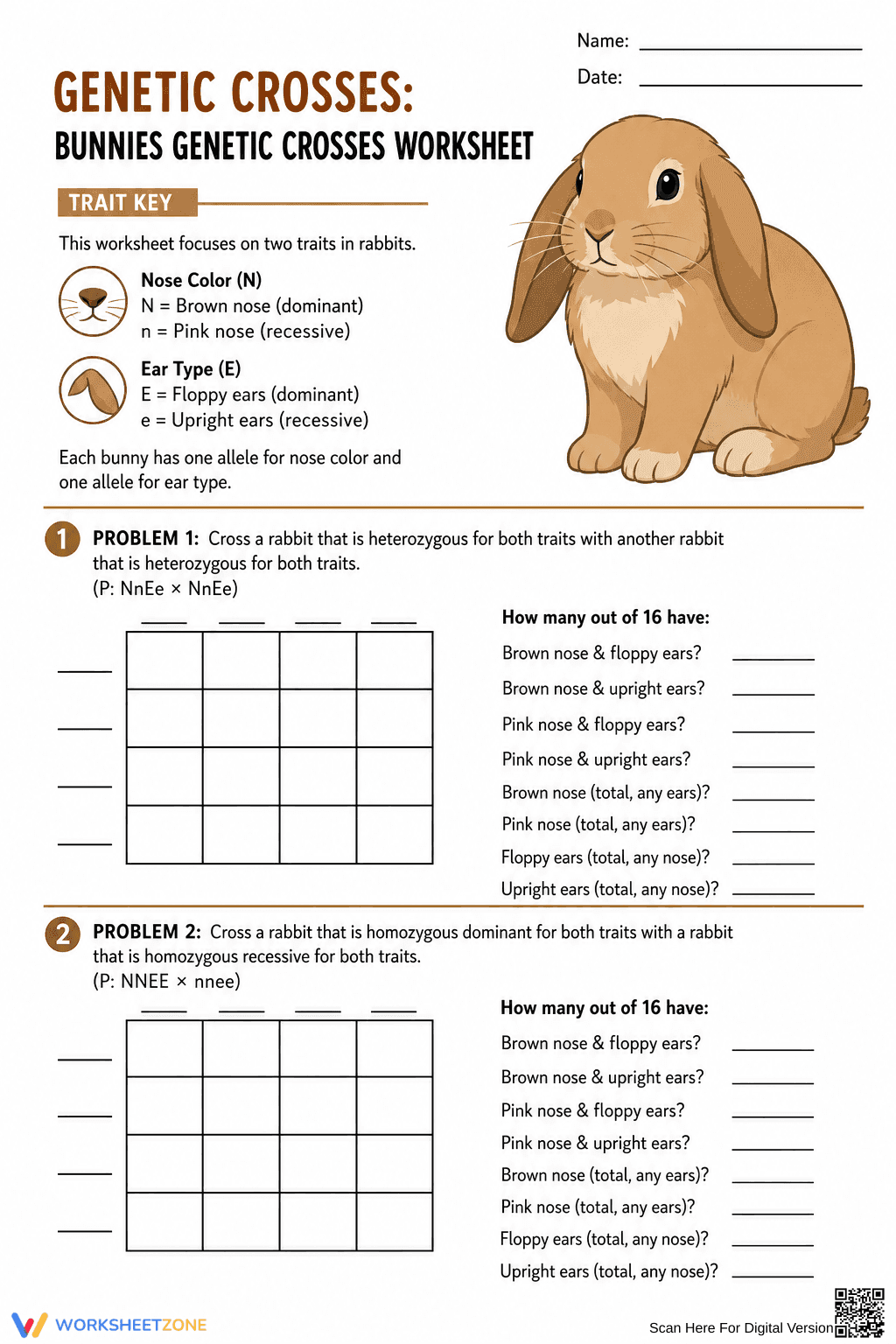
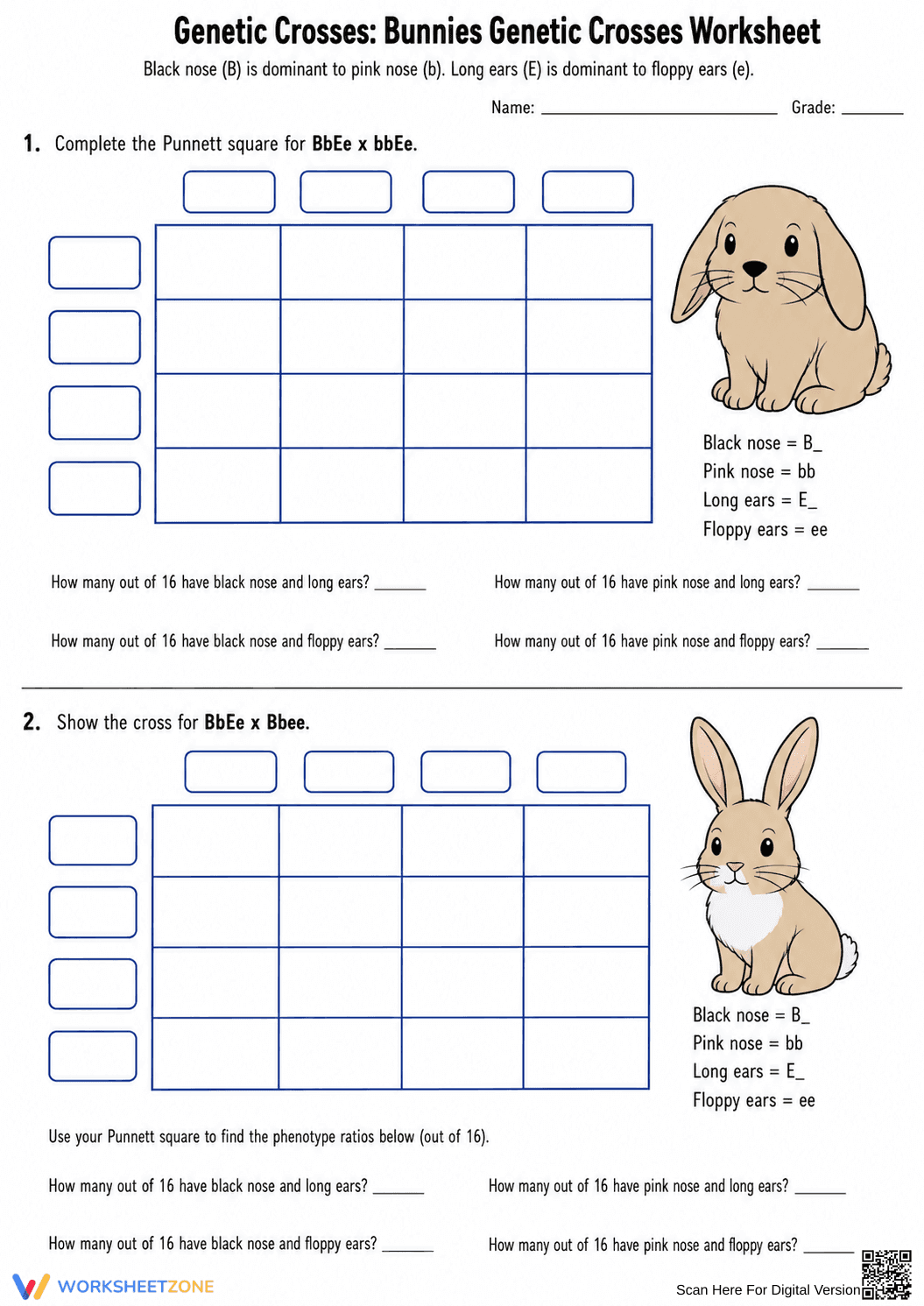
This two-page resource features four dihybrid cross problems centered around bunny genetics. Each problem includes a blank 16-box Punnett square and a section for calculating phenotypic ratios. A clear trait key helps students identify dominant and recessive alleles before crossing parent genotypes. An answer key is included.
- Guided practice: The first page introduces the trait key and provides straightforward heterozygous crosses (e.g., NnEe x NnEe) to establish the foundational steps of setting up a 4x4 grid.
- Supported practice: Students progress to crossing homozygous dominant and homozygous recessive parents, reinforcing how allele combinations dictate physical traits.
- Independent practice: The second page challenges learners with mixed genotype crosses (e.g., BbEe x bbEe), requiring them to independently determine gametes and calculate exact phenotypic outcomes.
This gradual-release approach ensures students build confidence as they move from basic I Do, We Do setups to complex You Do independent problem-solving.
This worksheet is aligned to the Next Generation Science Standards, specifically HS-LS3-3: Apply concepts of statistics and probability to explain the variation and distribution of expressed traits in a population. It directly supports students in using mathematical reasoning to predict the frequency of specific phenotypes in a genetic cross. Both standard codes can be copied directly into lesson plans, IEP goals, or district curriculum mapping tools.
Deploy this worksheet during a genetics unit, following direct instruction on independent assortment. It serves as an excellent in-class assignment where students can work in pairs to verify their grid setups. As a formative assessment tip, observe how students determine the parent gametes using the FOIL method before they fill in the squares; this is where most misconceptions occur. Expect students to complete the two pages in 25 to 35 minutes.
This resource is designed for high school biology students in grades 9 through 11. It is easily differentiated by allowing struggling learners to use a pre-filled gamete guide, while advanced students can be challenged to convert the out-of-16 ratios into percentages. It pairs perfectly with an introductory lesson on Mendelian genetics or a visual anchor chart demonstrating the FOIL method for dihybrid crosses.
Mastering complex genetic inheritance requires repeated, structured practice with mathematical models. According to a ScienceDirect TpT Analysis, providing students with relatable, visual examples significantly improves their ability to grasp abstract biological concepts. This worksheet targets standard HS-LS3-3, requiring students to apply probability concepts to explain trait variation through the use of dihybrid Punnett squares. By calculating phenotypic ratios for bunny ear and nose traits, learners bridge the gap between theoretical allele combinations and observable physical characteristics. The structured format of the 16-box grids reduces cognitive overload, allowing students to focus on the statistical probability of inheritance rather than formatting. This targeted practice ensures that high school biology students develop the analytical skills necessary to predict genetic outcomes accurately, forming a strong foundation for advanced studies in molecular biology and population genetics.


