


























Views
Downloads


Dihybrid Cross Practice Worksheet | Essential Biology
Paste this activity's link or code into your existing LMS (Google Classroom, Canvas, Teams, Schoology, Moodle, etc.).
Students can open and work on the activity right away, with no student login required.
You'll still be able to track student progress and results from your teacher account.
This Grade 9-12 dihybrid cross worksheet provides comprehensive practice for students mastering complex Mendelian genetics. By solving 12 multi-part problems, learners will accurately predict offspring genotypes and phenotypes for two independent traits. This resource ensures students can calculate mathematical probabilities and understand the law of independent assortment through structured, repetitive application.
At a Glance
At a Glance
- Grade: 9-12 · Subject: Biology
- Standard:
HS-LS3-3— Apply probability to explain the variation and distribution of expressed traits- Skill Focus: Dihybrid Crosses
- Format: 5 pages · 12 problems · Answer key included · PDF
- Best For: High school genetics unit practice
- Time: 45–60 minutes
What's Inside
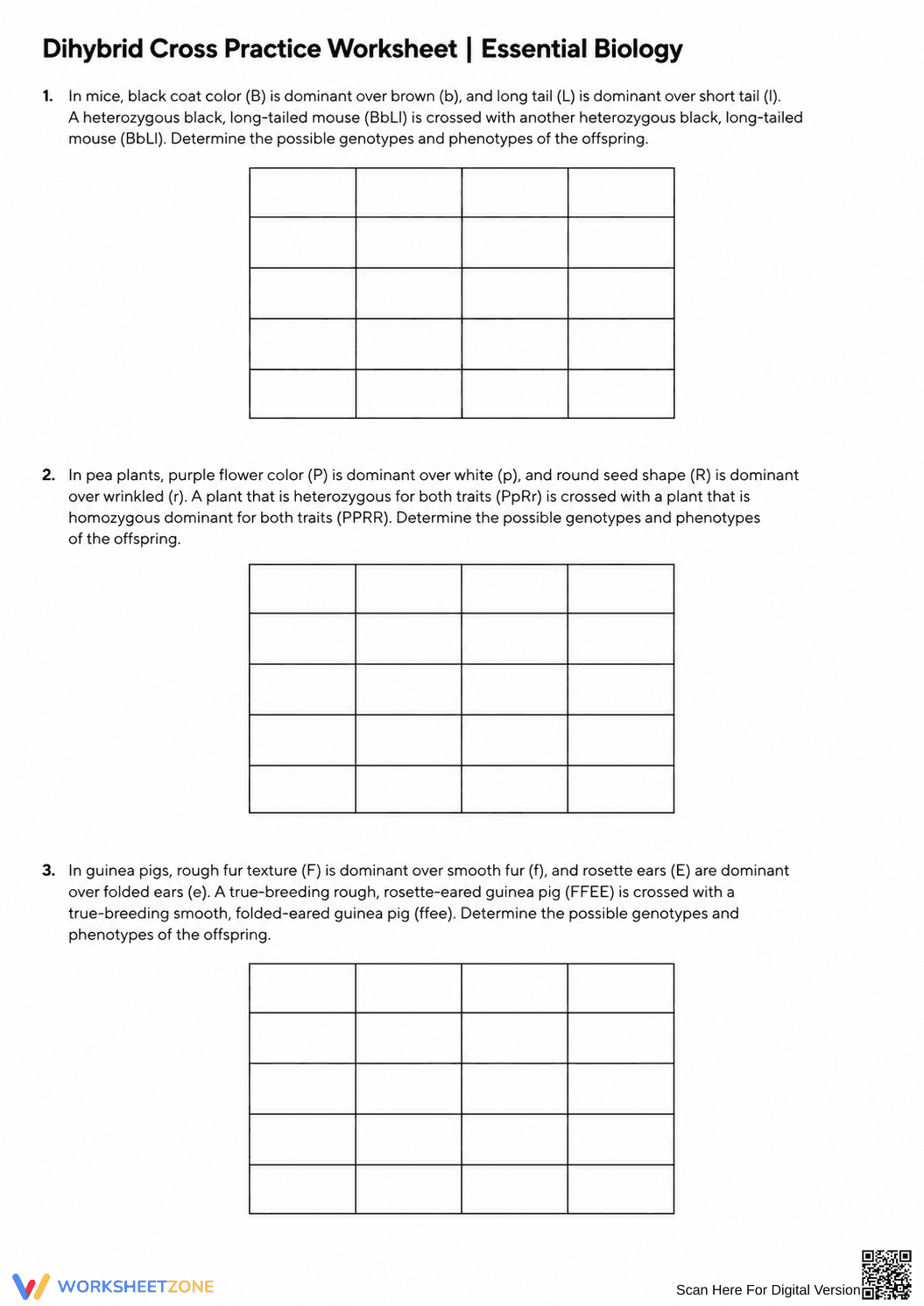
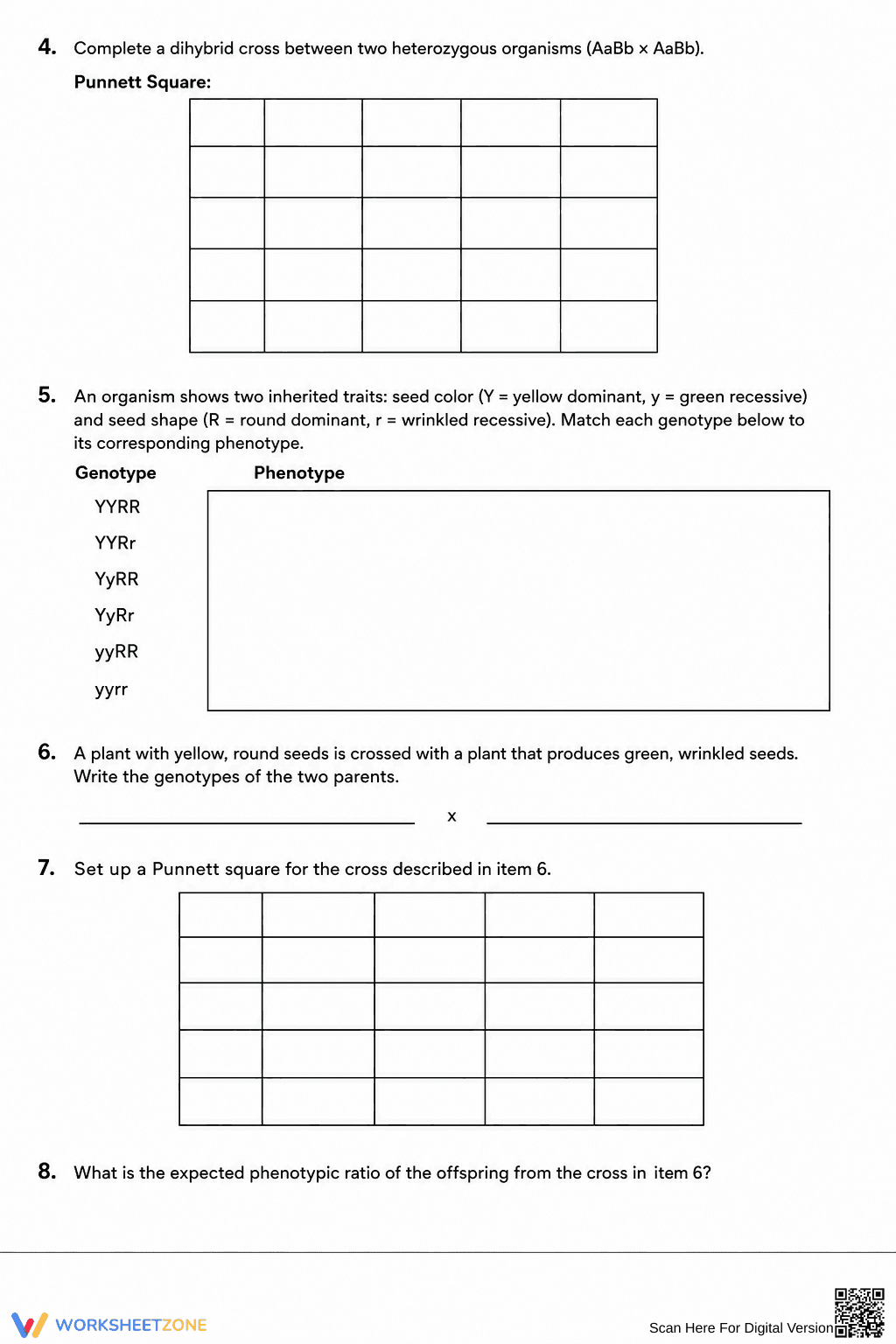
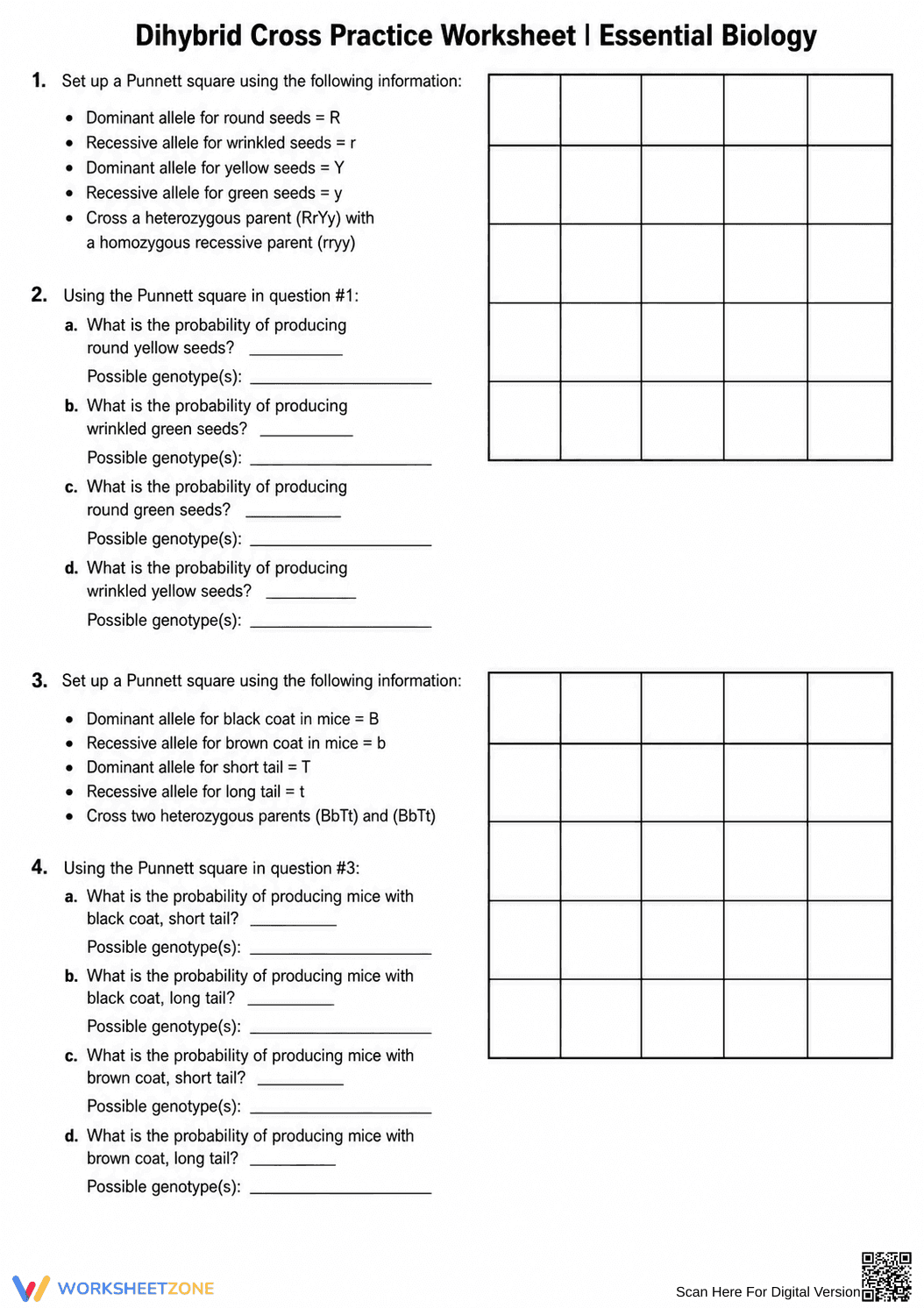
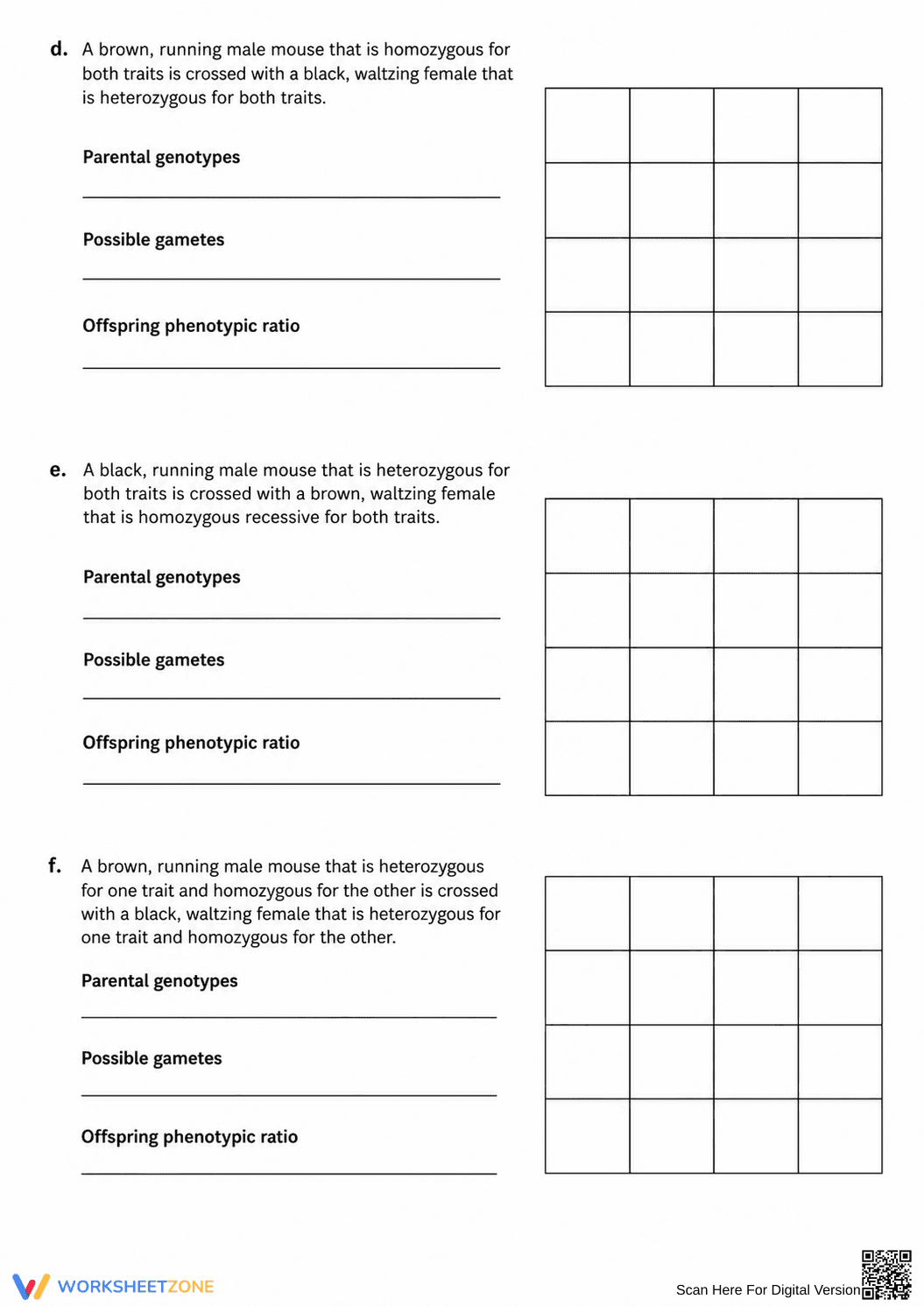
Inside this 5-page PDF, you will find a series of increasingly difficult genetics scenarios involving humans, horses, squash, and mice. The worksheet includes 12 large-format Punnett squares, dedicated space for parental genotype identification, and specific prompts for phenotypic ratio analysis. A complete answer key is provided to facilitate quick grading or student self-correction during independent study sessions.
Skill Progression
- Guided Practice: The first 3 problems provide pre-formatted 16-square grids and clearly defined dominant/recessive alleles to establish foundational mechanics.
- Supported Practice: Problems 4 through 8 transition to scenario-based prompts where students must identify parental genotypes and determine gametes before filling the squares.
- Independent Practice: The final 2 pages present complex multi-part questions requiring students to calculate specific phenotypic ratios and probabilities without structural scaffolds.
This sequence follows the gradual-release model, moving from teacher-led modeling to independent student mastery of complex inheritance patterns.
Standards Alignment
This resource is primarily aligned to `HS-LS3-3`: Apply concepts of statistics and probability to explain the variation and distribution of expressed traits in a population. It also supports HS-LS3-2 by illustrating how meiosis and fertilization lead to genetic variation. Both standard codes can be copied directly into lesson plans, IEP goals, or district curriculum mapping tools.
How to Use It
Assign this worksheet during the middle of a genetics unit after students have mastered monohybrid crosses. It works effectively as a collaborative lab activity where pairs solve one page together before rotating. For formative assessment, observe students during problem 5 to ensure they are correctly segregating alleles into gametes. Expect a completion time of 45 to 60 minutes.
Who It's For
This packet is designed for Grade 9-12 Biology students, including those in Honors or AP tracks requiring rigorous probability practice. It provides sufficient repetition for students needing extra support with mathematical ratios. Pair this with a visual anchor chart showing the FOIL method for gamete distribution for maximum instructional impact.
The HS-LS3-3 standard requires students to apply concepts of statistics and probability to explain the variation and distribution of expressed traits. This dihybrid cross worksheet facilitates this by requiring 12 distinct multi-trait analyses. According to Fisher & Frey (2014), the gradual release of responsibility model—moving from scaffolded Punnett squares to independent gamete determination—is vital for mastering abstract biological concepts. By calculating phenotypic ratios and genotypic probabilities, students move beyond rote memorization into active scientific inquiry. This resource provides the necessary repetition to ensure students can predict inheritance patterns with high accuracy in controlled assessments. The inclusion of diverse organisms, from arthropods to guinea pigs, reinforces the universality of Mendelian genetics across different species. This comprehensive 5-page packet serves as a foundational tool for high school biology curriculum mapping and individual student progress monitoring in genetics units.


