




























Views
Downloads

Printable Dihybrid Cross Worksheet | Grade 9-11 Biology

Paste this activity's link or code into your existing LMS (Google Classroom, Canvas, Teams, Schoology, Moodle, etc.).
Students can open and work on the activity right away, with no student login required.
You'll still be able to track student progress and results from your teacher account.
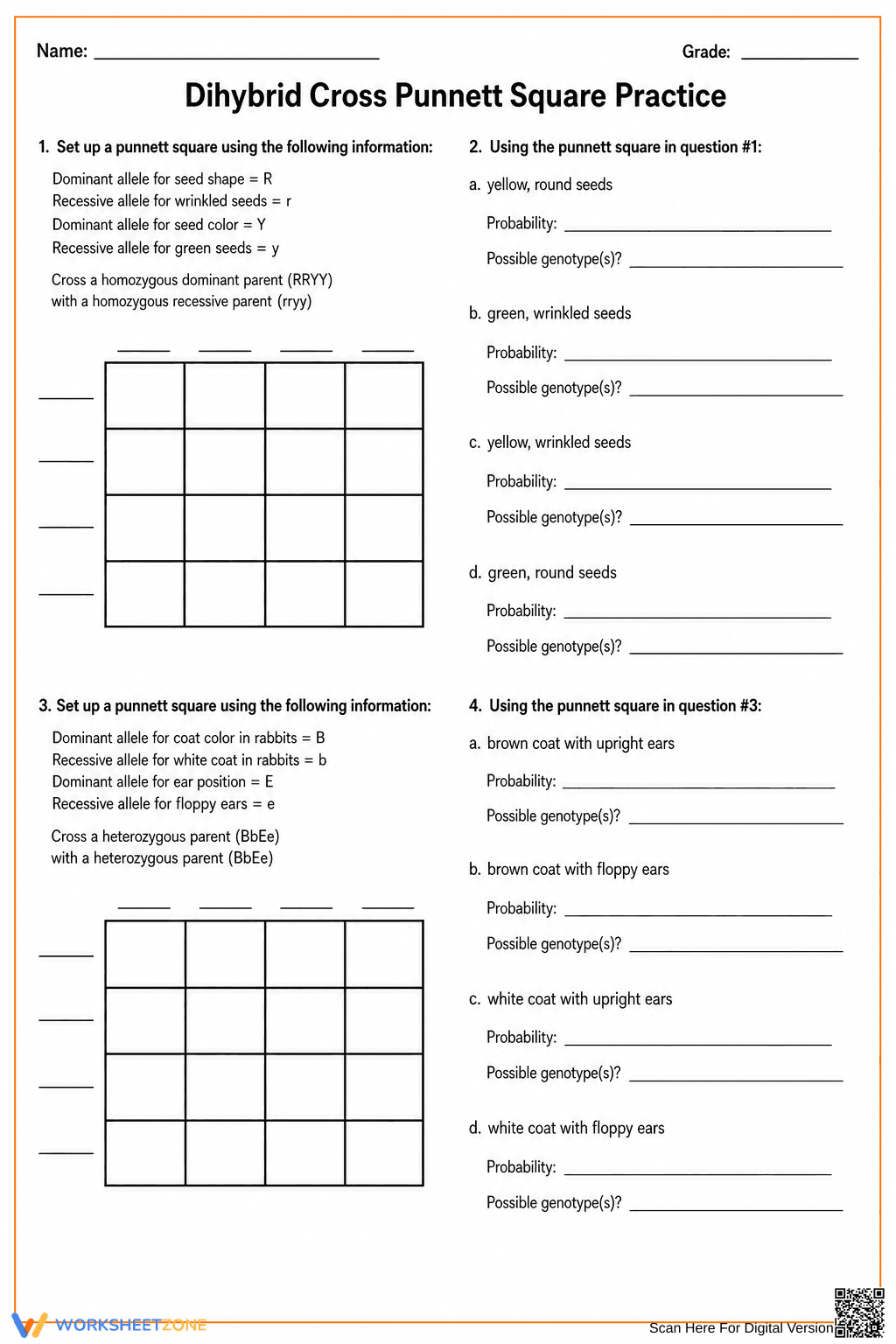
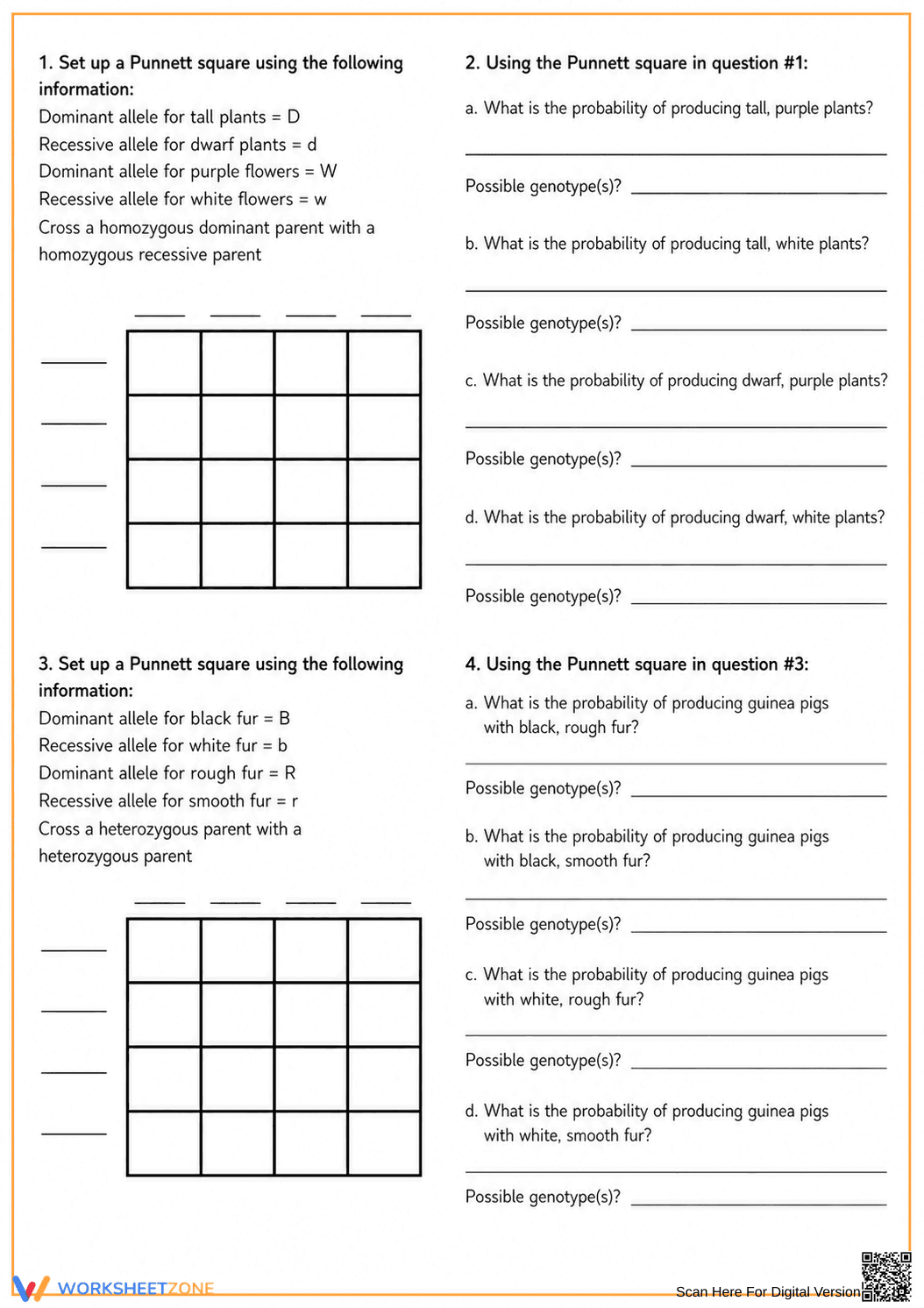
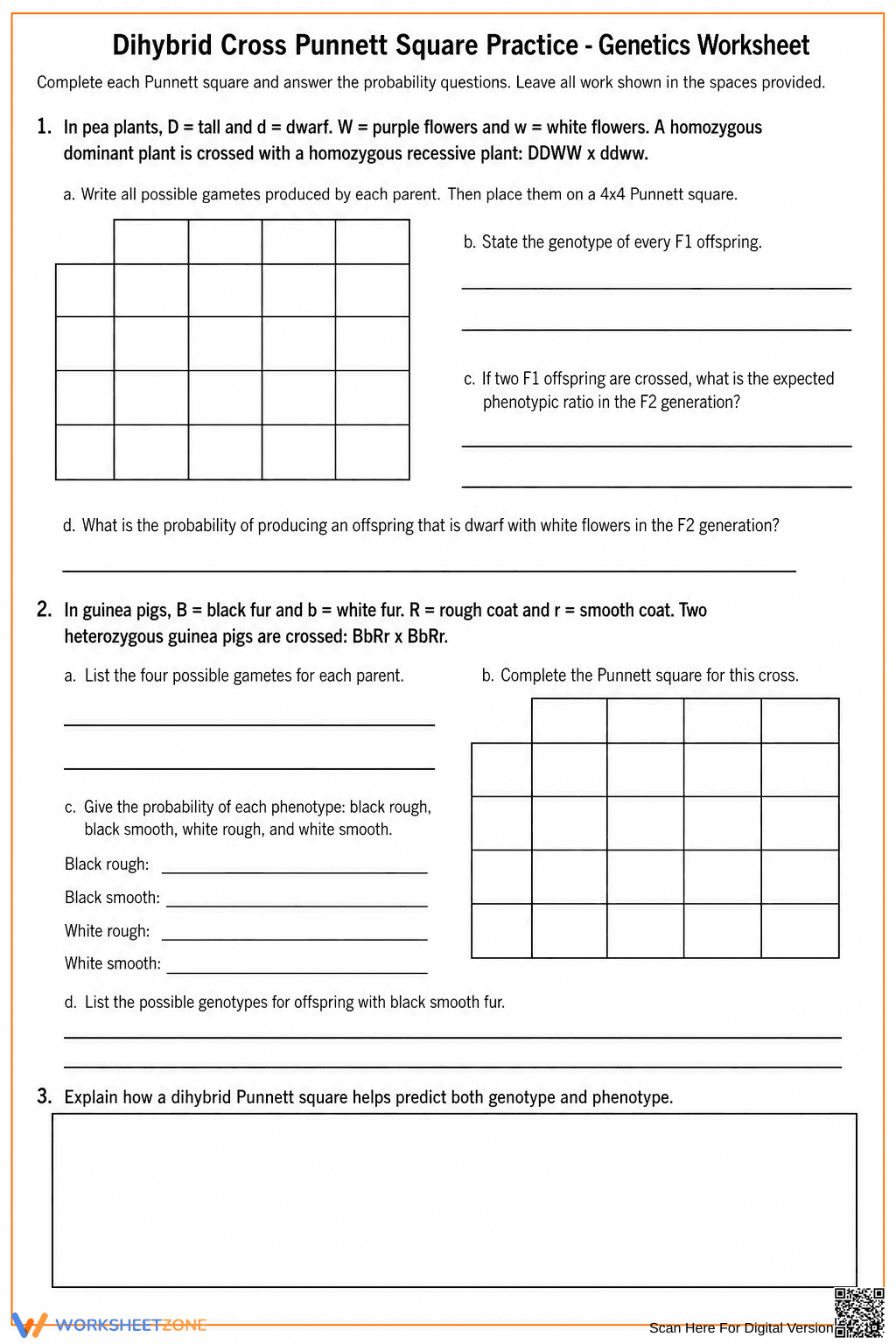
This high school biology worksheet provides focused practice on dihybrid crosses, helping students master complex inheritance patterns. By completing 4x4 Punnett squares, learners will calculate phenotypic and genotypic probabilities for two traits simultaneously, solidifying their foundational understanding of Mendelian genetics and independent assortment.
At a Glance
- Grade: 9-11 · Subject: Biology
- Standard:
HS-LS3-3— Apply probability to explain trait variation- Skill Focus: Dihybrid Crosses & Punnett Squares
- Format: 3 pages · 12 problems · Answer key included · PDF
- Best For: Independent practice and review
- Time: 30–45 minutes
Inside this comprehensive packet, educators will find three pages of structured genetics problems. Students are tasked with identifying parent genotypes, determining possible gamete combinations, and filling out 16-box Punnett squares. The resource includes a complete answer key to streamline grading and ensure accurate feedback on complex probability calculations.
- Guided practice: The initial problems provide explicit parent genotypes and step-by-step prompts to set up the 4x4 grid, ensuring students understand the basic mechanics of gamete distribution.
- Supported practice: Subsequent tasks require learners to extract allele information from word problems, bridging the gap between reading comprehension and genetic application.
- Independent practice: The final sections challenge students to calculate specific phenotypic ratios and explain how dihybrid crosses predict both genotype and phenotype.
This gradual-release approach follows the proven I Do, We Do, You Do model, building student confidence with complex genetic inheritance.
This resource is aligned to HS-LS3-3: Apply concepts of statistics and probability to explain the variation and distribution of expressed traits in a population. It also supports foundational math standards related to calculating compound probabilities. Both standard codes can be copied directly into lesson plans, IEP goals, or district curriculum mapping tools.
Deploy this worksheet immediately following direct instruction on independent assortment and dihybrid crosses. It serves as an excellent independent homework assignment or in-class collaborative activity where students can check each other's 16-box grids. As a formative assessment tip, walk the room and observe whether students are correctly identifying the four possible gametes for each parent before they begin filling in the squares; this is the most common point of error. Expect students to complete the packet in 30 to 45 minutes.
This resource is designed for high school biology students in grades 9 through 11. To support learners who struggle with visual tracking, teachers can provide highlighters to color-code the different alleles within the Punnett squares. It pairs perfectly with a direct instruction lesson on Mendelian genetics or a hands-on coin-flipping probability lab.
Mastering the mechanics of inheritance requires repeated, structured practice with statistical models. This worksheet aligns with HS-LS3-3, requiring students to apply probability to explain trait variation. According to a ScienceDirect TpT Analysis, explicit instruction combined with targeted practice significantly improves student retention of complex biological mechanisms like independent assortment. By breaking down the dihybrid cross into manageable steps—from gamete formation to final phenotypic ratios—this resource reduces cognitive overload. Students who regularly engage with visual models like 16-box Punnett squares demonstrate higher proficiency in predicting genetic outcomes and understanding population variance. Providing immediate feedback through the included answer key further solidifies these essential scientific concepts, ensuring learners are prepared for advanced topics in molecular biology and heredity.


