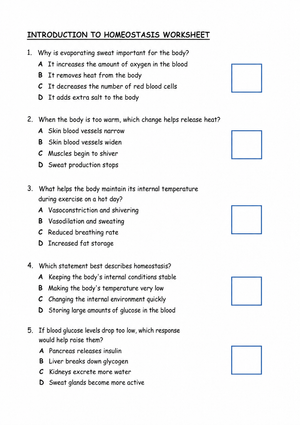
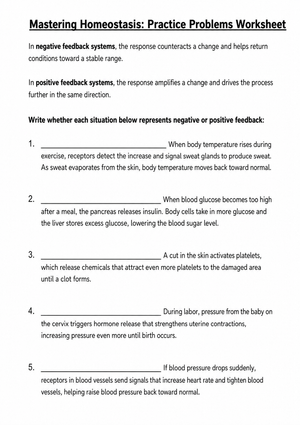
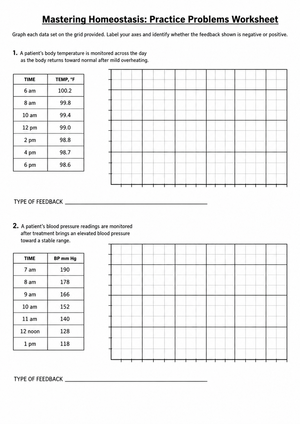
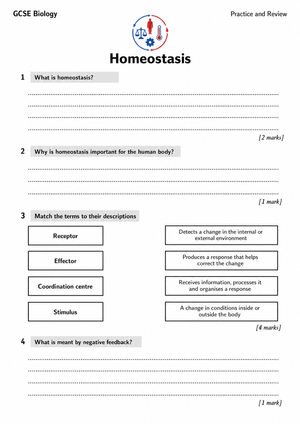
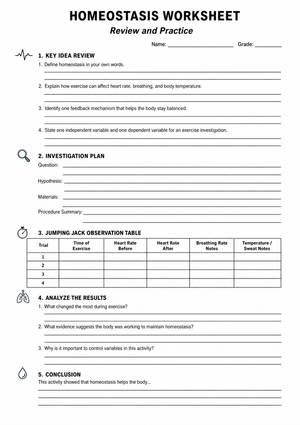
10th grade homeostasis worksheets give biology teachers a reliable way to move students past the definition and into actual system-level reasoning—tracing what detects a change, what processes the signal, and what corrects the imbalance. The set covers feedback loop structure, body system connections, and scenario analysis, so teachers have resources that fit guided instruction, independent practice, formative checks, and unit review without switching platforms.
Student Errors That Surface Quickly in Homeostasis Instruction
The word "negative" in negative feedback consistently misleads students who read it as meaning something harmful or defective. They assume the body is failing, when the term signals that the response opposes the original change. A worksheet that pairs the vocabulary with a complete worked loop—showing that "negative" describes the direction of correction—helps students reframe the term before it becomes entrenched.
A second persistent error involves confusing the receptor with the control center. On labeling diagrams, students frequently place the brain in the receptor slot, especially in thermoregulation examples where peripheral thermoreceptors feel abstract. The most effective correction is to ask students to write a one-sentence function for each component—what it detects, what it decides, what it does—before they attempt any labeling. That sequence resolves the confusion more reliably than re-explaining the terms.
Positive feedback generates a specific misclassification worth anticipating. Students often label exercise-induced heart rate increases as positive feedback because "more activity equals more response" resembles amplification. It is not—it is a regulated increase driven by neural and hormonal signals, not a self-reinforcing loop building toward a defined endpoint. Worksheets that treat positive feedback as its own category—asking students to name the terminal endpoint that stops the loop and contrast it directly with a negative feedback example—address this before it surfaces on a test.
One annotation step that consistently improves accuracy across all scenario questions: require students to underline the variable being regulated before writing any answer. In observed student work, errors cluster around students describing the body's action—sweating, insulin release, vasoconstriction—without first identifying whether temperature, blood glucose, or fluid volume is the thing that must stay within a normal range. That single annotation step changes how students read the scenario.
Concepts and Tasks Across the Set
The worksheets move from vocabulary through applied reasoning so that students are explaining how the body maintains stability, not just naming parts. Tasks across the set include:
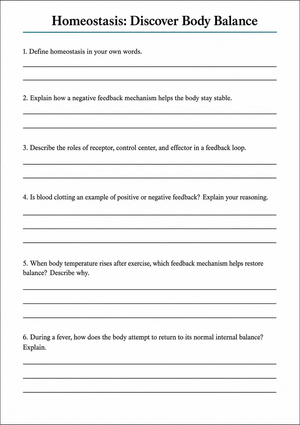
- Defining homeostasis and internal environment: Students write in their own words what it means for a variable to remain within a normal range despite external changes.
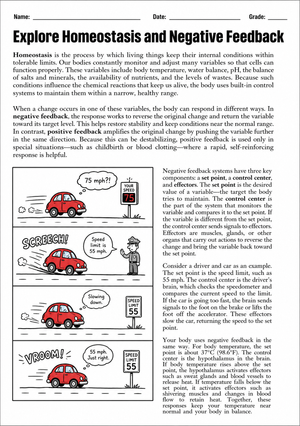
- Identifying feedback loop components: Students label receptors, control centers, and effectors, then write a brief function for each before labeling a full diagram.
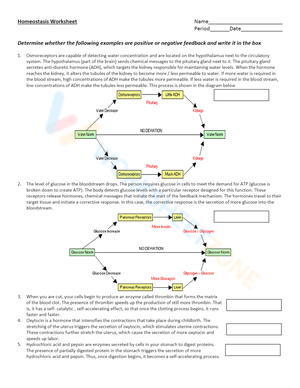
- Negative feedback analysis: Students trace thermoregulation, blood glucose regulation, and water balance step by step—from stimulus through effector response.
- Positive feedback distinction: Students compare amplifying loops such as labor contractions and blood clotting against negative feedback examples, identifying the endpoint that terminates each loop.
- Body system integration: Students connect feedback loop components to the nervous, endocrine, circulatory, respiratory, and excretory systems through short identification questions and diagram work.
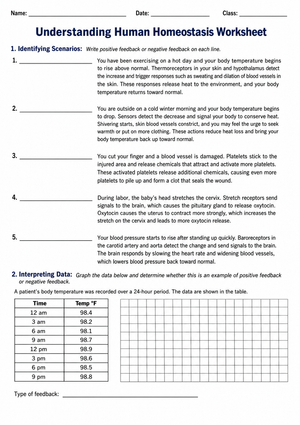
- Scenario-based reasoning: Students read brief physiological scenarios and determine whether the body's response restores a variable to its normal range or amplifies the original change.
Question formats vary across the set—matching, diagram labeling, short answer, and scenario analysis—so teachers can select whichever worksheet fits the day's instructional goal without repeating the same task format.
Working These Worksheets Into Your Unit Sequence
Using 10th grade homeostasis worksheets across a full body systems unit—rather than in one concentrated block—gives students repeated contact with the same analytical framework in different biological contexts. A vocabulary and feedback loop worksheet works well in the first or second class period to establish the conceptual frame. From there, teachers can return to a homeostasis worksheet each time a new body system is introduced: when the endocrine system comes up, students revisit blood glucose regulation; when the excretory system arrives, they revisit water balance. That pattern builds transfer across the unit without requiring a separate review day.
For daily lesson structure, scenario analysis worksheets work well as a 10-minute warm-up after a new system has been introduced in the previous class. Students arrive, read a short physiological scenario, and write out the loop before any instruction begins. That cold attempt surfaces gaps quickly and gives the teacher a clear starting point for the day's discussion. Exit-ticket worksheets—used in the final five to eight minutes of class—close the loop on whether students can apply the concept to a new example after instruction.
For collaborative practice, pairs work well with one student analyzing a negative feedback scenario and the other analyzing a positive feedback scenario from the same worksheet, then comparing their responses. The contrast that emerges generates sharper discussion than a lecture on the difference between the two loop types.
Standard Alignment
These worksheets align directly with NGSS HS-LS1-2, which asks students to develop and use a model to illustrate how interacting systems in multicellular organisms provide specific functions. Feedback loop diagrams and scenario analysis questions address that standard at the application level—students are not recalling a definition but explaining the logic of a coordinated physiological response. HS-LS1-3 is also supported: while these worksheets are not laboratory investigations, they build the conceptual background students need before planning or interpreting an investigation involving feedback mechanisms. In practice, teachers often assign the scenario analysis worksheets as preparatory work before a homeostasis lab, ensuring students can articulate what variable they expect to see regulated before collecting any data.
Adjusting Each Worksheet for Mixed-Ability Biology Classes
10th grade homeostasis worksheets reach a wide range of readiness levels in a typical biology classroom. For students still building their grasp of the vocabulary, provide a partially completed feedback loop diagram—with the stimulus and receptor slots pre-labeled and the effector response left blank. That structure reduces the number of simultaneous decisions a student must make while still requiring them to reason through the biology rather than copy a complete example.
For students who move through identification tasks quickly, the scenario-based worksheets offer natural extension. Replace the familiar thermoregulation scenario with a less common one—osmoregulation in a marine fish, or thermoregulation in an endotherm under heat stress—and ask students to build the full loop from scratch with no pre-labeled components. The underlying logic is identical to the classroom examples, but the unfamiliar context reveals whether students have generalized the concept or only memorized specific cases.
Students who struggle with written explanation benefit from a sentence frame: "When _____ detected a change in _____, the control center _____ in order to _____." That structure keeps students focused on cause-and-effect reasoning without requiring them to generate sentence form and biology content at the same time. Remove the frame once a student demonstrates consistent accuracy across two or three consecutive scenarios.
Frequently Asked Questions
Which body examples work best for introducing feedback loops?
Thermoregulation is the clearest starting point because students have direct experience with sweating and shivering. Once they can trace that loop from stimulus to receptor to control center to effector, blood glucose regulation is the logical next step—it adds endocrine system content and introduces insulin and glucagon in context. Water balance works well as a third example because it connects the excretory system to scenarios students recognize, such as dehydration during exercise or fluid recovery afterward.
How many class periods do these worksheets typically span?
That depends on how teachers use them. A teacher who uses 10th grade homeostasis worksheets as warm-ups and exit tickets will spread the set across five to eight class periods within a body systems unit. A teacher who assigns one worksheet for guided practice and a second for independent review might move through the set more quickly—two or three focused periods. The range of formats means both approaches work without the practice feeling repetitive.
Do the worksheets address positive feedback in enough depth for high school biology?
Yes. Positive feedback is a reliable confusion point because students encounter far more negative feedback examples and sometimes treat positive feedback as a minor variation of the same process. The worksheets address it as a distinct category—asking students to identify the amplifying nature of the response, name the terminal endpoint that stops the loop, and contrast the mechanism directly with a negative feedback example. That contrast is where the distinction actually becomes clear rather than just memorized.
Are answer keys included with each worksheet?
Yes. Each worksheet includes a corresponding answer key. For scenario analysis questions with open-response components, the key provides a model answer along with a note on acceptable variations in student phrasing. This makes the resources workable for sub plans without requiring a detailed lesson handoff.