




























Views
Downloads

Essential Dihybrid Crosses Worksheet | Grade 9-12 Biology

Paste this activity's link or code into your existing LMS (Google Classroom, Canvas, Teams, Schoology, Moodle, etc.).
Students can open and work on the activity right away, with no student login required.
You'll still be able to track student progress and results from your teacher account.
This high school biology worksheet provides comprehensive practice for mastering dihybrid crosses and Mendelian genetics. Students learn to predict complex inheritance patterns by calculating phenotypic and genotypic ratios across 14 structured problems. By the end of these exercises, learners will confidently navigate two-trait Punnett squares and determine offspring probabilities with high accuracy.
At a Glance
- Grade: 9-12 · Subject: Biology
- Standard:
HS-LS3-3— Apply probability concepts to explain the variation and distribution of expressed traits- Skill Focus: Dihybrid Cross Punnett Squares
- Format: 8 pages · 14 problems · Answer key included · PDF
- Best For: High school genetics unit practice
- Time: 45–60 minutes
What's Inside
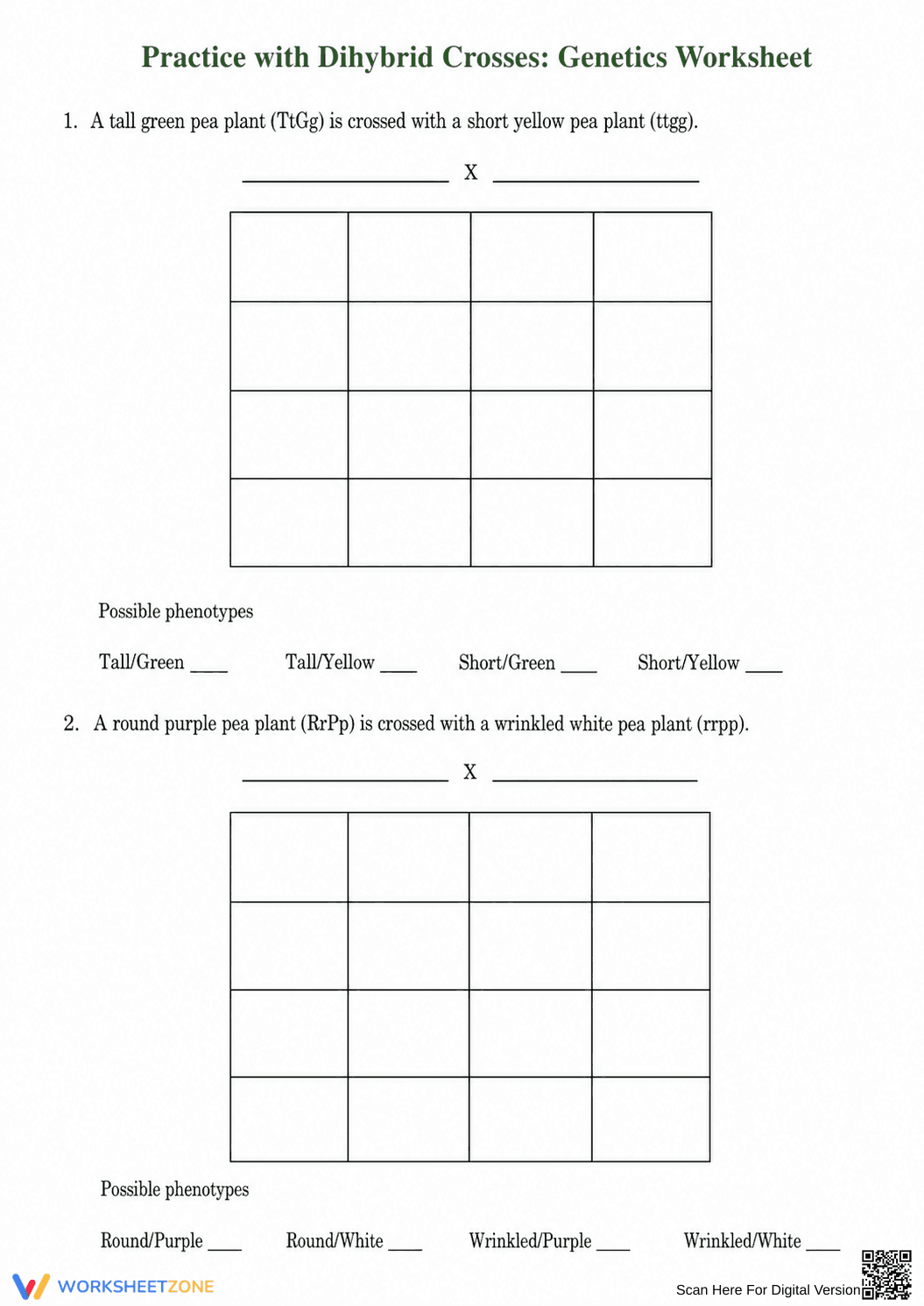
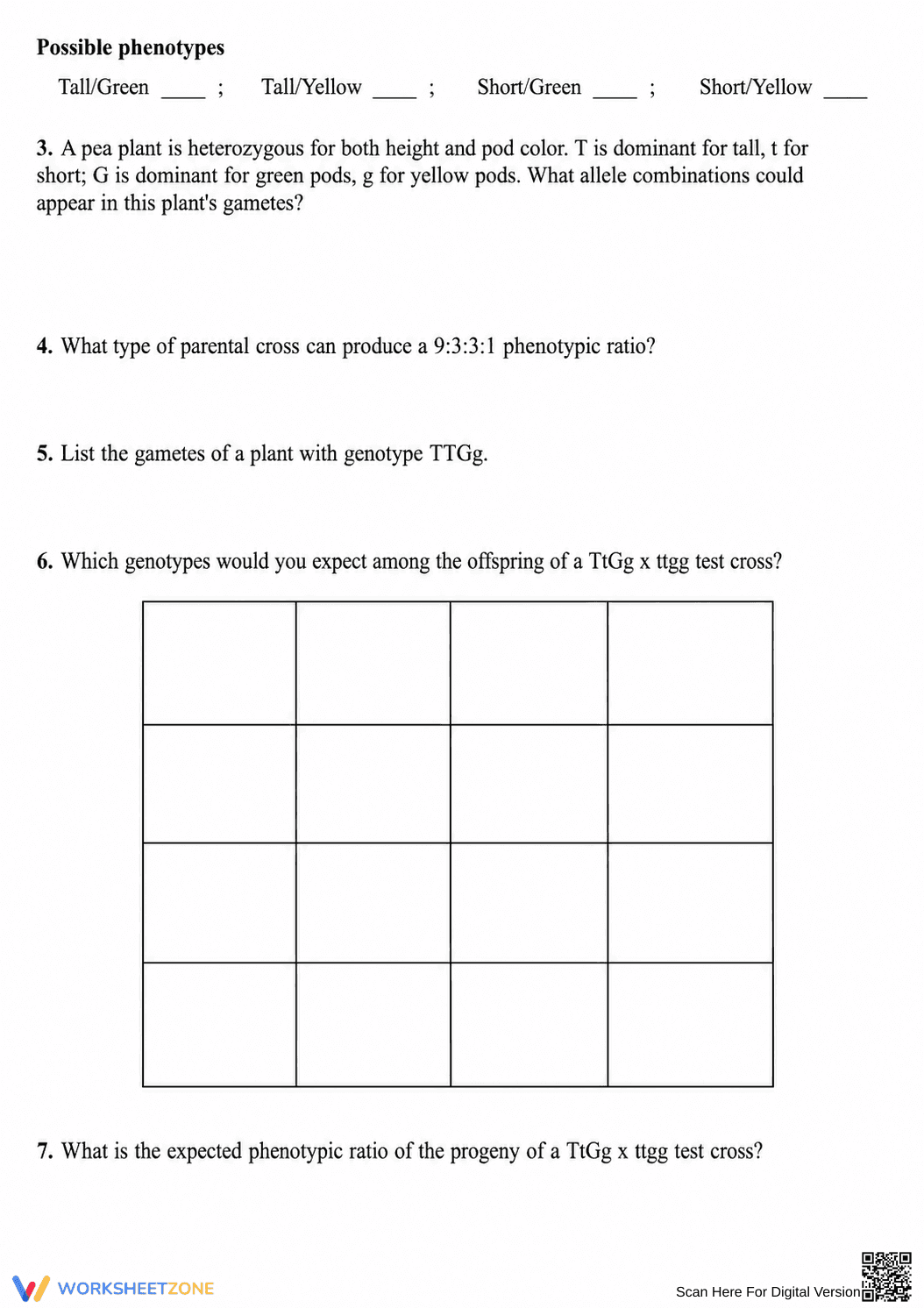
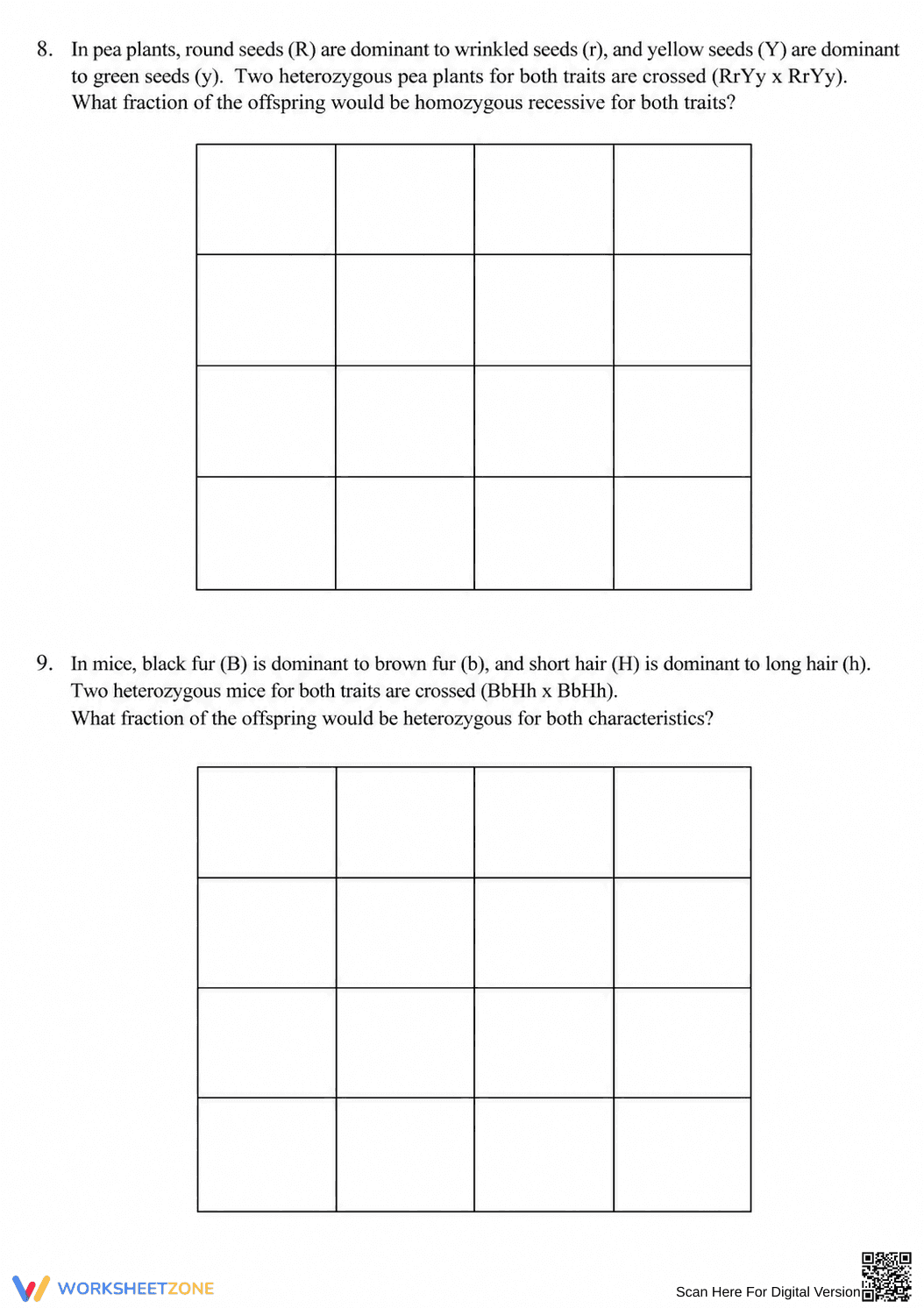
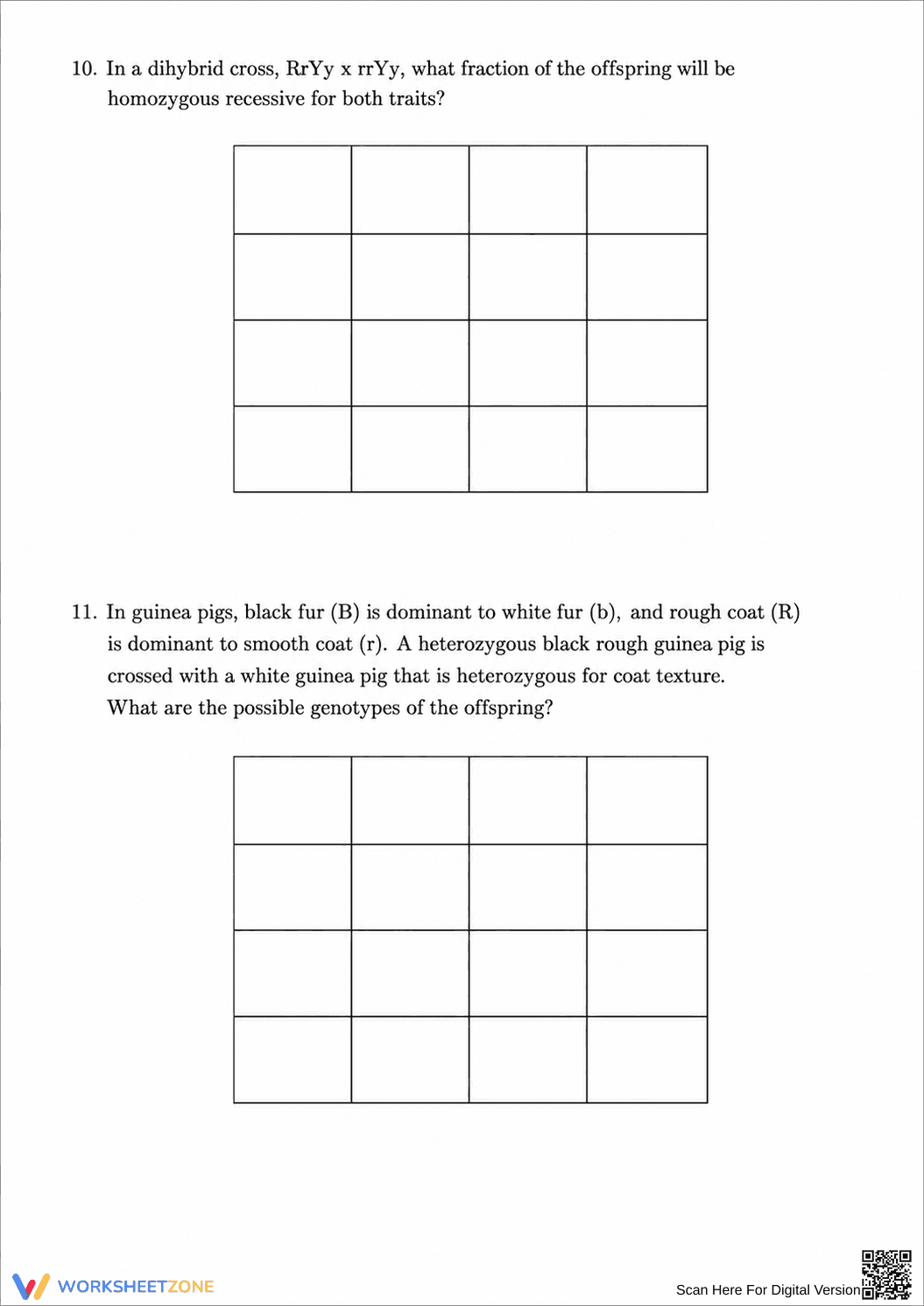
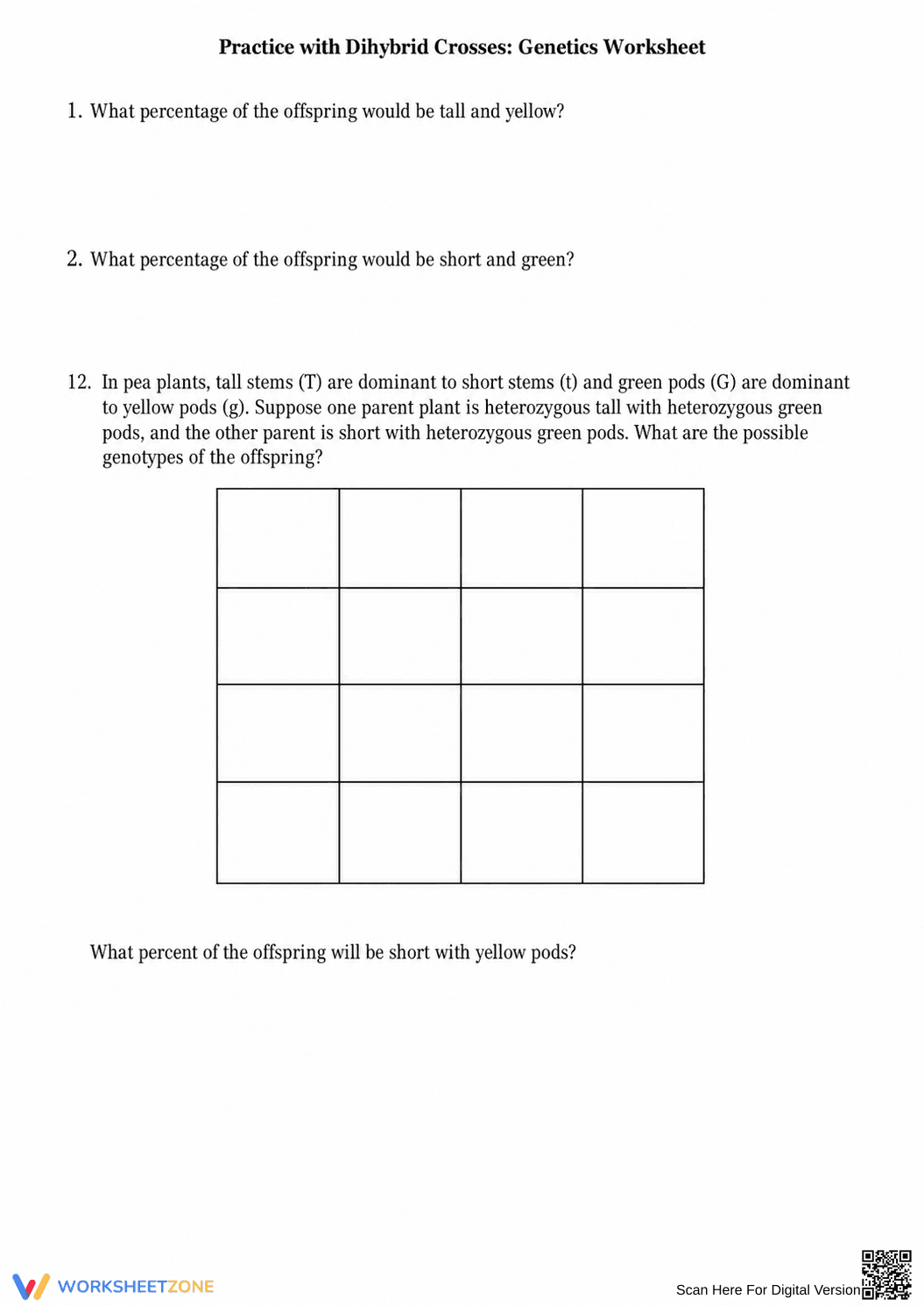
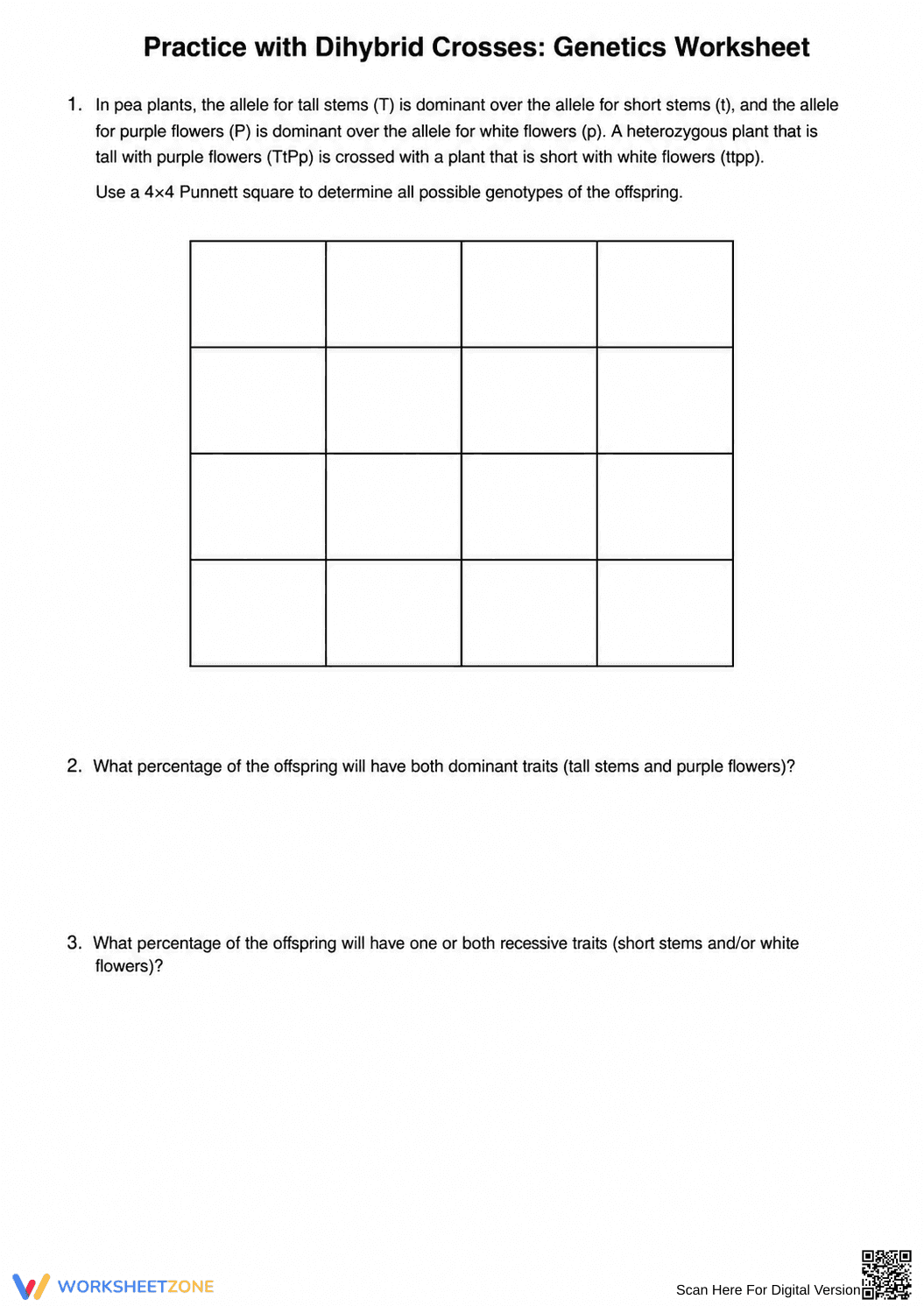
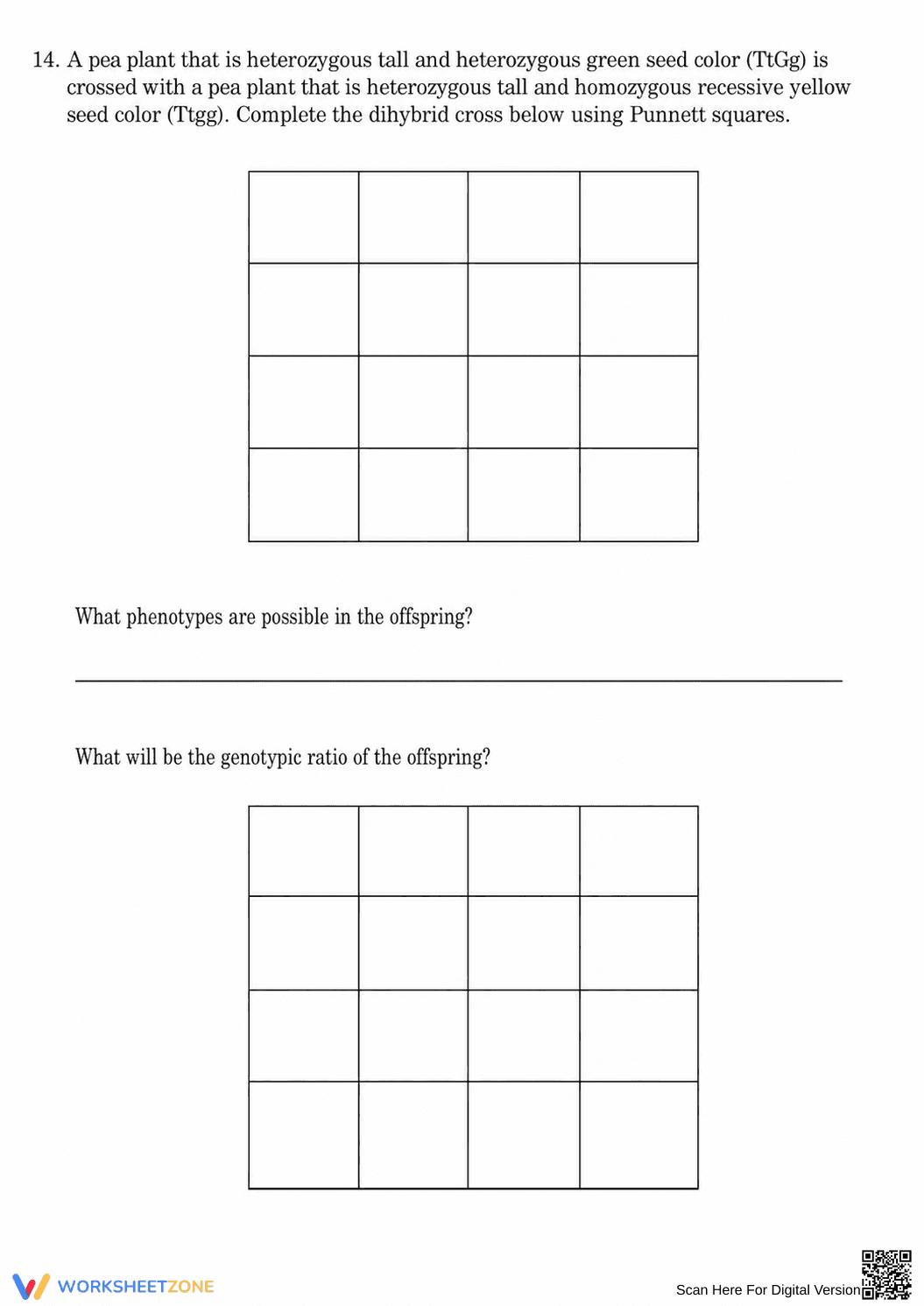
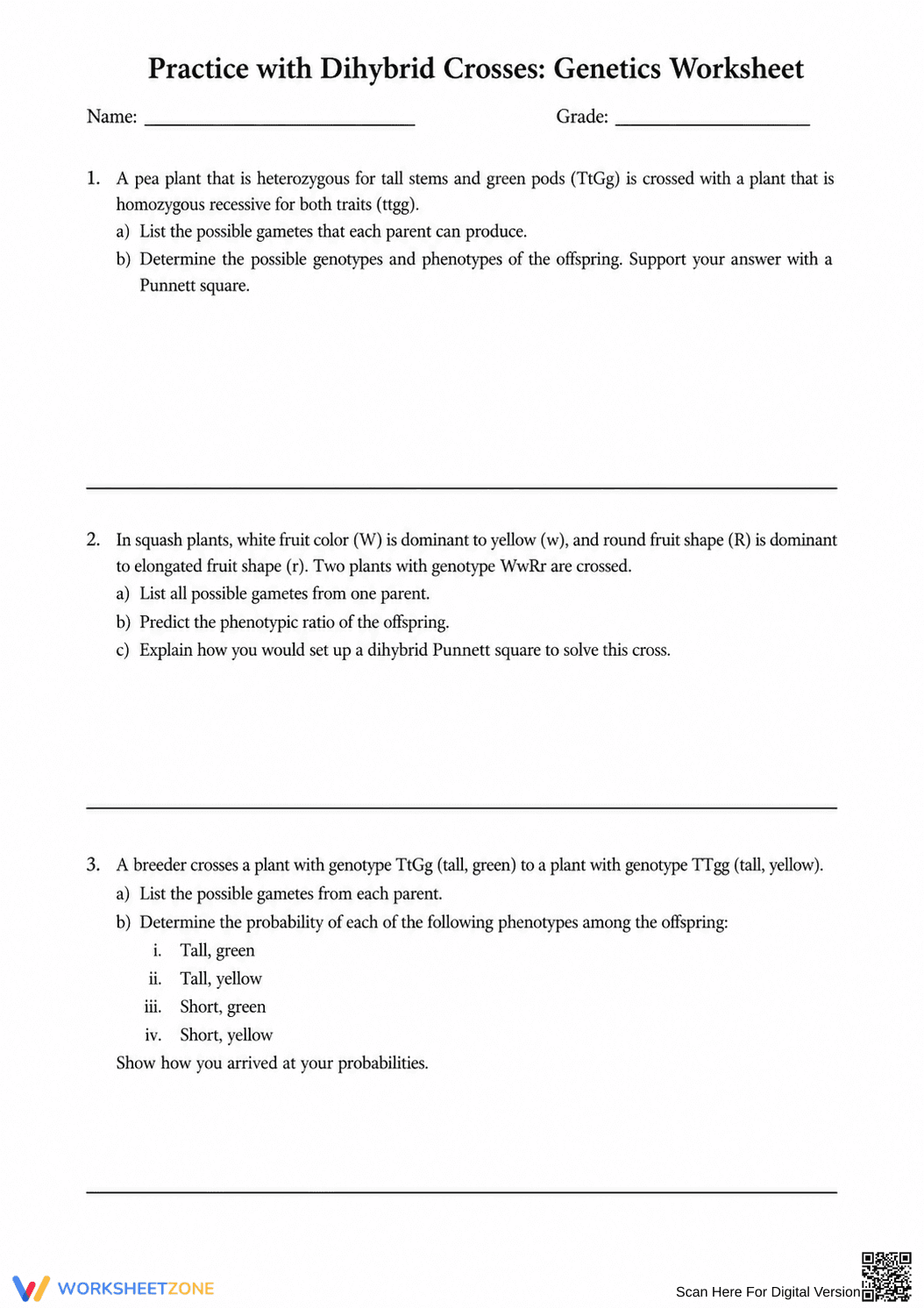
The 8-page PDF contains 14 distinct dihybrid cross scenarios involving pea plants, mice, and guinea pigs. Each problem includes a dedicated 4x4 Punnett square grid, space for listing parental gametes, and specific prompts for calculating phenotypic percentages or genotypic ratios. The layout is clean and provides ample writing space for complex genetic notation, ensuring students can track multiple alleles without confusion.
Skill Progression
- Guided practice: The initial problems provide parent genotypes (e.g., TtGg x ttgg) and scaffold the gamete identification process to ensure students understand the law of independent assortment.
- Supported practice: Middle-tier tasks require students to translate word descriptions into genotypes before setting up the 16-square grid, reinforcing vocabulary like "heterozygous" and "homozygous recessive."
- Independent practice: Final challenges present complex scenarios with multiple probability questions, requiring students to synthesize their understanding of phenotypic ratios without instructional cues.
This gradual-release model ensures students move from basic grid completion to high-level genetic analysis using the I Do, We Do, You Do framework.
Standards Alignment
This resource is aligned with HS-LS3-3: "Apply concepts of statistics and probability to explain the variation and distribution of expressed traits in a population." It specifically addresses the mathematical modeling of inheritance patterns and the prediction of trait frequency. Both standard codes can be copied directly into lesson plans, IEP goals, or district curriculum mapping tools.
How to Use It
Assign this worksheet as a mid-unit formative assessment after students have mastered monohybrid crosses but before introducing non-Mendelian genetics. During the activity, circulate and observe if students are correctly applying the FOIL method to determine gametes; this is a critical checkpoint for dihybrid success. Expected completion time ranges from 45 to 60 minutes depending on prior knowledge.
Who It's For
This is designed for Grade 9-12 biology students, including those in Honors or AP tracks who need to solidify their foundational genetics skills. It serves as an excellent resource for students requiring extra practice with probability. It pairs naturally with a classroom anchor chart on Mendelian laws or a direct instruction lesson on trait distribution.
The use of structured Punnett square practice is a cornerstone of effective science instruction, as highlighted in the RAND AIRS 2024 report on secondary STEM literacy. By providing 14 repetitive yet increasingly complex tasks, this worksheet leverages the principle of deliberate practice to move students toward mastery of HS-LS3-3. Research indicates that visual modeling of genetic probability helps bridge the gap between abstract mathematical ratios and observable biological phenotypes. This resource ensures that students are not merely filling in boxes but are actively interpreting the statistical likelihood of trait distribution within a population. According to the RAND AIRS 2024 analysis, high-quality science materials must integrate quantitative reasoning with core disciplinary ideas to improve long-term retention of heredity concepts. This worksheet meets those criteria by requiring students to calculate percentages and fractions based on their own generated data.


