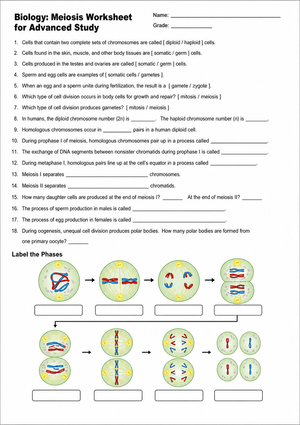
These 10th grade mitosis verses meiosis worksheets resources give biology teachers five distinct comparison activities targeting the conceptual distinction students most consistently miss in a standard cell division unit. Each worksheet approaches the mitosis-meiosis contrast from a different angle — phase labeling, side-by-side charts, Venn diagram sorting, vocabulary matching, and short-answer application — so that students are evaluating the differences, not just reading and repeating them. The set prints cleanly as PDFs and works equally well as class-period activities, homework assignments, or review materials posted to a learning management system.
The Concepts Each Worksheet Targets
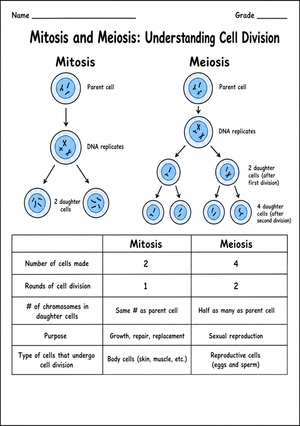
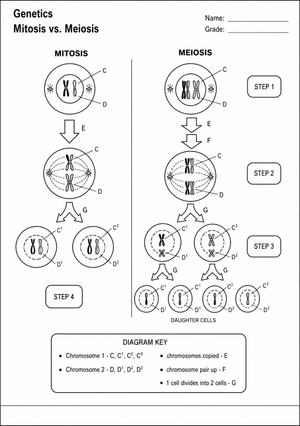
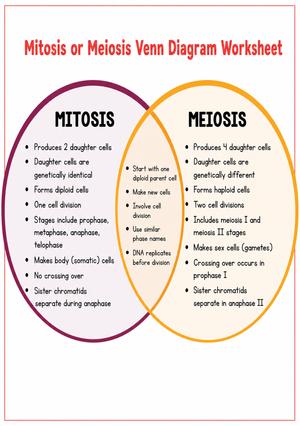
The core distinction students must internalize: mitosis produces two genetically identical diploid daughter cells for growth and tissue repair, while meiosis produces four genetically unique haploid cells used exclusively in gamete formation. Both processes begin with a diploid parent cell and move chromosomes along spindle fibers — which is precisely why students conflate them. Shared surface features mask a fundamentally different biological purpose, and comparison activities are the most direct way to break that conflation.
Each worksheet in the set targets one or more of these interconnected concepts:
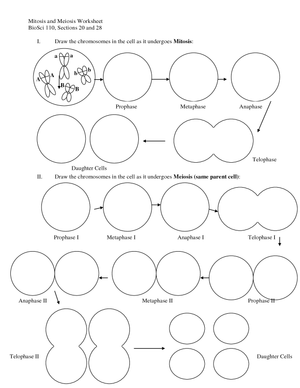
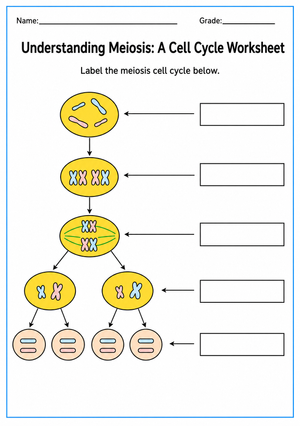
- Division rounds: Mitosis completes one cycle — prophase, metaphase, anaphase, telophase. Meiosis runs two sequential rounds, meiosis I and meiosis II, each with its own named phases, making the total phase count roughly twice that of mitosis.
- Chromosome arithmetic: A diploid parent cell (2n) undergoing mitosis yields two daughter cells at 2n. The same starting cell undergoing meiosis yields four cells at n — half the original count. In humans, that means mitosis preserves 46 chromosomes per daughter cell while meiosis produces gametes carrying 23.
- Sources of genetic variation: Crossing over during prophase I and independent assortment at the metaphase I plate occur in meiosis only. Neither event takes place in mitosis. Students need to understand not just that variation originates in meiosis, but why chromosome pair behavior at the metaphase I plate differs from the single-file alignment of mitosis.
- Real biological contexts: Skin cell replacement, liver regeneration, and uncontrolled cell division in cancer all involve mitosis. Egg and sperm production, fertilization outcomes, and heritable trait variation all tie to meiosis. Several application prompts ask students to assign a real-world scenario to the correct process and justify the choice.
- Vocabulary precision: Homologous chromosomes, sister chromatids, bivalent, synapsis, cytokinesis, and gamete all appear across the worksheets. Students who cannot distinguish homologous chromosomes from sister chromatids will misread every diagram they encounter in this unit.
Frequent Student Errors Worth Watching For
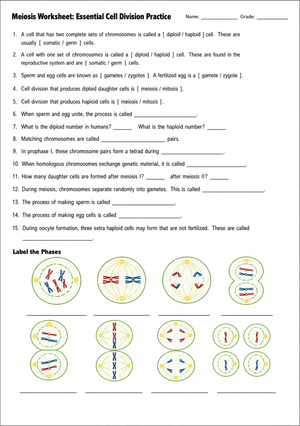
The most persistent mistake in 10th grade student work on this topic is prophase confusion. Because both processes include a stage called "prophase," students routinely write that crossing over happens during the prophase of mitosis. They retain the association — crossing over, prophase — but fail to attach the "I" qualifier that marks prophase I as a structurally different event. Worksheets that display mitotic prophase and meiotic prophase I in adjacent diagram columns, with separate annotation tasks for each, force students to hold that distinction rather than blend it.
A second consistent error involves chromosome counting after meiosis II. Many students know the final answer — 23 chromosomes in a human gamete — but cannot trace how that number was reached. Their written explanations often say "46 divided by 2 because meiosis makes two cells," which reveals that they have memorized the result without understanding the two-round division structure that produced it. A comparison worksheet that asks students to record the chromosome count at each stage checkpoint, not just at the end, exposes this reasoning gap before it reaches the unit test.
Genetic variation misconceptions show up in a specific pattern: students describe crossing over accurately but leave out independent assortment entirely. When asked to explain why siblings from the same two parents are genetically distinct, most 10th graders write about crossing over and stop. Separate short-answer prompts for each mechanism — rather than one open-ended "explain genetic variation" question — catch this incomplete understanding and give teachers a clear instructional target.
Fitting These Worksheets Into the Unit Structure
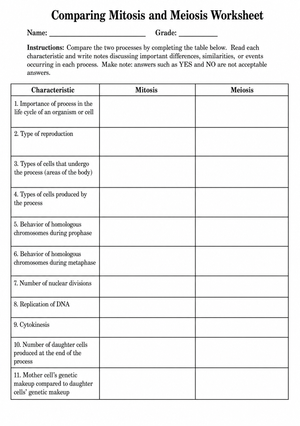
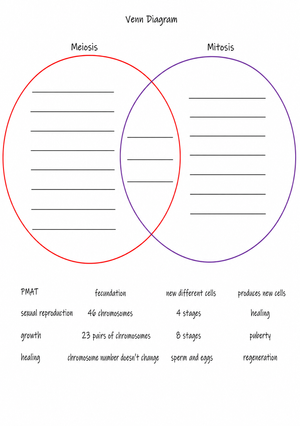
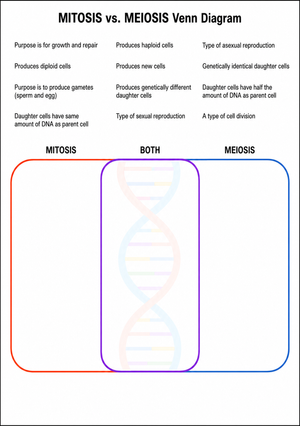
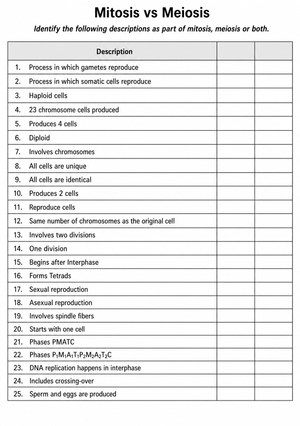
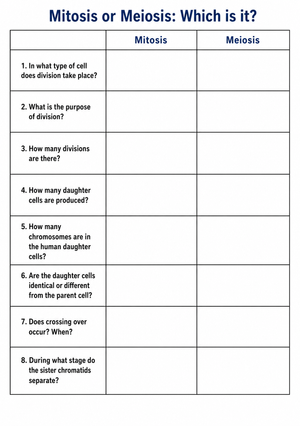
The sequencing that works best across a four- or five-day cell division unit: use the diagram labeling worksheet on day one, when students are still building phase vocabulary from scratch. The side-by-side comparison chart belongs on day two, after they can name the phases but before they have consolidated the contrast. Venn diagram sorting — placing a list of statements into "mitosis only," "meiosis only," or "both" circles — works well on day three or four because it demands evaluation rather than recall. Application questions belong on the final day before an assessment; those prompts reveal whether students can transfer knowledge to a scenario they have not seen, which is exactly what the test will ask them to do.
For a standard 50-minute period, the comparison chart worksheet runs roughly 25 minutes of student work time. Leave 10 minutes at the start to review any diagrams and 10 minutes at the end for a whole-class debrief on the two items students consistently miss — crossing over placement and chromosome count at the close of meiosis II. An exit ticket asking students to state, in their own words, the functional difference between the two processes gives a fast formative read on where the class landed without adding grading burden.
These 10th grade mitosis verses meiosis worksheets materials print cleanly at standard paper size and post to most learning management systems without formatting adjustments. Teachers who use them as homework report that the comparison chart and vocabulary matching work especially well independently, while the application questions benefit from at least brief class discussion before or after completion.
Adjusting the Set for Different Student Levels
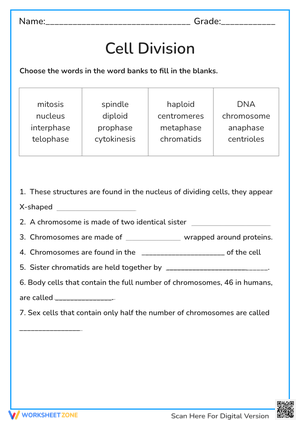
Students still building basic biology vocabulary should work through the diagram labeling and vocabulary matching worksheets before attempting the Venn diagram. Sending an underprepared student directly to comparison sorting produces guessing rather than thinking — they place statements by intuition, without the biological reasoning behind each placement. Providing a completed phase-name reference or a simple word bank for those students keeps them productively engaged while they close the vocabulary gap. These 10th grade mitosis verses meiosis worksheets resources include enough format variety that a teacher can assign different worksheets to different groups during the same class period without making the differentiation visible or logistically complicated.
Students who move through the material quickly get the most out of the application questions. Prompts asking what would happen if crossing over occurred less frequently, or asking students to predict the chromosome composition of a cell at each stage of meiosis II, push well beyond recall. A useful extension: have those students annotate their comparison chart with one original biological example per row — a real-world situation that matches each feature they recorded. That move forces generalization, not just description.
Standard Alignment
These worksheets align with two NGSS performance expectations commonly addressed in 10th grade biology. HS-LS3-2 asks students to make and defend a claim, based on evidence, that inheritable genetic variations result from new genetic combinations through meiosis — including crossing over and independent assortment. The Venn diagram and application question worksheets address this expectation directly by requiring students to evaluate mechanisms rather than name them. HS-LS1-4 addresses the role of mitosis in growth, repair, and asexual reproduction; this expectation runs through the comparison chart rows focused on daughter cell type, chromosome number, and biological context. Both standards appear on state assessments derived from the NGSS framework, so this practice material supports test readiness without narrowing instruction to isolated recall drills.
Frequently Asked Questions
Why do students still confuse mitosis and meiosis even after direct instruction?
Shared phase names are the core problem. Students learn prophase, metaphase, anaphase, and telophase for mitosis and then encounter those same names again in meiosis I and meiosis II. Without consistent use of the Roman numeral qualifiers — and without activities that place both processes side by side using the same visual vocabulary — students merge the two phase sequences into one blurry schema. Teaching each process separately and then comparing them later is less effective than presenting the comparison early and returning to it through different activity formats.
How long does each worksheet take to complete in class?
Completion time varies by format. The diagram labeling and vocabulary matching worksheets run about 15 to 20 minutes each. The comparison chart and Venn diagram sorting each take approximately 25 minutes for most students. The application questions run 25 to 30 minutes and benefit from a few minutes of whole-class debrief to close out effectively. All five worksheets fit within a standard 50-minute period when paired with brief instructional framing at the start.
Can these worksheets work for both honors and standard-level biology sections?
Yes, across both tracks. Honors students will move quickly through the comparison chart and Venn diagram sorting, spending most of their time on the application questions, which push into analysis and prediction. Standard-level students benefit from working through the diagram labeling and vocabulary worksheets first to build the language base they need before tackling comparison tasks. Teachers using 10th grade mitosis verses meiosis worksheets materials across both tracks typically assign the full set in honors and select three of the five worksheets for standard-level classes, depending on pacing.
Does the set cover crossing over in enough depth for an end-of-unit assessment?
Crossing over appears across three of the five worksheets. The diagram labeling worksheet asks students to mark where crossing over occurs on a prophase I illustration and name the chromosome structures involved. The Venn diagram includes multiple statements about genetic variation that require students to correctly attribute crossing over to meiosis only. The application questions include a prompt asking students to predict how gamete diversity would change if crossing over frequency decreased — which requires mechanistic reasoning, not a recalled definition.