


























Views
Downloads

Dihybrid Cross Practice Worksheet | Essential Biology
Paste this activity's link or code into your existing LMS (Google Classroom, Canvas, Teams, Schoology, Moodle, etc.).
Students can open and work on the activity right away, with no student login required.
You'll still be able to track student progress and results from your teacher account.
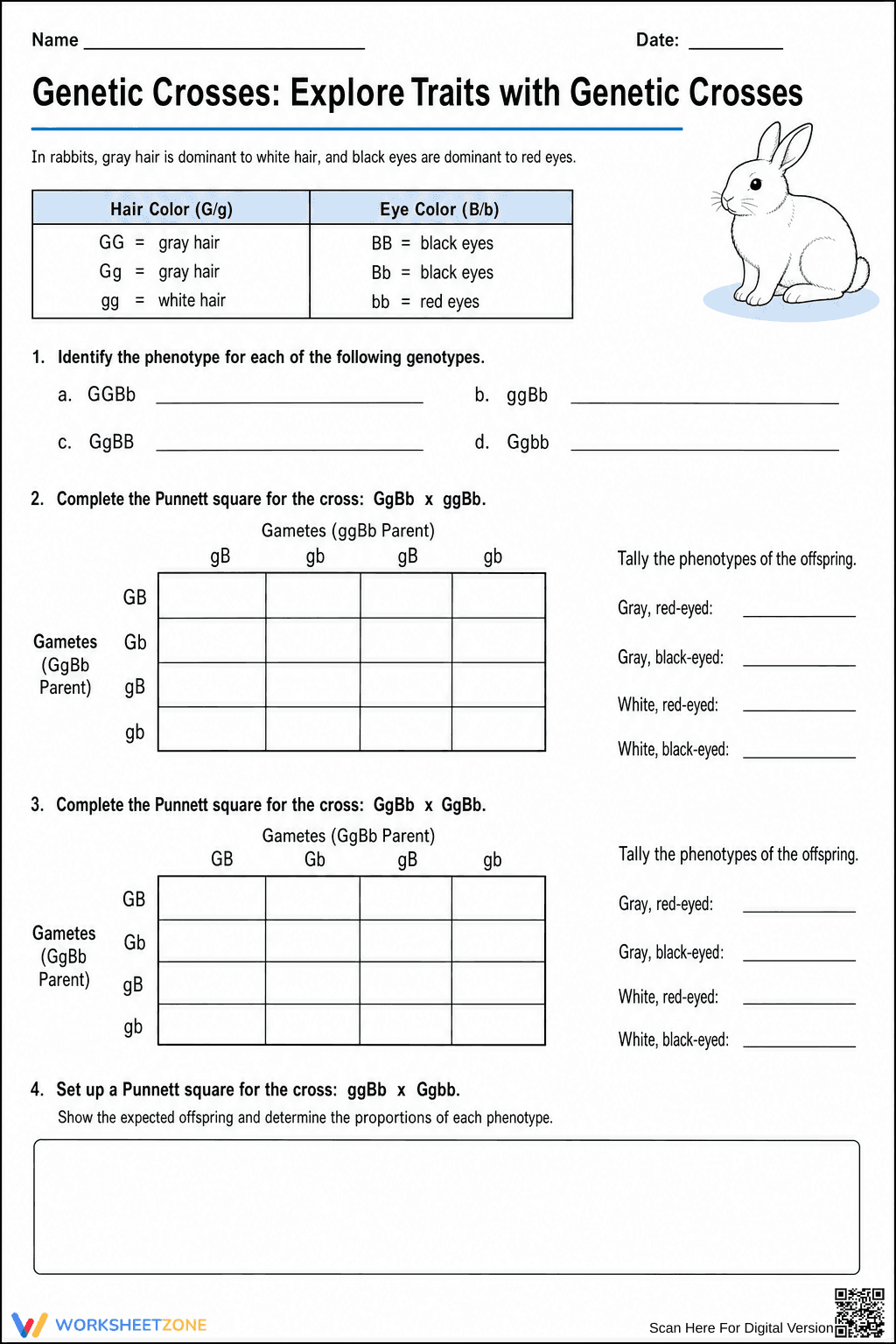
This dihybrid cross worksheet provides high school biology students with targeted practice in predicting inheritance patterns for two independent traits. By calculating phenotypic ratios for rabbit fur and eye color, learners bridge the gap between genotypic probability and observable physical characteristics. It is designed to reinforce Mendelian principles through active problem-solving.
At a Glance
- Grade: 9-12 · Subject: Biology
- Standard:
HS-LS3-3— Apply probability to explain the variation and distribution of expressed traits- Skill Focus: Dihybrid Punnett Squares
- Format: 1 page · 4 problems · Answer key included · PDF
- Best For: Independent practice or formative assessment
- Time: 20–30 minutes
This single-page PDF features a clear reference table for rabbit alleles, specifically G/g for hair color and B/b for eye color. It contains 4 progressive tasks: identifying phenotypes from complex genotypes, completing pre-structured 16-square Punnett grids, and a final challenge where students must set up a cross from scratch. The layout ensures students have ample space for tallying offspring ratios.
- Guided practice: Problem 1 requires simple decoding of 4 genotypes into phenotypes using the provided allele key to build confidence.
- Supported practice: Problems 2 and 3 provide pre-labeled 4x4 grids to help students organize gamete combinations without getting lost in the setup.
- Independent practice: Problem 4 removes all scaffolding, requiring students to determine gametes and construct the full grid independently.
This sequence follows a gradual-release model to ensure students master the mechanics of dihybrid inheritance before working without prompts.
The worksheet aligns with HS-LS3-3, focusing on the application of probability to genetic variation. Students must calculate the frequency of specific trait combinations, demonstrating an understanding of Mendelian inheritance and the Law of Independent Assortment. Both standard codes can be copied directly into lesson plans, IEP goals, or district curriculum mapping tools.
Assign this worksheet immediately following a lecture on Mendel’s laws. It serves as an excellent formative assessment; teachers should circulate and check Problem 2 to ensure students are correctly distributing alleles into gametes before they proceed to the independent final task. Completion typically takes 25 minutes in a standard classroom setting.
Designed for Grade 9-12 Biology students, this resource is ideal for those needing concrete practice with 16-square grids. It pairs naturally with a dihybrid cross-interactive simulation or a direct instruction lesson on non-linked traits. It is also suitable for advanced Grade 8 students ready for high school life science concepts.
According to the RAND AIRS 2024 report, structured practice in genetic modeling significantly improves student retention of complex inheritance patterns. This worksheet targets the HS-LS3-3 standard, which requires students to use mathematical representations to support explanations of how traits are passed through generations. By focusing on the specific skill of dihybrid Punnett square construction, the resource provides the necessary repetition for students to internalize the 9:3:3:1 ratio and its variations. Research from Fisher & Frey (2014) emphasizes that scaffolds, such as the pre-labeled grids included here, are vital for transitioning learners from simple monohybrid understanding to the multi-trait complexity required in high school life science. This 1-page PDF ensures that the cognitive load remains focused on genetic probability rather than administrative setup.


