




























Views
Downloads

Essential Dihybrid Cross Practice | Grade 9-11 Biology

Paste this activity's link or code into your existing LMS (Google Classroom, Canvas, Teams, Schoology, Moodle, etc.).
Students can open and work on the activity right away, with no student login required.
You'll still be able to track student progress and results from your teacher account.
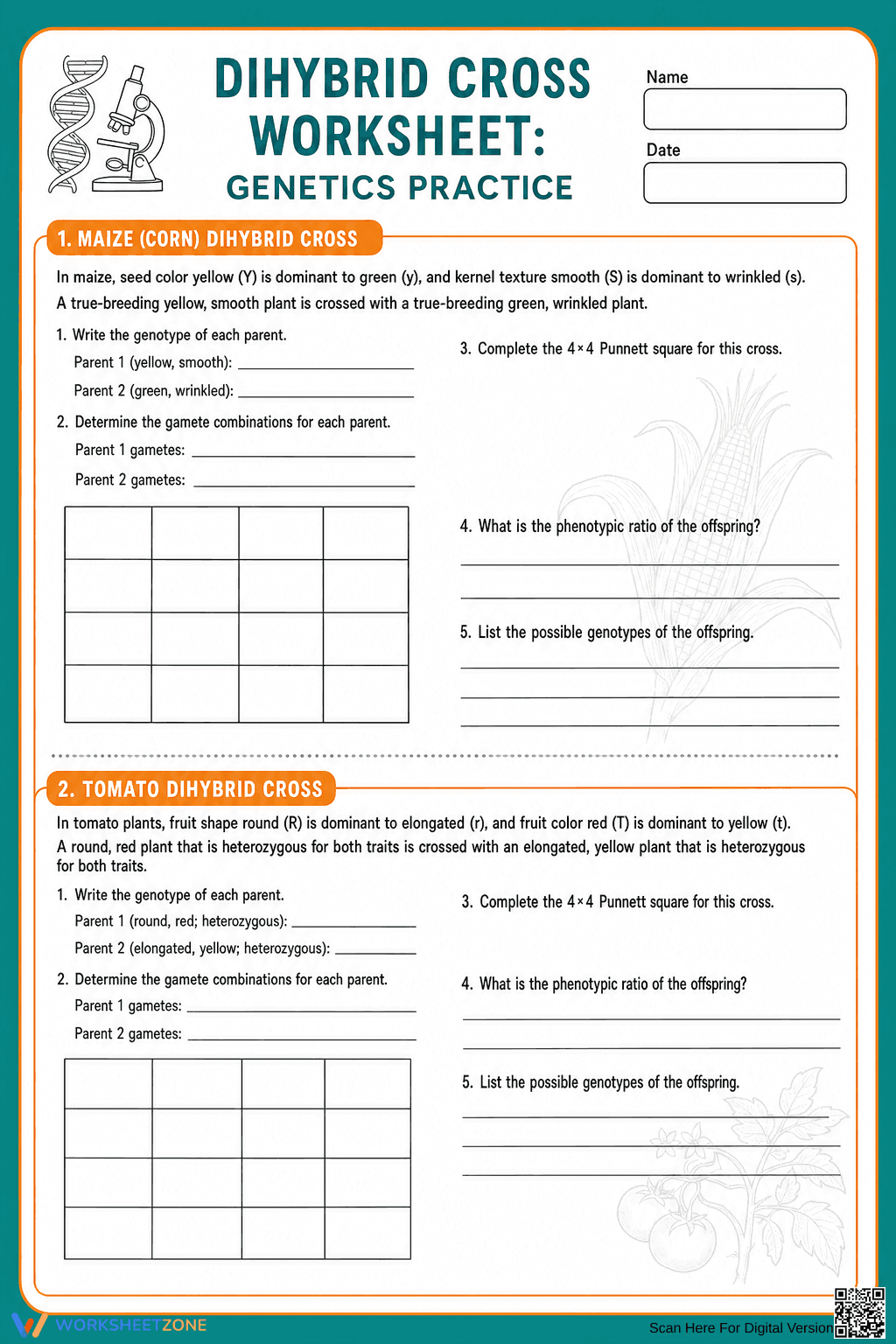
This Grade 9-11 biology worksheet provides targeted practice for mastering dihybrid crosses and Mendelian inheritance patterns. Students analyze two distinct genetic scenarios—maize and tomato plants—to predict offspring outcomes using 4x4 Punnett squares. By calculating phenotypic ratios and identifying genotypes, learners develop a concrete understanding of independent assortment and complete dominance.
At a Glance
- Grade: 9-11 · Subject: Biology
- Standard:
HS-LS3-3— Apply probability to explain the variation and distribution of expressed traits- Skill Focus: Dihybrid Punnett Squares
- Format: 1 page · 10 tasks · Answer key included · PDF
- Best For: Independent practice and formative assessment
- Time: 25–35 minutes
What's Inside
The worksheet features two comprehensive dihybrid cross problems involving multiple traits like seed color, texture, and fruit shape. It includes structured spaces for writing parental genotypes, determining gamete combinations, and completing 4x4 Punnett squares. A full answer key is provided to facilitate quick grading or student self-correction during independent study sessions.
Skill Progression
- Guided Practice: The first scenario (Maize) provides clear trait definitions and dominant/recessive alleles to help students establish the initial cross parameters.
- Supported Practice: Students must independently derive gamete combinations for both parents before populating the 16-cell grid to ensure accuracy.
- Independent Practice: The second scenario (Tomato) requires students to interpret "heterozygous" descriptions to build genotypes from scratch without explicit allele prompts.
This resource follows a gradual-release model, moving from explicit trait identification to higher-order probability analysis and genotype listing.
Standards Alignment
This resource is aligned with `HS-LS3-3`: "Apply concepts of statistics and probability to explain the variation and distribution of expressed traits in a population." It also supports HS-LS3-2 by illustrating how variation results from new genetic combinations during meiosis. Both standard codes can be copied directly into lesson plans, IEP goals, or district curriculum mapping tools.
How to Use It
Assign this worksheet as a mid-unit formative assessment after students have mastered monohybrid crosses but before moving into non-Mendelian genetics. During the activity, circulate to ensure students are correctly distributing alleles into gametes, as this is the most common point of error. Expect completion within 30 minutes for most high school biology students during a standard class period.
Who It's For
This worksheet is designed for high school biology students, including those in Honors or Pre-AP tracks who require rigorous genetics practice. It serves as an excellent scaffolded resource for students needing extra support with complex Punnett squares when paired with a visual anchor chart or a direct instruction lesson on the Law of Independent Assortment.
Research by Fisher & Frey (2014) emphasizes that the gradual release of responsibility is critical when teaching complex biological concepts like the dihybrid cross. By providing structured 4x4 grids and specific prompts for gamete determination, this worksheet reduces the cognitive load associated with organizational tasks, allowing students to focus on the underlying genetic principles. According to the NAEP science framework, the ability to predict phenotypic ratios using mathematical models is a core competency for secondary life science students. This worksheet addresses that need by requiring 10 specific analytical steps across two distinct biological contexts. The inclusion of an answer key supports immediate feedback loops, which are proven to increase retention in STEM subjects. This resource ensures that students meet the HS-LS3-3 standard through rigorous, evidence-based practice that bridges the gap between theoretical probability and observable biological traits.


