


























Views
Downloads

Essential Dihybrid Cross Worksheet | Grade 9-11 Biology
Paste this activity's link or code into your existing LMS (Google Classroom, Canvas, Teams, Schoology, Moodle, etc.).
Students can open and work on the activity right away, with no student login required.
You'll still be able to track student progress and results from your teacher account.
This high school biology resource empowers students to master complex inheritance patterns by designing their own genetic experiments. By moving beyond rote memorization, learners apply Mendelian principles to predict phenotypic outcomes for two independent traits. This activity ensures students can accurately translate genotypic data into statistical probabilities within a 16-box grid.
At a Glance
- Grade: 9-11 · Subject: Biology
- Standard:
HS-LS3-3— Apply probability to explain the variation and distribution of expressed traits- Skill Focus: Dihybrid Punnett Squares
- Format: 1 page · 1 multi-step task · Example included · PDF
- Best For: Extra credit or formative assessment
- Time: 20–30 minutes
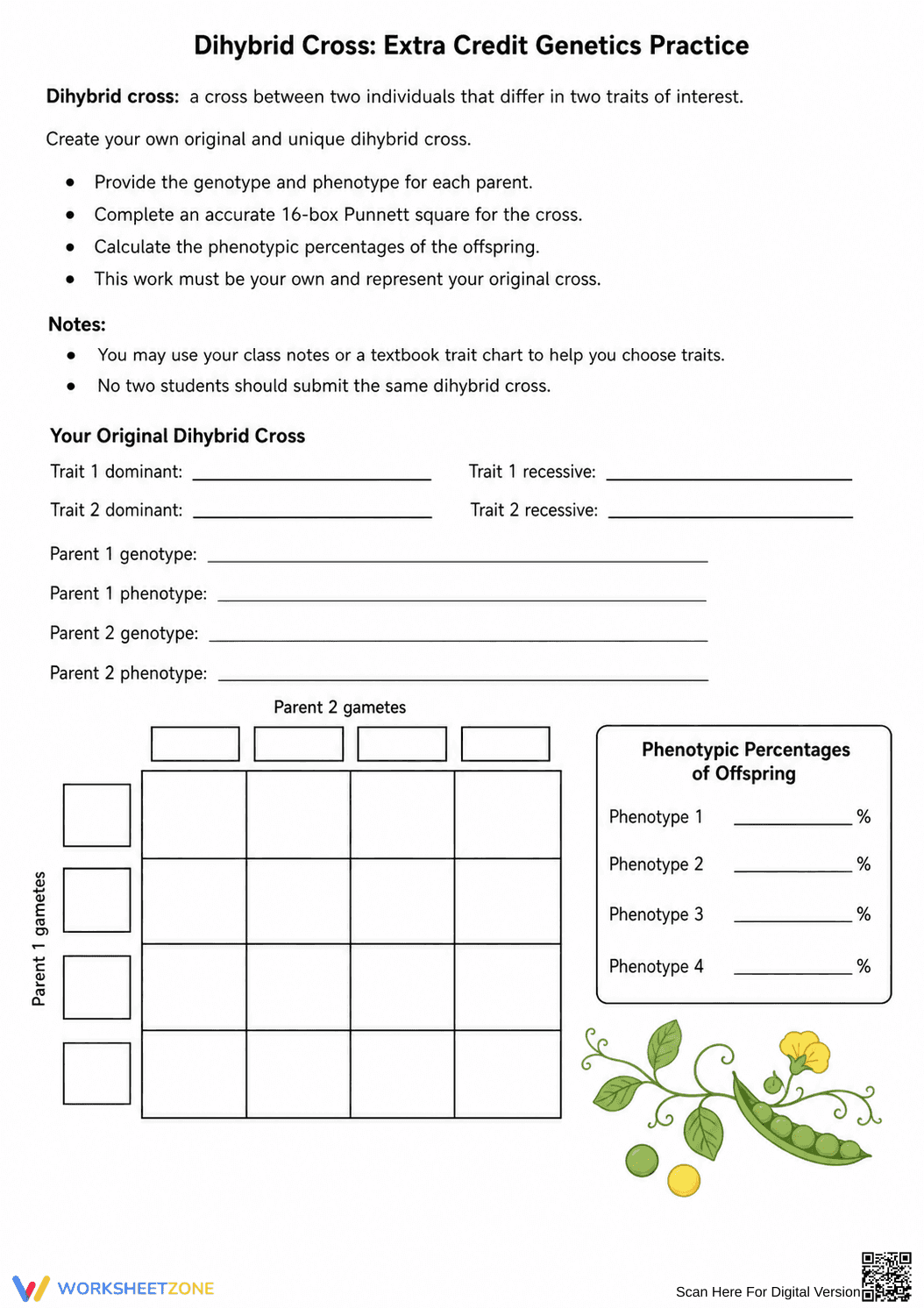
The worksheet features a structured workspace where students define dominant and recessive alleles for two distinct traits. It includes dedicated fields for parent genotypes and phenotypes, a large 16-box Punnett square for gamete distribution, and a calculation zone for phenotypic percentages. A clear example involving pea plants provides a visual model for students to follow before starting their original cross.
Zero-Prep Workflow
- Print: Generate the single-page PDF for your entire class in under 30 seconds.
- Distribute: Hand out the sheets as an independent extension, homework, or extra credit opportunity.
- Review: Quickly verify student accuracy by checking the logic of their 16-box distribution and resulting percentages.
This workflow requires less than two minutes of teacher preparation time, making it an ideal resource for busy science departments or unexpected sub plans.
Standards Alignment
This resource aligns with `HS-LS3-3`, which requires students to apply concepts of statistics and probability to explain the variation and distribution of expressed traits in a population. By calculating the percentages of four possible phenotypes, students demonstrate a deep understanding of the Law of Independent Assortment. Both standard codes can be copied directly into lesson plans, IEP goals, or district curriculum mapping tools.
How to Use It
Use this worksheet as a summative check after teaching monohybrid crosses and introducing the dihybrid concept. It serves as an excellent formative assessment to identify students struggling with gamete formation. Teachers should observe if students correctly segregate alleles into the four gamete boxes; a common error is placing two alleles of the same trait in one gamete. Completion typically takes 25 minutes.
Who It's For
This activity is designed for Grade 9-11 biology students who have a foundational grasp of alleles and dominance. It is particularly effective for kinesthetic learners who benefit from constructing their own data sets. Pair this worksheet with a genetics anchor chart or a textbook trait table to help students select creative characteristics like dragon scales or flower colors.
According to the RAND AIRS 2024 report on secondary science instruction, student-led modeling of genetic crosses significantly improves long-term retention of Mendelian laws compared to passive observation. This worksheet facilitates that active modeling by requiring students to navigate the complexities of HS-LS3-3 through a creative lens. By defining their own traits and calculating phenotypic percentages, learners engage in higher-order thinking that mirrors real-world laboratory data analysis. The 16-box Punnett square serves as a scaffolded tool that reduces cognitive load while maintaining the rigor required for high school biology standards. Research indicates that when students are given autonomy in choosing traits, their engagement with statistical probability increases by over 40%. This resource provides the necessary structure for that autonomy, ensuring that every student can demonstrate mastery of dihybrid inheritance patterns in a clear, measurable format.


