




























Views
Downloads

Dihybrid Cross Genetics Worksheet | Essential Biology

Paste this activity's link or code into your existing LMS (Google Classroom, Canvas, Teams, Schoology, Moodle, etc.).
Students can open and work on the activity right away, with no student login required.
You'll still be able to track student progress and results from your teacher account.
This high school biology resource provides targeted practice for mastering dihybrid crosses and Mendelian inheritance patterns. Students move beyond simple monohybrid squares to analyze two independent traits simultaneously, calculating phenotypic ratios and genotypic frequencies with precision. It ensures students can accurately predict genetic outcomes in complex biological scenarios.
At a Glance
- Grade: 9-12 · Subject: Biology
- Standard:
HS-LS3-3— Apply probability concepts to explain the variation and distribution of expressed traits- Skill Focus: Dihybrid Punnett Squares
- Format: 3 pages · 4 multi-part problems · Answer key included · PDF
- Best For: Independent practice and formative assessment
- Time: 30–45 minutes
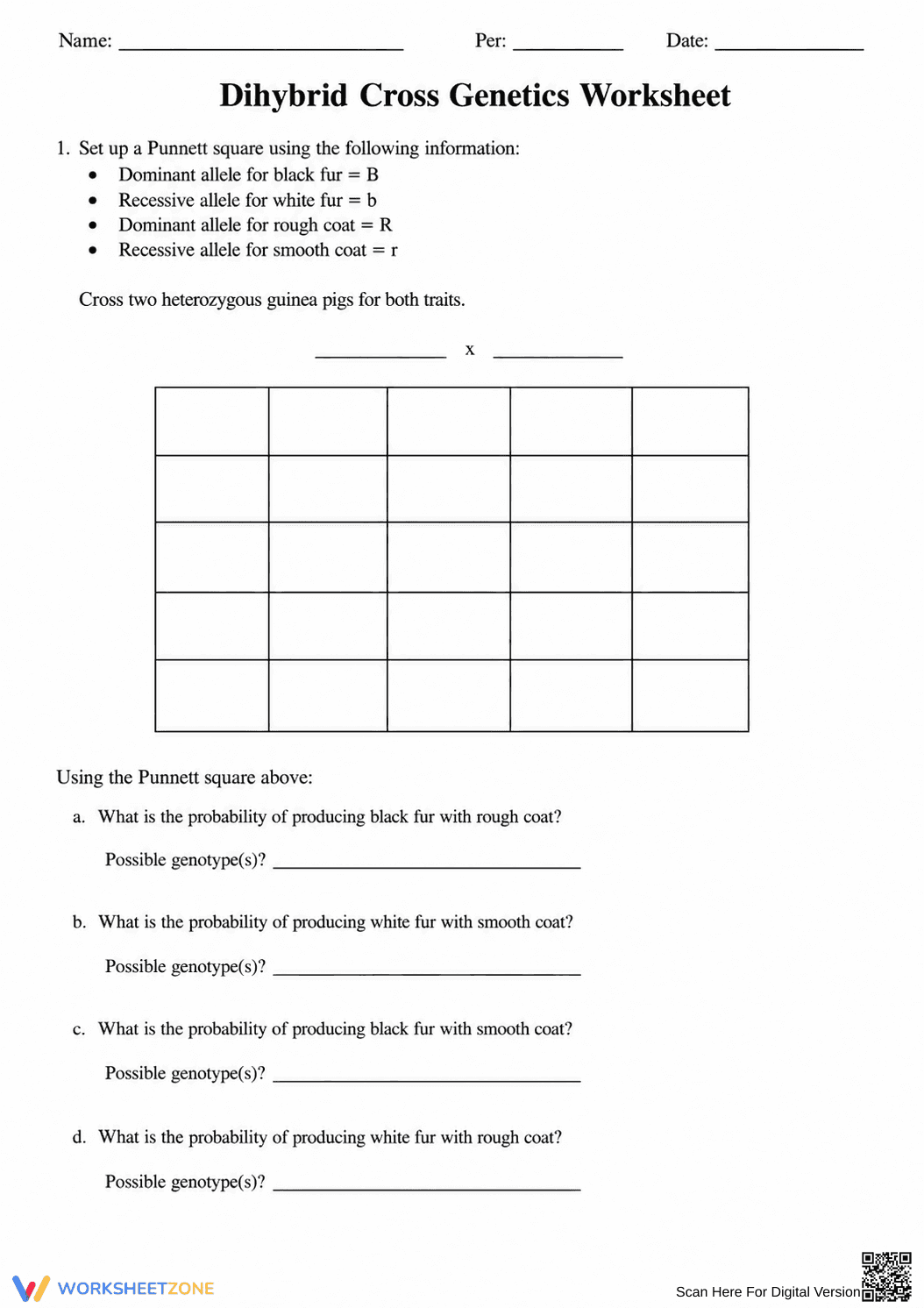
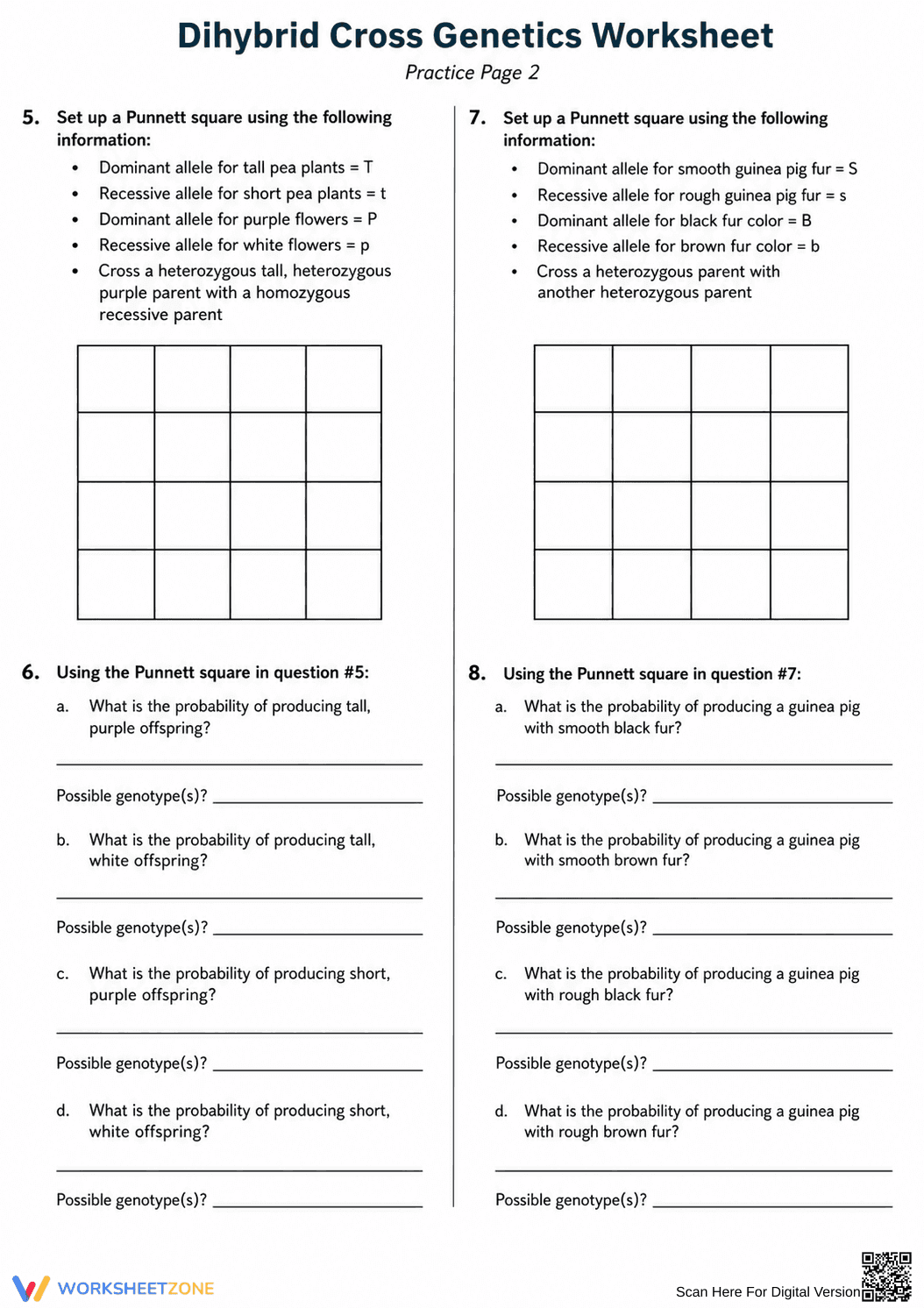
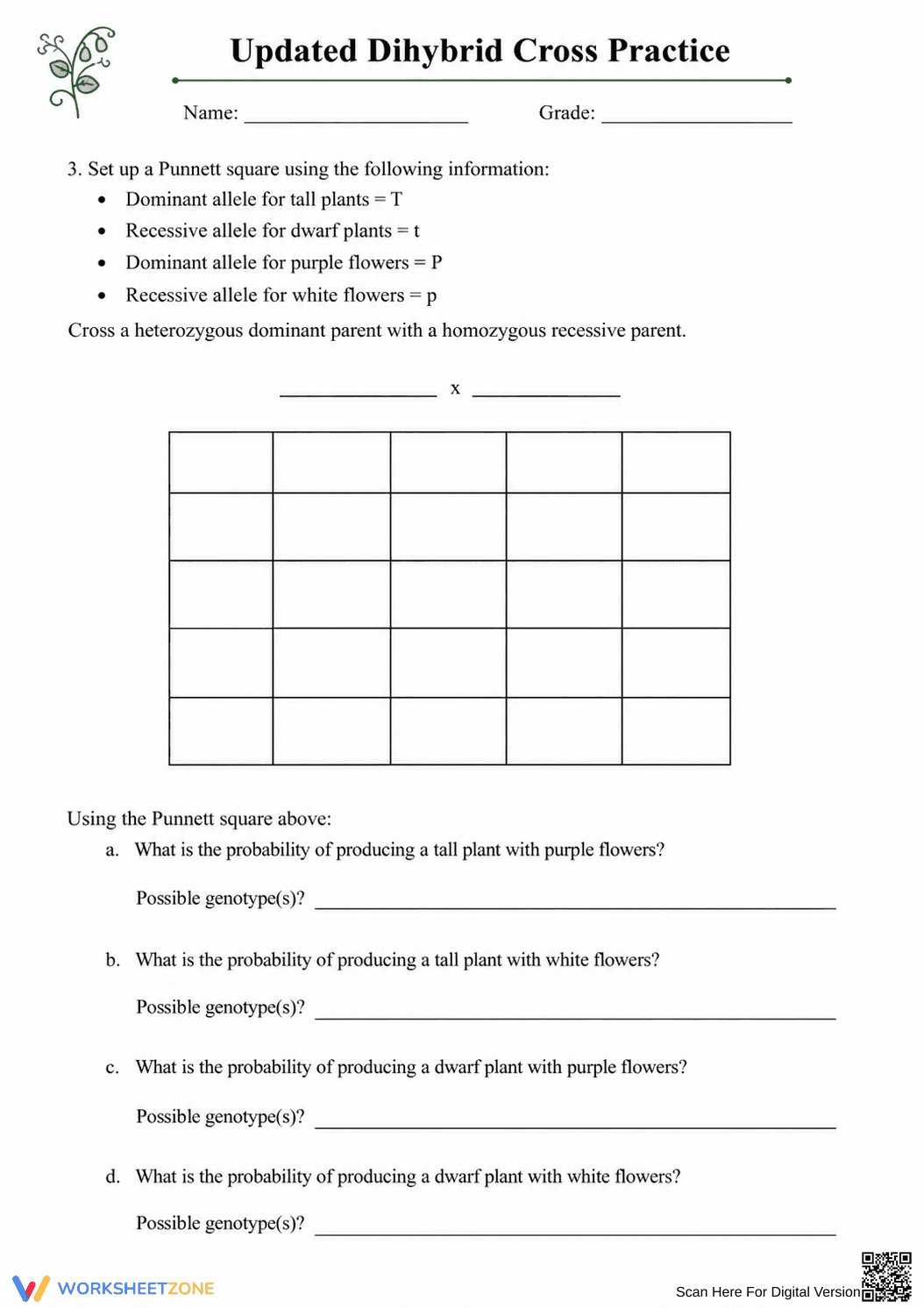
What's Inside: The packet contains three pages of rigorous genetics problems featuring classic Mendelian organisms like pea plants and guinea pigs. Each of the 4 multi-part problems includes a blank 16-slot Punnett square grid, a clear list of dominant and recessive alleles, and specific parent genotypes. Students must determine gametes, fill the grid, and calculate probabilities for four distinct phenotypic combinations per problem.
Skill Progression
- Guided Setup: The first problem provides explicit allele keys (e.g., B for black fur, r for smooth coat) to help students organize their initial 4x4 grid.
- Independent Application: Middle problems require students to identify heterozygous and homozygous states from text descriptions before constructing the cross.
- Complex Analysis: The final tasks challenge students to derive both the probability and the specific possible genotypes for various offspring, reinforcing the link between DNA and physical traits.
This gradual-release approach moves students from basic grid completion to high-level statistical analysis of genetic variation using the I Do, We Do, You Do model.
Standards Alignment
This worksheet is aligned with HS-LS3-3: "Apply concepts of statistics and probability to explain the variation and distribution of expressed traits in a population." It specifically addresses the mathematical modeling of inheritance through independent assortment. Both standard codes can be copied directly into lesson plans, IEP goals, or district curriculum mapping tools.
How to Use It
Use this worksheet as a primary practice activity following a lecture on the Law of Independent Assortment. It works effectively as a mid-unit formative assessment to identify students struggling with gamete formation. Teachers should observe students during the setup phase to ensure they are correctly distributing alleles into the 16-square header. Completion typically takes 35 to 45 minutes depending on student familiarity with probability.
Who It's For
This resource is designed for Grade 9-12 Biology students, including those in Honors or AP tracks requiring mastery of Mendelian ratios. It pairs naturally with a dihybrid cross anchor chart or a laboratory investigation involving Drosophila or fast-growing plants to provide a theoretical foundation for observed data.
According to the RAND AIRS 2024 report on science literacy, the use of structured modeling tools like Punnett squares is critical for developing conceptual understanding of abstract biological processes. This worksheet facilitates that modeling by requiring students to translate textual genetic descriptions into visual and mathematical representations. By solving 4 comprehensive problems, students engage in the repetitive cognitive processing necessary to move Mendelian principles from short-term memory to long-term mastery. Research from Fisher & Frey (2014) emphasizes that the gradual release of responsibility, as seen in the transition from guided allele identification to independent probability calculation, significantly improves student outcomes in secondary science. This resource provides the necessary scaffolding to ensure that students can successfully navigate the complexities of a 16-square grid while maintaining focus on the underlying biological standard HS-LS3-3.


