


























Views
Downloads
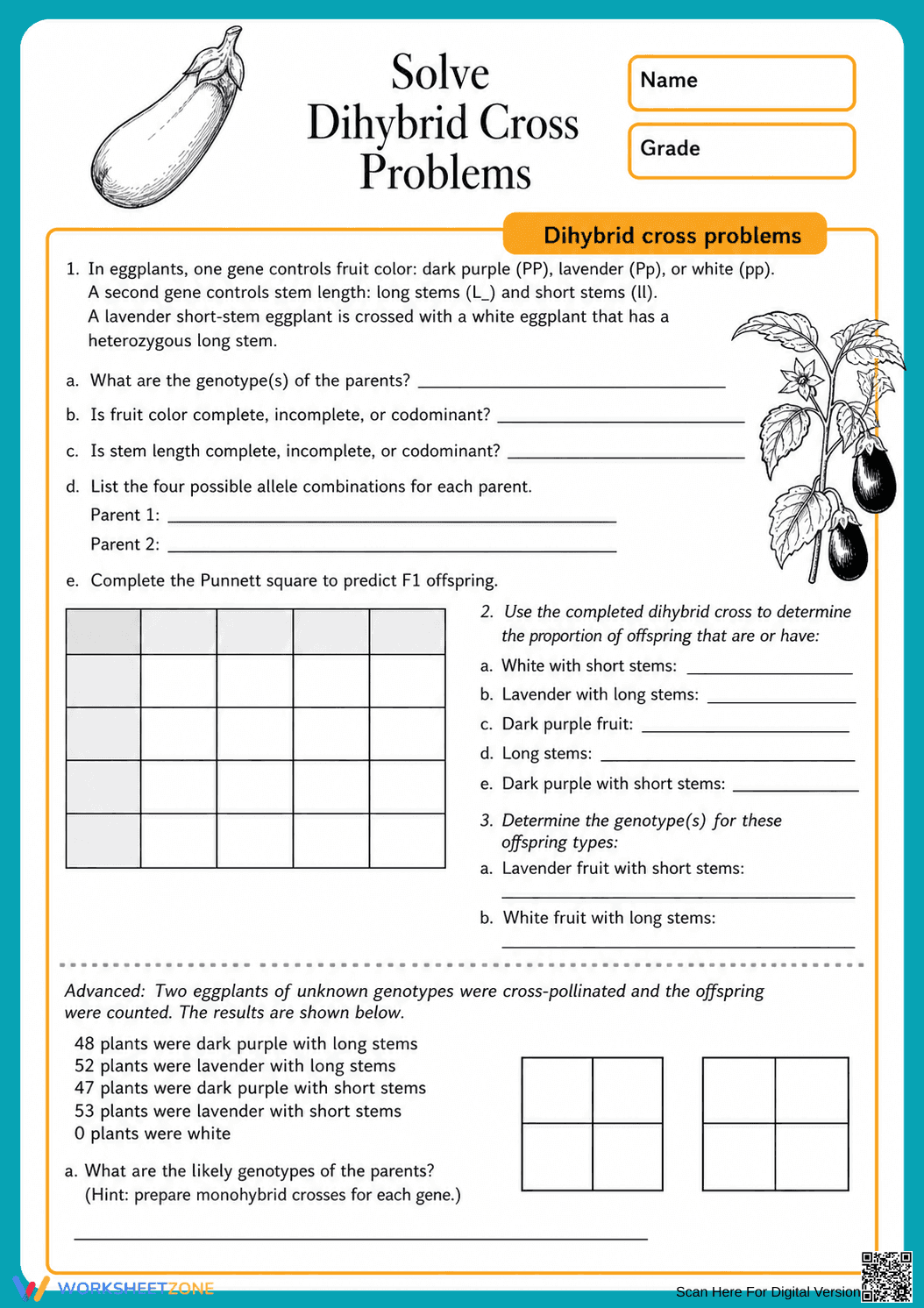

Dihybrid Cross Practice Worksheet | Essential Grade 9-11
Paste this activity's link or code into your existing LMS (Google Classroom, Canvas, Teams, Schoology, Moodle, etc.).
Students can open and work on the activity right away, with no student login required.
You'll still be able to track student progress and results from your teacher account.
This Grade 9-11 biology worksheet provides a comprehensive environment for students to master dihybrid crosses using eggplant genetics. By calculating phenotypic ratios and determining parental genotypes, learners develop a concrete understanding of Mendelian inheritance. The resource transitions from basic Punnett square construction to advanced data analysis, ensuring students can apply genetic principles to real-world biological scenarios.
At a Glance
- Grade: 9-11 · Subject: Biology
- Standard:
HS-LS3-3— Apply probability to explain the variation and distribution of expressed traits- Skill Focus: Dihybrid Cross & Genotype Analysis
- Format: 1 page · 13 tasks · Answer key included · PDF
- Best For: Independent practice or formative assessment
- Time: 20–30 minutes
What's Inside: This single-page PDF features 13 targeted tasks centered on eggplant heredity. It includes a 16-square Punnett grid, sections for allele combination listing, and a specific "Advanced" section that challenges students to work backward from offspring counts to parental genotypes. The layout provides ample writing space for genotypes and clear prompts for identifying dominance patterns, including incomplete dominance examples.
Skill Progression
- Guided Practice: The worksheet begins by asking students to identify parental genotypes from a descriptive prompt, establishing the foundation for the cross.
- Supported Practice: Students populate a 4x4 Punnett square and use the results to calculate specific phenotypic proportions for five different trait combinations.
- Independent Practice: The final section presents raw offspring data, requiring students to use monohybrid hints to infer unknown parental genetics.
This gradual-release model ensures students build confidence before tackling higher-order analysis.
Standards Alignment
This resource is primarily aligned with `HS-LS3-3`, which requires students to apply concepts of statistics and probability to explain the variation and distribution of expressed traits in a population. It also supports HS-LS3-2 by illustrating how variation results from new genetic combinations via meiosis. Both standard codes can be copied directly into lesson plans, IEP goals, or district curriculum mapping tools.
How to Use It
Assign this worksheet as a mid-unit formative assessment after students have mastered monohybrid crosses but are still refining their 16-square grid skills. For a quick check for understanding, observe students during the "Advanced" section; if they struggle to work backward from the 50/50 ratios, provide a quick mini-lesson on test crosses. Expected completion time is 20 to 30 minutes.
Who It's For
This resource is designed for high school biology students, including those in Honors or AP tracks who need to reinforce the mathematical side of genetics. It pairs naturally with a lecture on Mendelian laws or a laboratory activity involving real-world plant breeding data.
According to research by Fisher & Frey (2014), the use of scaffolded graphic organizers like Punnett squares is essential for helping students internalize the complex probability involved in multi-trait inheritance. This worksheet directly addresses the NGSS HS-LS3-3 standard by forcing students to move beyond simple memorization into statistical application. By analyzing 13 distinct sub-tasks, including a data-heavy advanced section, students practice the exact type of evidence-based reasoning required by modern science frameworks. The inclusion of incomplete dominance scenarios further challenges the learner to distinguish between different modes of inheritance, a key skill identified by NAEP as a marker of biological literacy. This structured approach ensures that learners can accurately predict offspring outcomes while understanding the underlying mechanisms of genetic variation and trait distribution in diverse populations.


