


























Views
Downloads

Essential Dihybrid Cross & Epistasis Worksheet | Grade 10-11
Paste this activity's link or code into your existing LMS (Google Classroom, Canvas, Teams, Schoology, Moodle, etc.).
Students can open and work on the activity right away, with no student login required.
You'll still be able to track student progress and results from your teacher account.
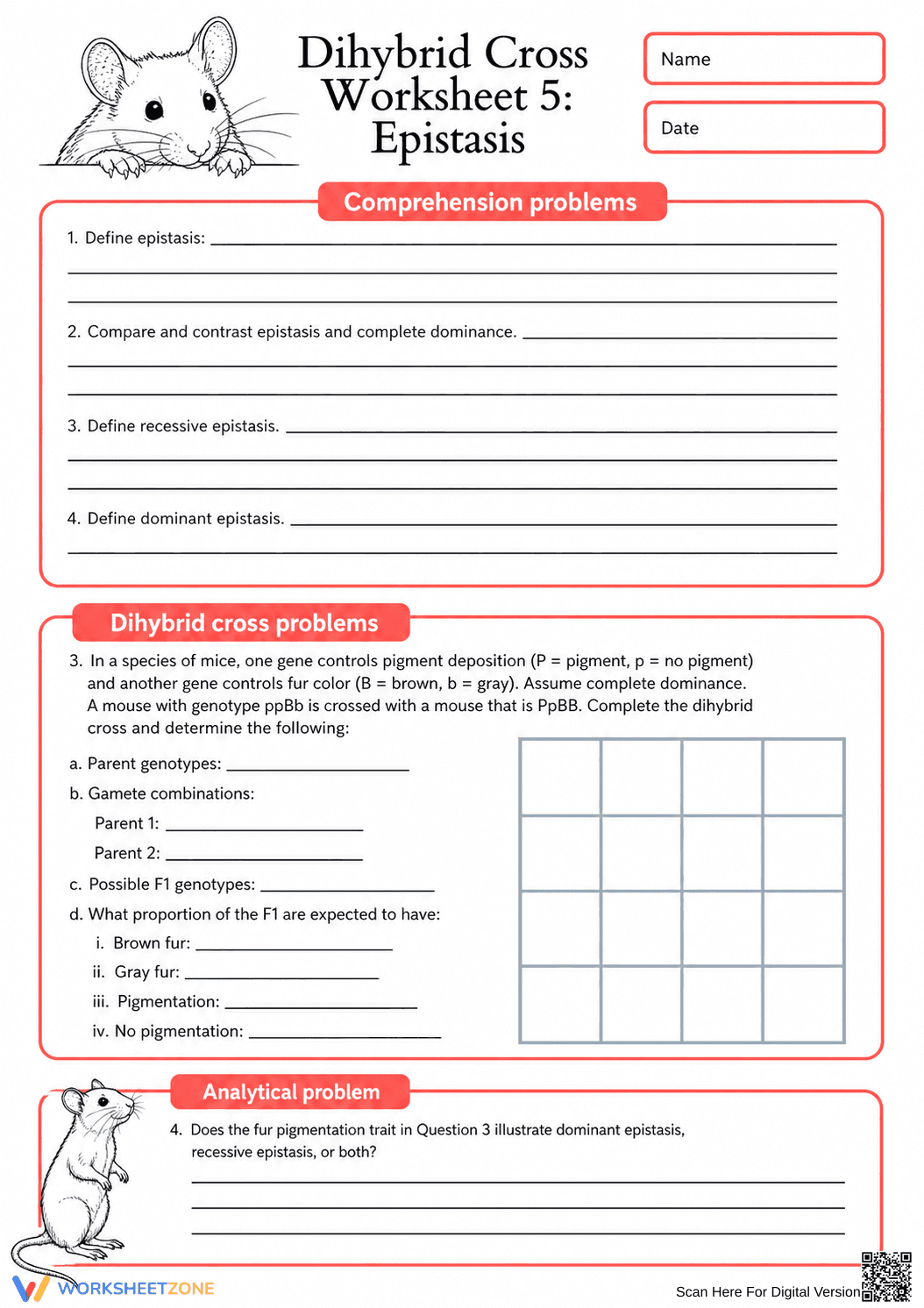
This Grade 10-11 Biology worksheet provides targeted practice on dihybrid crosses involving epistasis. Students define key genetic interactions, solve a complex mouse fur pigmentation problem using a Punnett square, and analyze inheritance patterns. It ensures students can distinguish between dominant and recessive epistasis while calculating phenotypic ratios in multi-gene traits.
At a Glance
- Grade: 10-11 · Subject: Biology
- Standard:
HS-LS3-3— Apply probability to explain the variation and distribution of expressed traits- Skill Focus: Dihybrid Cross & Epistasis
- Format: 1 page · 6 problems · Answer key included · PDF
- Best For: Independent practice or formative assessment
- Time: 25–35 minutes
The worksheet features three distinct sections: conceptual definitions, a multi-step dihybrid cross problem, and a final analytical challenge. It includes a pre-formatted 4x4 Punnett square grid to assist with gamete combinations and genotype tracking. Students work through a mouse fur color scenario involving both pigment deposition and specific color genes, providing a concrete application of abstract genetic theory.
This resource is designed for immediate classroom implementation with a total teacher prep time of under 2 minutes. Simply print the single-page PDF and distribute it to students during the genetics unit. The structured layout allows for a 5-minute introduction, 20 minutes of independent student work, and a 5-minute peer-review or whole-class check using the provided answer key. It is an ideal sub-plan for advanced biology.
This worksheet aligns with HS-LS3-3: "Apply concepts of statistics and probability to explain the variation and distribution of expressed traits in a population." It specifically addresses how non-Mendelian interactions like epistasis alter expected 9:3:3:1 ratios. Both standard codes can be copied directly into lesson plans, IEP goals, or district curriculum mapping tools.
Use this worksheet as a formative assessment after students have mastered basic Mendelian dihybrid crosses but before moving into complex polygenic inheritance. During instruction, observe students as they fill the Punnett square to ensure they are correctly segregating alleles for the pigment (P/p) and color (B/b) genes. Expect completion within 30 minutes for most high school learners.
This is tailored for Grade 10-11 Biology students, including those in Honors or AP tracks who require rigorous genetics practice. It provides scaffolding through clear definitions while challenging students with analytical reasoning. Pair this with a mouse genetics simulation or a visual anchor chart detailing the biochemical pathways of pigment deposition.
According to the Fisher & Frey (2014) framework for gradual release of responsibility, structured practice with complex genetic interactions like epistasis is vital for moving students from conceptual understanding to independent mastery. This worksheet specifically targets the HS-LS3-3 standard by requiring students to apply probability to mouse fur pigmentation scenarios. Research from the RAND AIRS 2024 report suggests that high-quality, standards-aligned science materials that integrate mathematical modeling—such as Punnett squares—significantly improve student retention of non-Mendelian inheritance patterns. By requiring students to define, calculate, and then analyze the type of epistasis present, the resource builds the higher-order thinking skills necessary for success in advanced placement biology and collegiate-level genetics courses. This 1-page PDF provides a focused, evidence-based approach to teaching how gene-to-gene interactions influence the phenotypic distribution within a population.


