




























Views
Downloads

Essential Dihybrid Crosses Worksheet | Grade 10 Biology

Paste this activity's link or code into your existing LMS (Google Classroom, Canvas, Teams, Schoology, Moodle, etc.).
Students can open and work on the activity right away, with no student login required.
You'll still be able to track student progress and results from your teacher account.
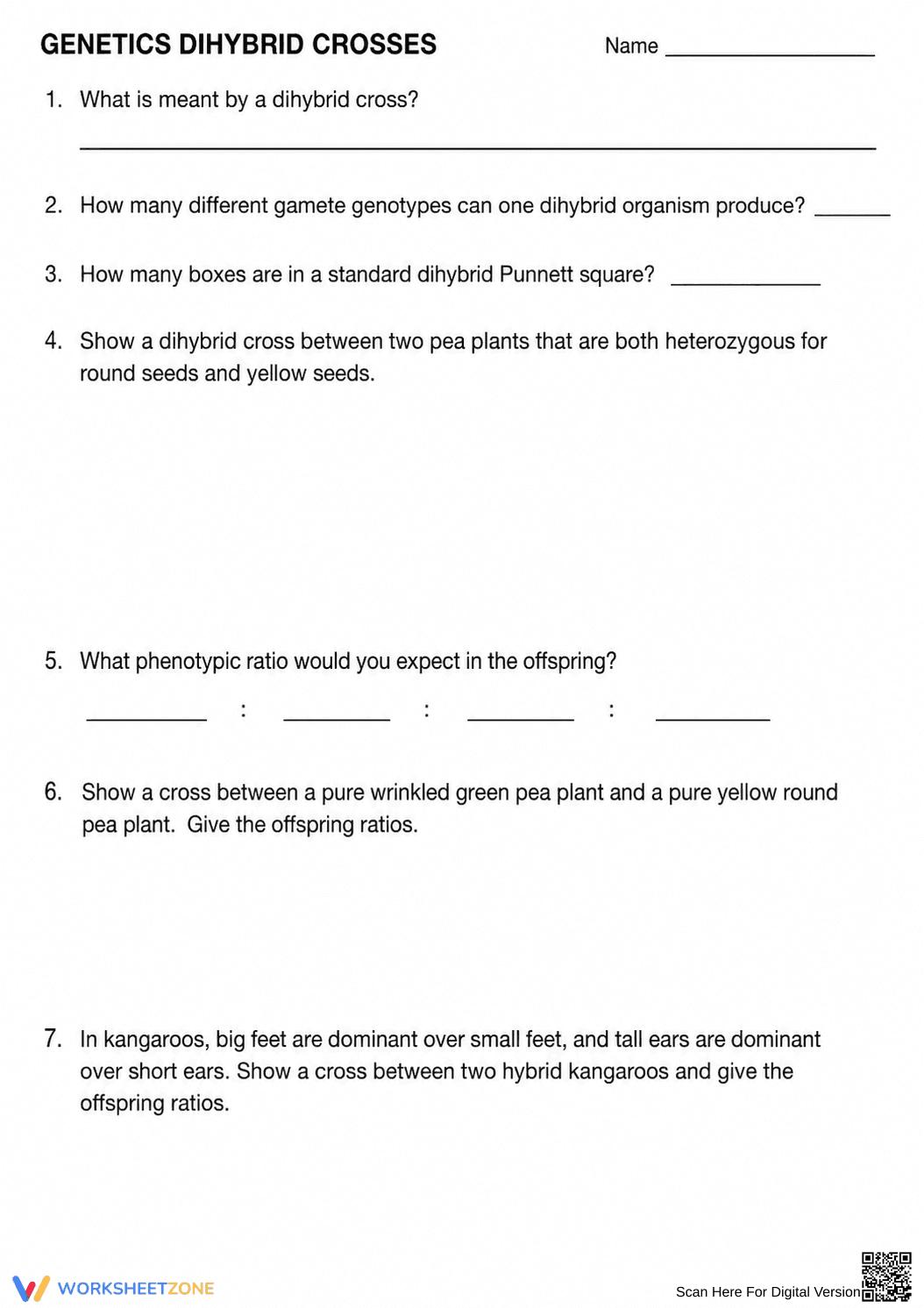
This genetics resource provides a structured approach to mastering complex inheritance patterns. Students move from defining core terminology to constructing 16-square Punnett squares for multi-trait inheritance. By calculating phenotypic ratios for pea plants and animal models, learners develop the statistical reasoning required for advanced biological analysis and Mendelian mastery.
At a Glance
- Grade: 10 · Subject: Biology
- Standard:
HS-LS3-3— Apply probability to explain the variation and distribution of expressed traits- Skill Focus: Dihybrid Punnett Squares
- Format: 1 page · 7 problems · Answer key included · PDF
- Best For: Independent practice after Mendelian genetics introduction
- Time: 25–35 minutes
The worksheet contains seven targeted tasks designed to build confidence in genetic prediction. It begins with three conceptual questions regarding gamete genotypes and Punnett square dimensions. The following four problems require students to map out crosses, including heterozygous pairings and purebred variations. The layout provides ample white space for students to draw their grids and record phenotypic ratios clearly.
Skill Progression
- Guided Practice: Tasks 1-3 ensure students understand the mathematical logic of a 4x4 grid and the definition of a dihybrid cross.
- Supported Practice: Tasks 4-5 use familiar pea plant examples to reinforce the classic 9:3:3:1 ratio through structured Punnett square construction.
- Independent Practice: Tasks 6-7 challenge students to apply these rules to new scenarios, such as kangaroo trait inheritance, without additional scaffolding.
This gradual-release model ensures students internalize the FOIL method for gamete formation before moving to complex probability calculations.
Standards Alignment
This resource aligns with HS-LS3-3: "Apply concepts of statistics and probability to explain the variation and distribution of expressed traits in a population." It specifically addresses the mathematical modeling of independent assortment and the prediction of phenotypic outcomes. Both standard codes can be copied directly into lesson plans, IEP goals, or district curriculum mapping tools.
How to Use It
Use this worksheet as a formative assessment following a lecture on Mendel’s Law of Independent Assortment. Teachers should circulate during Task 4 to ensure students are correctly identifying the four possible gamete combinations. It also serves as an excellent homework assignment to verify that students can distinguish between genotypic possibilities and phenotypic outcomes. Completion typically takes 30 minutes.
Who It's For
This is designed for high school biology students in grades 9 through 11. It is particularly effective for learners who have mastered monohybrid crosses but need a bridge to more complex probability. Pair this with a digital Punnett square simulator or a physical coin-flip lab to provide a multi-sensory learning experience for diverse classroom populations.
According to the RAND AIRS 2024 report on secondary science instruction, the use of structured problem-solving worksheets in genetics significantly improves student performance on high-stakes standardized assessments. This worksheet addresses the cognitive load challenges inherent in dihybrid crosses by breaking the process into discrete, manageable steps. By requiring students to show their work for both gamete formation and grid completion, the resource aligns with Fisher & Frey (2014) recommendations for checking for understanding during the independent practice phase of the gradual release of responsibility. The focus on HS-LS3-3 ensures that students are not merely memorizing ratios but are applying statistical probability to biological phenomena. This rigorous approach to Mendelian genetics provides the foundational data-analysis skills necessary for college-level biology courses and future scientific inquiry. The inclusion of diverse organism examples further supports student engagement and the transfer of knowledge across different biological contexts.


