


























Views
Downloads

Printable Dihybrid Cross Worksheet | Grade 9-11 Biology
Paste this activity's link or code into your existing LMS (Google Classroom, Canvas, Teams, Schoology, Moodle, etc.).
Students can open and work on the activity right away, with no student login required.
You'll still be able to track student progress and results from your teacher account.
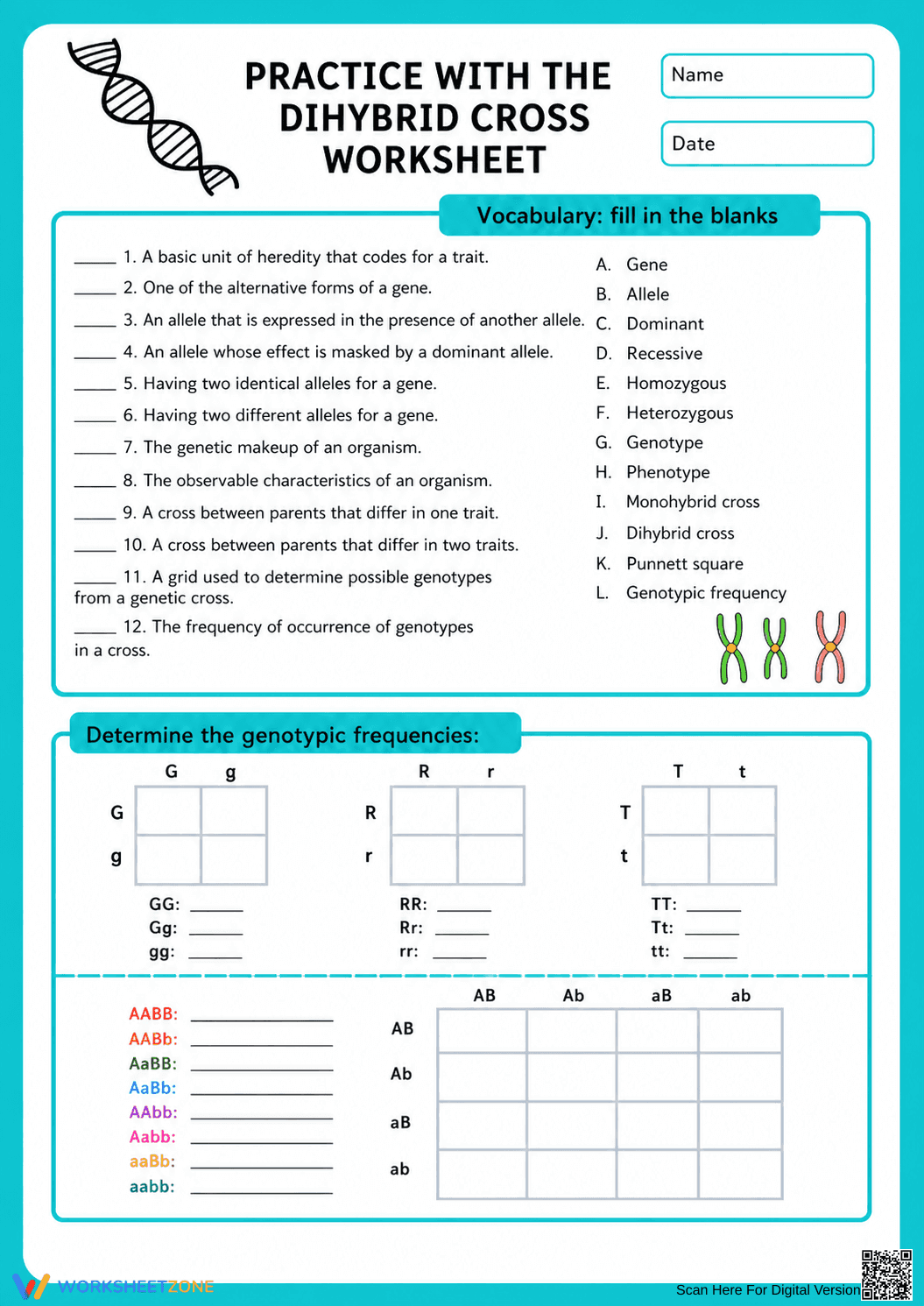
This high school biology worksheet provides targeted practice with genetics vocabulary and Punnett squares. Students master inheritance mechanics by calculating genotypic frequencies for monohybrid and dihybrid crosses. Completing these structured exercises builds the foundational skills needed to predict genetic outcomes accurately.
At a Glance
- Grade: 9-11 · Subject: Biology
- Standard:
HS-LS3-3— Apply probability to explain trait variation and distribution.- Skill Focus: Dihybrid Crosses & Punnett Squares
- Format: 1 page · 16 problems · Answer key included · PDF
- Best For: Independent practice or homework
- Time: 20–30 minutes
This single-page resource features three sections to reinforce genetics concepts. It begins with a 12-question vocabulary matching activity covering essential terms. The middle section includes three monohybrid cross Punnett squares where students calculate basic genotypic frequencies. Finally, the worksheet culminates in a comprehensive 16-box dihybrid cross, requiring students to determine frequencies of nine genotype combinations. A complete answer key is included.
- Guided practice: The vocabulary matching section activates prior knowledge, ensuring students understand required terminology.
- Supported practice: Three monohybrid crosses allow students to practice basic 4-box Punnett squares and frequency calculations.
- Independent practice: The final dihybrid cross challenges students to apply skills to a complex 16-box grid.
This gradual-release approach ensures students build confidence with single traits before tackling demanding dihybrid calculations.
This resource is aligned to HS-LS3-3: Apply concepts of statistics and probability to explain the variation and distribution of expressed traits in a population. Both standard codes can be copied directly into lesson plans, IEP goals, or district curriculum mapping tools.
Deploy this worksheet following direct instruction on Mendelian genetics. It serves as excellent independent practice or homework. As a formative assessment tip, monitor students during the monohybrid crosses; if they struggle with genotypic frequencies, review before they proceed to the dihybrid cross. Expected completion time is 20 to 30 minutes.
This worksheet is designed for high school biology students studying genetics. It provides built-in scaffolding through vocabulary review, making it accessible for learners needing a refresher. Pair this resource with a visual anchor chart demonstrating how to foil alleles for a dihybrid cross.
Mastering genetic probability requires consistent, structured practice that moves from simple to complex applications. This worksheet aligns with HS-LS3-3, helping students apply probability to explain trait variation and distribution. According to a ScienceDirect TpT Analysis, instructional materials that utilize a gradual release of responsibility—starting with vocabulary acquisition and progressing to multi-step problem solving—significantly improve student retention of complex scientific processes. By breaking down the mechanics of inheritance into manageable steps, from monohybrid to dihybrid crosses, this resource minimizes cognitive overload. Students can focus on the specific mathematical relationships between alleles without becoming overwhelmed by the larger biological concepts. This targeted approach ensures that learners develop a robust, working knowledge of genotypic frequencies, preparing them for more advanced topics in molecular genetics and population biology.


