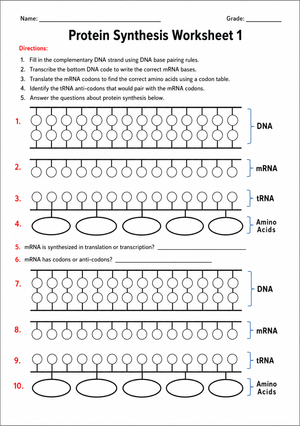
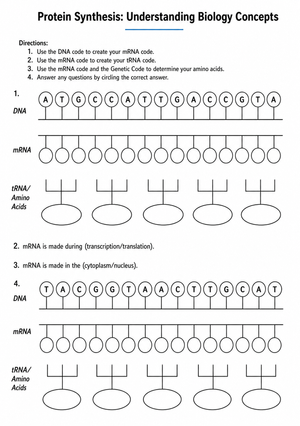
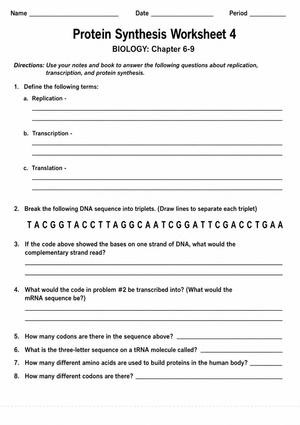
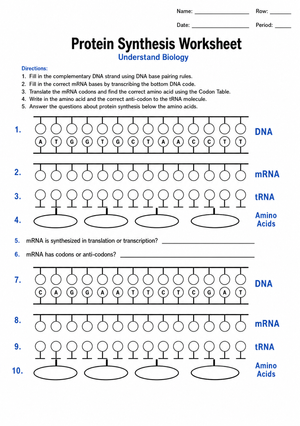
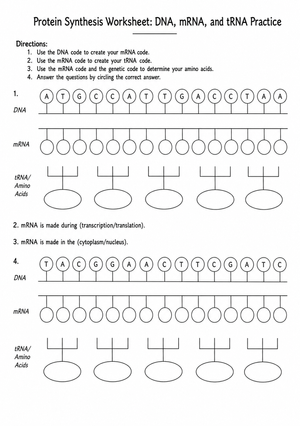
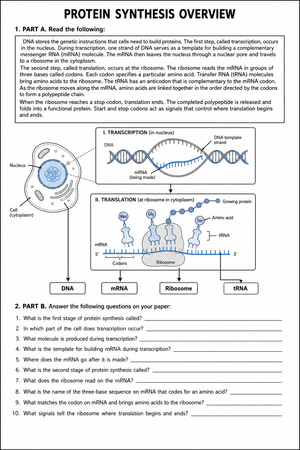
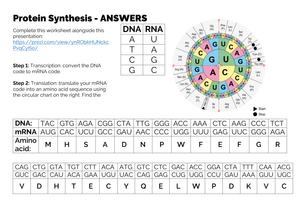
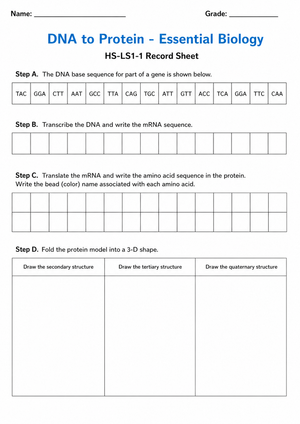
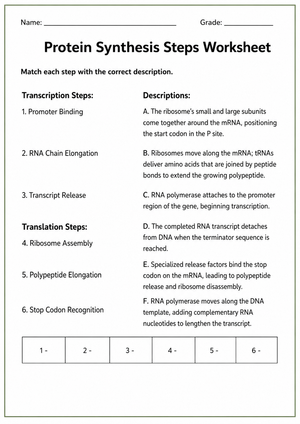
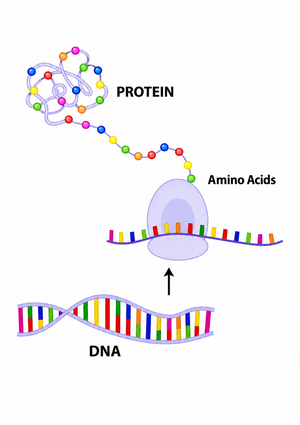
Students move from a DNA sequence on paper to mRNA, codons, anticodons, and finally an amino acid chain that represents a protein product. Teachers usually need printable pages that work for classwork, homework, review, or a quick sub plan. The most useful worksheet sets include short tasks students can complete in a reasonable class period: labeling diagrams, converting DNA to mRNA, decoding codons with a chart, matching tRNA anticodons, and identifying what happens after a mutation.
What a Strong Worksheet Set Should Include
A high-quality PDF worksheet for this topic should be organized in a way that matches how students learn the process. Instead of giving one large block of text, it helps to break practice into small sections that build from simple to more analytical work.
- Transcription practice: Students convert a DNA sequence into mRNA using correct base-pair rules and recognize that RNA uses uracil instead of thymine.
- Translation practice: Students read mRNA in triplets, use a codon chart, and determine the amino acid sequence.
- Vocabulary in context: Terms such as ribosome, codon, anticodon, mRNA, and tRNA appear inside actual tasks instead of isolated memorization lists.
- Diagram labeling: Students identify where transcription and translation happen and match structures to functions.
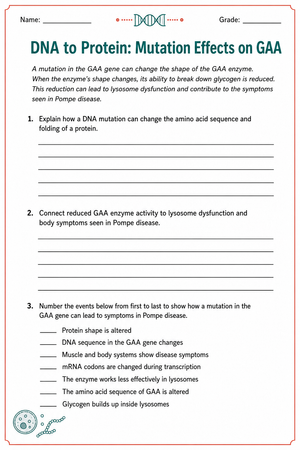
- Mutation analysis: Students compare an original sequence with a changed sequence and predict whether the result is silent, missense, or nonsense.
This format matters because protein synthesis depends on precision. If one step is shaky, the next step often falls apart. A worksheet that moves from DNA to mRNA to protein in order lets teachers pinpoint where a student is struggling.
Key Concepts Students Need to Practice
When selecting or creating 10th grade protein synthesis pdf worksheets, it helps to center the pages around a few nonnegotiable ideas. First, students should know that transcription is the process of making mRNA from a DNA template. Second, they should know that translation uses mRNA codons at the ribosome to build an amino acid chain. Third, they should understand that codons are read in groups of three bases.
Another core point is the difference between codons and anticodons. Codons are on mRNA, while anticodons are on tRNA. This mix-up is common in biology classes, especially when students are moving quickly through a worksheet. Teachers can reduce the error rate by using one section that asks students to label each type before decoding.
It also helps to include at least one item that separates protein synthesis from DNA replication. Students often blend those topics together because both involve nucleic acids and base pairing. A direct comparison question can clear that up quickly.
Classroom Implementation
These worksheets fit well into several common lesson structures in a Grade 10 science classroom. For direct instruction days, a teacher can model one transcription example and one translation example, then release students to complete a short PDF practice set independently or in pairs. For review days, the same format can be used as a rotation station: one station for transcription, one for codon chart decoding, and one for mutation effects.
If students need more support, assign only the first half of the worksheet and pause for a check before moving on. If students are ready for extension, add a mutation section that asks them to compare the original amino acid chain with the changed one and explain the effect on the final protein.
Another practical use is homework that reinforces the sequence of steps. Teachers can assign one page that begins with DNA, moves to mRNA, and ends with an amino acid sequence. This kind of structure makes it easier to spot whether the student made one isolated mistake or misunderstood the full process.
One useful classroom move is to have students lightly mark vertical lines between every 3 RNA bases before using a codon chart. That simple annotation lowers errors because students stop treating the sequence as one long string and instead process it as codons, which is how translation actually works in the lesson model.
Common Student Errors to Address
Protein synthesis worksheets are most effective when they anticipate the mistakes students are likely to make. One frequent error is using DNA base-pair rules when writing mRNA. Another is starting translation without first checking that the mRNA sequence has been grouped into triplets. Students may also confuse the role of tRNA and mRNA or assume that every mutation changes the final protein in the same way.
Short corrective prompts can help. For example, a worksheet can ask, Is this sequence DNA or RNA? before students begin. It can also include a reminder that codons are found on mRNA and that anticodons pair with them during translation. In mutation practice, teachers can ask students to compare old and new amino acid results rather than guessing the type of mutation from the DNA letters alone.
These details are supported by the way major biology references explain gene expression. MedlinePlus Genetics and Khan Academy both present protein synthesis as a linked process, while Nature Education Scitable and Genome.gov emphasize the role of translation in building proteins from the RNA message.
Frequently Asked Questions
1. What should a Grade 10 protein synthesis worksheet include?
A useful worksheet should include transcription, translation, codon chart use, and at least one item on mutations. It should also separate codons from anticodons and make clear that transcription and translation are different steps in making a protein.
2. How do students use a codon chart on a worksheet?
Students first write or confirm the mRNA sequence, divide it into triplets, and then match each codon to its amino acid on the chart. This works best when the worksheet gives enough space to mark each codon clearly.
3. What is the difference between transcription and translation in simple classroom terms?
Transcription is copying DNA information into mRNA. Translation is reading the mRNA message at the ribosome to build an amino acid chain that becomes a protein.
4. How can teachers add mutation practice to a protein synthesis worksheet?
Add an original sequence and a changed sequence, then ask students to transcribe and translate both. After that, students can compare the amino acid chains and decide whether the mutation is silent, missense, or nonsense.
For teachers planning biology instruction, 10th grade protein synthesis pdf worksheets are most helpful when they stay focused on the essential sequence from DNA to RNA to protein. Clear layout, codon-based practice, and brief mutation analysis can turn a difficult topic into a manageable and meaningful classroom routine.