


























Views
Downloads


Printable Dihybrid Cross Worksheet | Grades 9-11 Biology
Paste this activity's link or code into your existing LMS (Google Classroom, Canvas, Teams, Schoology, Moodle, etc.).
Students can open and work on the activity right away, with no student login required.
You'll still be able to track student progress and results from your teacher account.
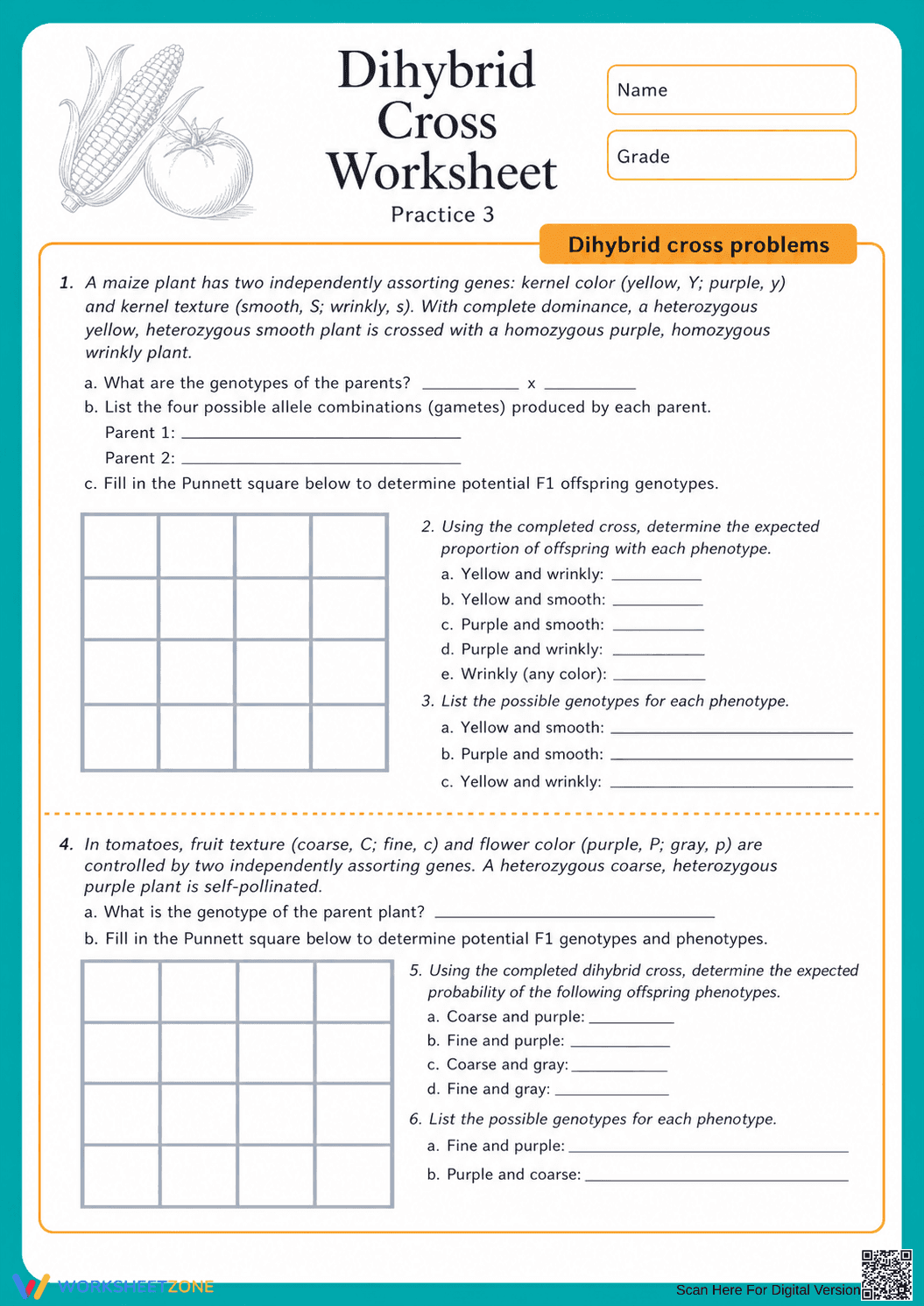
This comprehensive dihybrid cross worksheet equips high school biology students with the exact tools needed to master complex inheritance patterns. By calculating genotypes and phenotypes across multiple generations, learners will confidently predict offspring traits and understand the fundamental principles of independent assortment in genetics.
At a Glance
- Grade: 9-11 · Subject: Biology
- Standard:
HS-LS3-3— Apply statistics and probability to explain trait variation.- Skill Focus: Dihybrid crosses and phenotypic ratios
- Format: 5 pages · 15 problems · Answer key included · PDF
- Best For: Independent practice and review
- Time: 30–45 minutes
This five-page resource features 15 distinct dihybrid cross problems that guide students through the mechanics of Mendelian genetics. The packet includes step-by-step worked examples, blank 4x4 Punnett squares for structured solving, and clear prompts for determining parental alleles. Students will analyze traits in pea plants, rabbits, and tomatoes, calculating exact phenotypic ratios for each scenario. A complete answer key is provided to streamline grading and support accurate self-assessment.
Skill Progression
- Guided practice: The first section introduces the process with a fully worked example, showing students exactly how to distribute alleles and fill the 16-box grid.
- Supported practice: Subsequent problems provide the parental genotypes and pre-drawn Punnett squares, allowing learners to focus purely on the cross and resulting ratios.
- Independent practice: The final pages require students to read word problems, determine the parental genotypes from text descriptions, generate the gametes, and construct their own squares from scratch.
This gradual-release approach ensures students build confidence before tackling complex, multi-step inheritance questions on their own.
Standards Alignment
This resource is directly aligned to HS-LS3-3: Apply concepts of statistics and probability to explain the variation and distribution of expressed traits in a population. By calculating specific phenotypic ratios, students actively apply mathematical reasoning to biological inheritance. Both standard codes can be copied directly into lesson plans, IEP goals, or district curriculum mapping tools.
How to Use It
Deploy this worksheet during your genetics unit immediately following direct instruction on independent assortment. It serves as an excellent in-class assignment where the teacher can circulate and check for understanding. As a formative assessment tip, watch how students determine the initial gametes; errors here will cascade through the entire Punnett square. Alternatively, assign the later pages as homework to solidify the concepts. The entire packet takes approximately 30 to 45 minutes to complete.
Who It's For
This practice set is designed for high school biology students in grades 9 through 11. The structured progression makes it highly accessible for learners who need visual organization, while the advanced word problems provide sufficient rigor for honors-level students. It pairs perfectly with a foundational anchor chart on dominant and recessive alleles or a hands-on lab exploring plant genetics.
Mastering the mechanics of inheritance requires repeated, structured practice with probability models. This targeted resource aligns directly with HS-LS3-3, helping students apply statistics and probability to explain trait variation in populations. According to EdReports 2024, high-quality science instructional materials must provide students with explicit, repeated opportunities to integrate mathematical thinking into biological contexts. By requiring learners to calculate exact phenotypic ratios and map allele distribution across 16-box Punnett squares, this worksheet bridges the gap between abstract genetic theory and concrete statistical outcomes. The gradual increase in problem complexity ensures that cognitive load is managed effectively, allowing students to internalize the rules of independent assortment before applying them to novel, real-world scenarios. This focused approach not only reinforces core high school biology standards but also builds the essential quantitative reasoning skills required for advanced scientific literacy and future STEM coursework.


