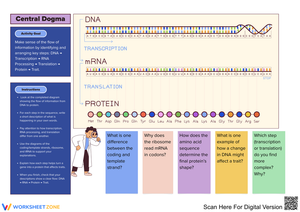
These DNA and RNA worksheets for 10th grade give biology teachers structured, printable practice that moves students past surface-level definitions and into the conceptual territory where the real confusion lives. Each worksheet targets a specific layer of understanding — structure, comparison, process, or application — so teachers can drop them into the unit exactly where the gap appears.
What's Inside the Set
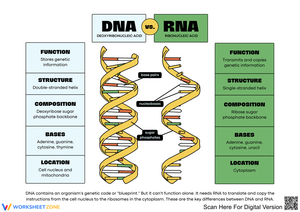
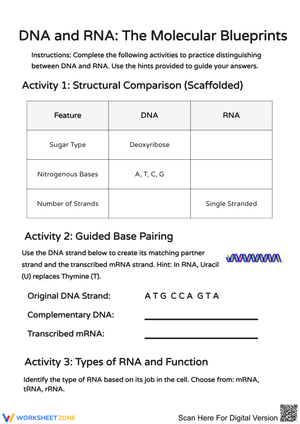
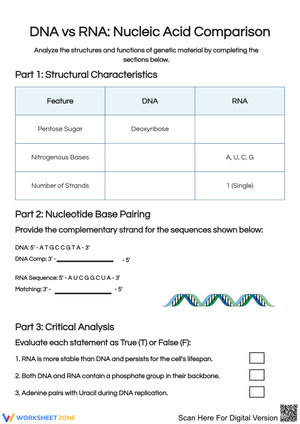
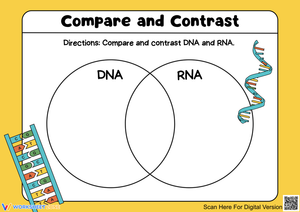
The worksheets address the concepts that 10th graders consistently struggle to keep distinct. Students compare the two sugars — deoxyribose and ribose — and identify which nitrogen bases belong to each molecule, including the thymine/uracil substitution that trips students up on assessments. Diagram labeling tasks ask students to mark nucleotide components: phosphate group, sugar, and nitrogenous base. Compare-and-contrast charts require students to sort features by molecule before they can answer any open-ended item. Process questions use the terms transcription and translation in context, so students practice placing each step in the correct position within the central dogma rather than treating the words as interchangeable synonyms.
Application items go beyond recall. Students explain why uracil works in place of thymine in RNA, predict the effect of a base substitution, and describe what happens to protein production if a transcription error occurs. Those brief explanatory tasks are where 10th graders reveal whether they understand function or just recognize vocabulary.
Frequent Student Errors Worth Watching For
The most persistent error pattern is directional: students can recite that DNA is double-stranded and RNA is single-stranded but then draw both as mirror-image ladders when asked to sketch them. On a labeling worksheet, this shows up as a student who correctly labels "deoxyribose" on both strands of a DNA diagram and then draws an RNA molecule with the same rungs. The structural shorthand they memorized doesn't transfer to a visual task unless the worksheet asks them to produce a drawing, not just select an answer.
A second, quieter error involves process vocabulary. Students who can define transcription and translation separately will still write, in a short-answer response, that "translation copies DNA into mRNA" — inverting the product and the template in a way that suggests the two terms are stored next to each other in memory without any directional logic attached. Worksheets that ask students to write a single sentence for each process, naming the starting molecule and the ending product, surface this confusion faster than any multiple-choice item.
Pedagogical Reasoning Behind the Sequence
The comparison chart appears first in each worksheet for a reason grounded in how working memory handles dense vocabulary. When 10th graders encounter deoxyribose, ribose, thymine, uracil, single-stranded, and double-stranded in the same paragraph of a textbook, those terms compete for limited cognitive space. A structured chart externalizes that comparison — it becomes a reference students can consult while labeling a diagram or answering a process question on the same worksheet. The chart reduces the retrieval load so students can allocate attention to reasoning rather than remembering which sugar goes where. Teachers who assign the chart section first, then move to labeling and application, report fewer of the reversal errors described above.
How to Build These Worksheets Into Your Lesson Plans
Early in the unit, the vocabulary and structure worksheet works well as guided practice immediately after direct instruction — students complete it while the lesson content is fresh, which makes it a consolidation task rather than a retrieval challenge. Mid-unit, the labeling worksheet functions as a quick formative check: a 10-minute independent task that shows, before the quiz, whether students have connected the molecular names to their visual representations. The compare-and-contrast chart holds up as a warm-up on the day before a test, giving students an organized review without requiring them to reread the chapter.
Several teachers have used the application questions as exit tickets — assigning only the final two or three items on a worksheet during the last eight minutes of class. That approach produces a fast, readable snapshot of where each student stands on reasoning tasks, distinct from whether they can recall definitions. For sub days, the full worksheet with answer key runs without preparation, and the comparison chart gives a substitute enough structure to prompt students without needing biology content knowledge.
Adjusting the Worksheets for a Range of Learners
For students who need more scaffolding, the comparison chart is the natural starting point and sometimes the only section assigned in the first session. Providing a word bank alongside the chart reduces the retrieval demand and lets struggling students focus on categorization — which features belong to DNA, which to RNA, which to both — without getting stuck on spelling or term recall. On labeling tasks, pre-labeling one structure on the diagram gives those students an anchor without removing the intellectual work.
For students who move through structure and comparison quickly, the application questions can be extended verbally or in writing. Asking a student to explain, in three sentences, why the structure of DNA makes it a reliable long-term storage molecule is a different cognitive task than filling in a chart, and it prepares them for the reasoning demanded in AP Biology the following year. A minority of 10th graders are already thinking about how base-pairing rules constrain mutation; those students benefit from the open-ended items more than from additional vocabulary practice.
Standard Alignment
These worksheets align with NGSS HS-LS1-1, which asks students to construct an explanation based on evidence for how the structure of DNA determines the structure of proteins, which carry out the essential functions of life through systems of specialized cells. In classroom terms, that standard lands in the unit where students are moving from "what are nucleic acids?" to "how do they produce a functional protein?" — exactly the transition this set is designed to support. The comparison and process worksheets sit at that boundary, giving students the structural vocabulary they need before the standard's application demands kick in. Instructors using the College Board's AP Biology curriculum framework will also find alignment with Big Idea 3 (Living systems store, retrieve, transmit, and respond to information essential to life processes).
Frequently Asked Questions
At what point in a genetics unit do these worksheets fit best?
The structure and comparison worksheets belong early in the unit, after the initial introduction to nucleic acids. The process worksheets — covering transcription and translation — fit after students have had direct instruction on gene expression. The mixed-review worksheet works best in the final days before the unit assessment.
Are these appropriate for students who will take AP Biology the following year?
For students heading into AP Biology, the application items and short explanation tasks give useful early exposure to the reasoning AP assessments require. The structural content is foundational across both courses, and students who can articulate the functional relationship between DNA structure and information storage arrive in AP with one less gap to close.
Can these be used for independent practice without teacher facilitation?
The comparison chart and vocabulary sections work well independently — the format is self-guiding enough that students know when an answer is missing. The process questions and application items benefit from at least a brief teacher introduction to the task, particularly for students who freeze when a question asks them to explain rather than identify.