




























Views
Downloads

Printable Dihybrid Cross Worksheet | High School Biology

Paste this activity's link or code into your existing LMS (Google Classroom, Canvas, Teams, Schoology, Moodle, etc.).
Students can open and work on the activity right away, with no student login required.
You'll still be able to track student progress and results from your teacher account.
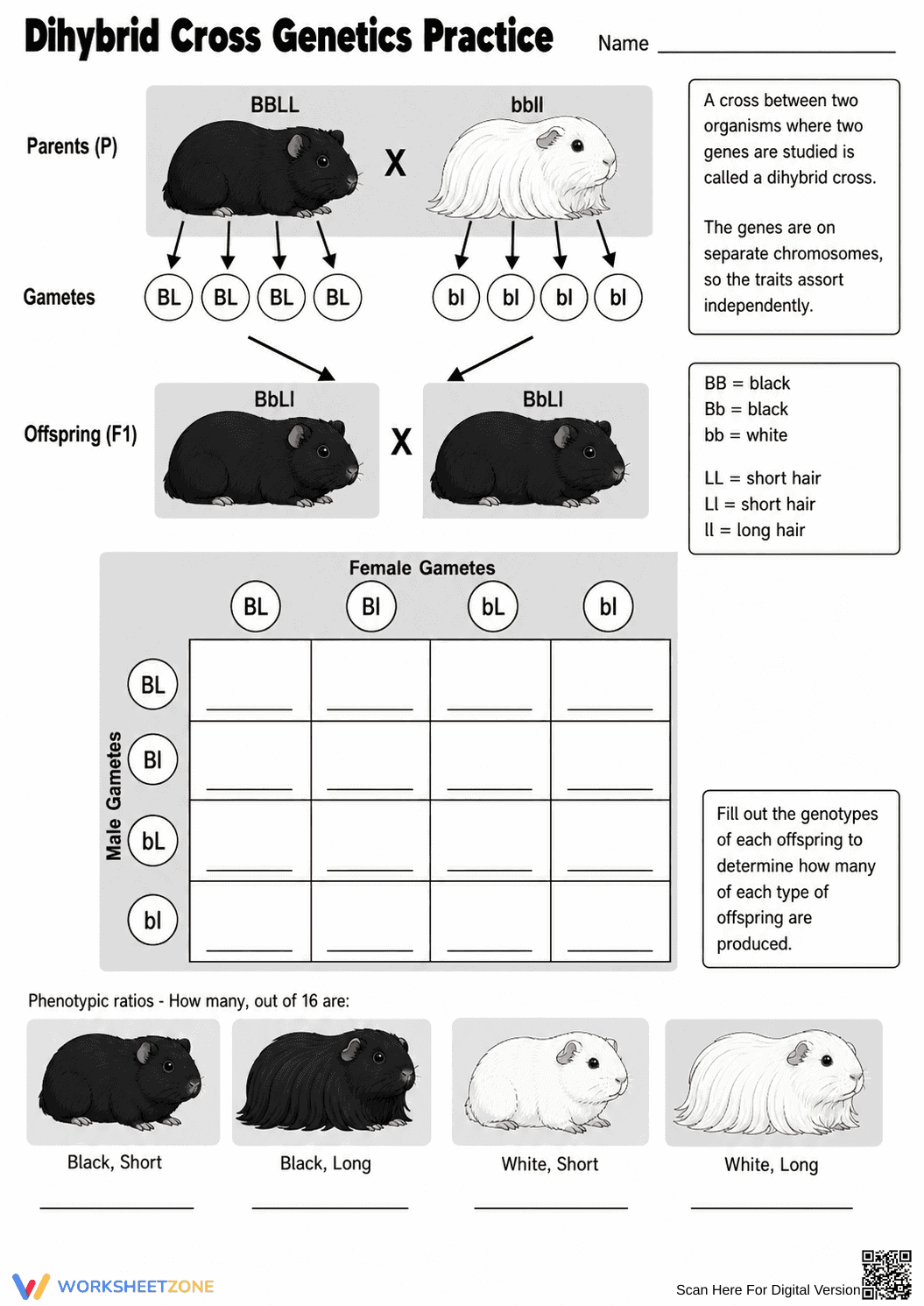
This high school biology worksheet provides targeted practice with dihybrid crosses, allowing students to predict genetic outcomes for two distinct traits simultaneously. By completing Punnett squares and calculating phenotypic ratios, learners build a concrete understanding of Mendelian genetics and independent assortment using engaging, real-world guinea pig examples.
At a Glance
- Grade: 9-12 · Subject: Biology
- Standard:
HS-LS3-3— Apply probability to explain the variation of expressed traits.- Skill Focus: Dihybrid crosses and phenotypic ratios
- Format: 2 pages · 3 problems · Answer key included · PDF
- Best For: Independent practice and skill reinforcement
- Time: 25–35 minutes
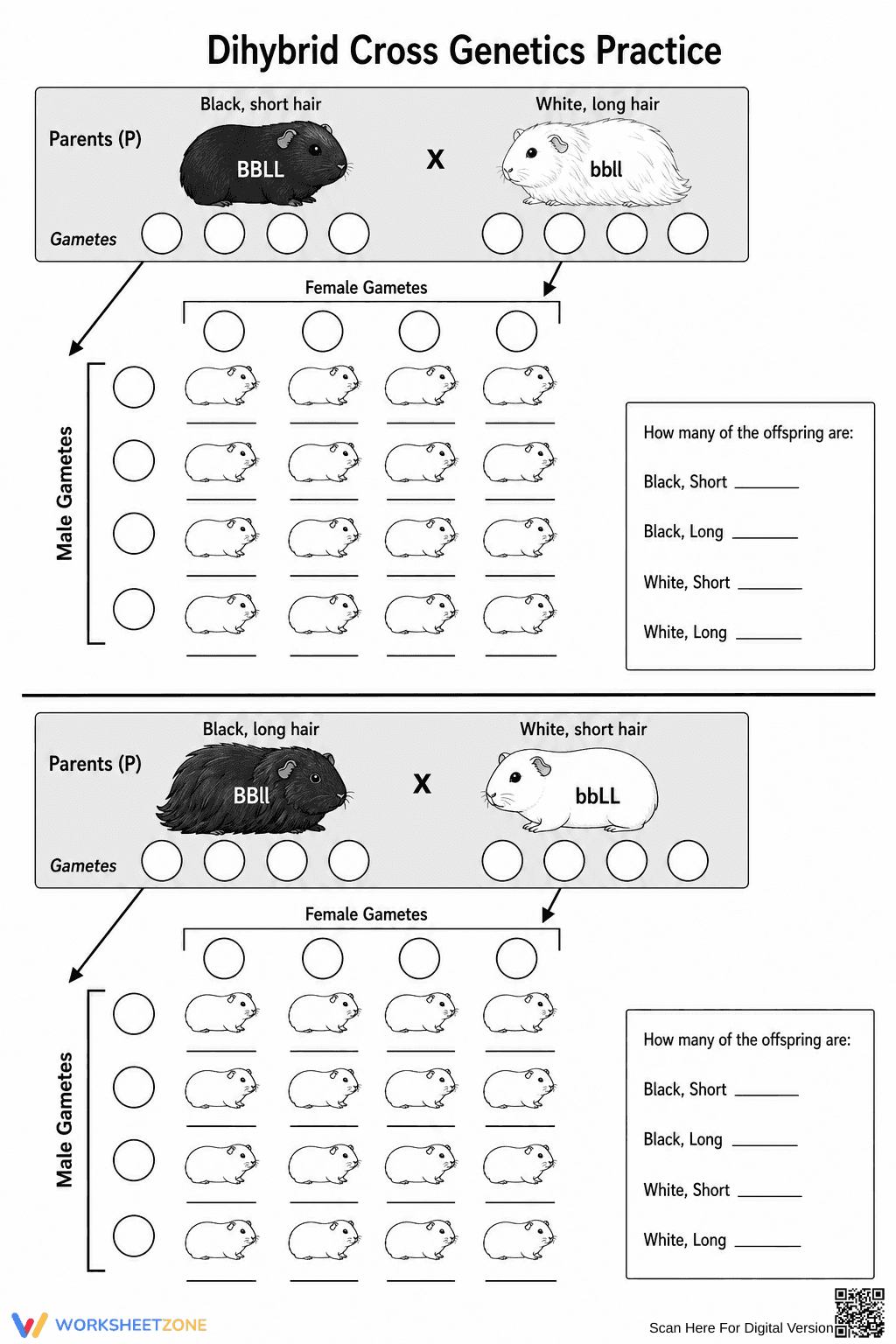
This two-page resource features three dihybrid cross problems centered around guinea pig genetics. Students determine parent genotypes, identify gametes, fill out 16-box Punnett squares, and calculate phenotypic ratios. The worksheet includes clear visual aids to connect abstract codes to physical traits, alongside a complete answer key.
Skill Progression
- Guided Practice: The first problem provides parent gametes, allowing students to focus on combining alleles in the Punnett square.
- Supported Practice: Students calculate phenotypic ratios (out of 16) for four physical trait combinations.
- Independent Practice: On page two, learners tackle two crosses where they independently determine gametes before completing the squares.
This gradual-release approach builds confidence with the I Do, We Do, You Do model.
Standards Alignment
This resource is aligned to the Next Generation Science Standards, specifically HS-LS3-3: "Apply concepts of statistics and probability to explain the variation and distribution of expressed traits in a population." It directly supports students in using mathematical reasoning to predict the inheritance of multiple traits. Both standard codes can be copied directly into lesson plans, IEP goals, or district curriculum mapping tools.
How to Use It
Deploy this worksheet immediately following direct instruction on independent assortment and dihybrid crosses. It serves as an excellent in-class assignment where the teacher can circulate and provide feedback. As a formative assessment observation tip, watch to see if students correctly distribute one allele for each trait into the gamete circles before they begin filling the Punnett square—this is the most common point of error. Expect students to complete the full two-page packet in 25 to 35 minutes.
Who It's For
This practice set is designed for high school biology students in grades 9 through 12 who are mastering Mendelian genetics. The visual nature of the guinea pig traits provides excellent scaffolding for visual learners and students who struggle with purely abstract letter combinations. It pairs perfectly with an introductory lesson or anchor chart on the FOIL method for determining gametes.
Mastering complex inheritance patterns requires structured, repetitive practice that moves from guided to independent application. By aligning with HS-LS3-3, this resource ensures students can apply probability to explain the variation of expressed traits. According to Fisher & Frey (2014), utilizing a gradual release of responsibility framework significantly improves student retention of multi-step procedural skills, such as setting up and solving 16-box Punnett squares. When learners first see the gametes modeled and then transition to extracting those gametes independently, they develop a more robust understanding of independent assortment and allele segregation. This targeted practice reduces cognitive overload, allowing high school biology students to focus on the mathematical relationships between genotypes and phenotypes rather than getting lost in the setup process. The clear visual representations further anchor these abstract genetic concepts into observable phenomena.


